
Text and jpegs by courtesy of hathitrust.org www.hathitrust.org, compiled by motorracinghistory.com
Motor Age, Vol. XXV (225), No. 20, May 14, 1914
History-Making Racing Cars, Part II
What They Did and How They Did It
By. Darwin S. Hatch
EDITOR’S NOTE. – This is the second and concluding installment of the article dealing with racing cars that have made good. In this chapter the more modern speed creations are taken up and we learn of the feats of the de Palma Mercedes, the Blitzen Benz, the Duray Fiat, the Cooper Stutz, the Dawson. National, Harroun Marmon, Mulford Lozier and others that have earned their niches in the hall of fame.
WHAT is undoubtedly the oldest racing car now in active service is the Fiat Cyclone. Originally it was built for Cedrino and campaigned by him until he was killed at Baltimore, then Ralph des Palma took it and used its With Cedrino at the wheel, this car, which was credited with 120 horsepower, won the 100-mile race for the Minneapolis cup at the 1908 Ormond beach meet. It was also responsible for the death of Louis Meneghetti, the South American speed king, last year. It has a displacement of 600 cubic inches and in its day was very speedy. It is now in the hands of a Richmond, Va., motorist and is for sale, it is understood, for $500. How have the mighty fallen!
The name, Fiat Cyclone, also was given to a similar car of somewhat later model, used by Ralph de Palma in dirt track work, during which time he set a new 1-mile record, taking it away from Barney Oldfield. This was the beginning of a speed duel between Oldfield and de Palma which is yet to be settled and a rivalry which was only added to by de Palma’s winning over Oldfield at Santa Monica this spring. The second Fiat Cyclone is now owned by the Fiat company.
Simplex Zip Still Active
A car which was brought out to compete with the Fiat Cyclone and at about the same time and one which still is in active track service is the Simplex Zip. Originally it was built for George Robertson, who drove it at Oakland and the Los Angeles l-mile board track. It is now owned by Louis Disbrow and is being campaigned steadily.
A car which had the eyes of the world upon it and the hopes of the nation bound up in it for 10 months, was the old Thomas Flyer, the winner of the New York to Paris race, which left New York February, 1908, and won the race from the five Ger. man, French and Italian cars. So far as the car itself is concerned, it was a stock product taken from the floor of the now defunct Thomas company, with a standard 60-horsepower Thomas Flyer motor. The car was driven by Montague Roberts, Miller and Schuster in the 20,000 mile trip and was fitted out under the former’s supervision at the Buffalo factory.
Thomas Details
Its special equipment for the world tour at racing speed is interesting. Ordinary 36-inch wheels and tires were used on the early part of the journey; later these were changed to 40-inch wheels with solid tires, so designed that should the rubber have worn out, the machine could have run on the steel rims. Spare tires were carried behind the rumble seat. Running the full length of the car, and each side of the vehicle, was a long wooden support to which parts of the equipment were attached, and which served to work over rough roads. Ninety gallons of gasoline were carried in the ordinary tank. A winch was fitted to the front of the car and connected to the engine by coupling gears. Provision was made for warming the driver by means of the exhaust gases, and protection was afforded the men by windshield and a buggy hood, rather a unique construction.
Savannah road races gave the Isottas a great deal of fame in this country in 1908. Lewis Strang, driving the 55-horsepower Isotta, won the 343-mile race for the Savannah Challenge trophy on the 17-mile circuit at a speed of 53.78 miles per hour. Up to the time it reached Savannah, its motor had not been turned over since leaving Italy and Strang had not driven this make of car before that time. The Isotta had a high-speed engine of four cylinders, cast in pairs with opposite valves.
When traveling on the course, its motor turned over at 1,800 revolutions per minute, which speed was made possible by the use of exceedingly large flat-seated valves measuring 3½ inches in diameter each. Also assisting in this high-speed work were the extremely light pistons, rendered so by perforations beneath the rings, and the use of hollow connecting rods. The cylinders had a bore and stroke of 5.7 and 4.7 inches, respectively. Instead of using the double ignition outfit employed on all of the other racers, only a single high-tension magneto outfit, with one set of plugs, was used, the plugs being carried horizontally in the intake valve chambers. In the clutch were fifty-one disks – twenty-five steel and twenty-six bronze.
Lytle’s Apperson. which finished second, differed radically from the Isotta in that it used separately cast cylinders with opposite valves and had a bore of 5½ inches and a stroke of 5 inches. While the Apperson cars did not use such large valves as the Isotta, they always had been known to be among the largest made use of in this country, and also were of the flat-seated type. The ignition employed was a double system, magneto and battery, with two sets of plugs, that for the magneto over the intake valves and the battery set over the exhaust valves. These cars had a wheelbase of 105½ inches, which assisted them not a little in making the turns.
The Jay-Eye-See, which now is owned by Louis Disbrow, really is the old Fiat that formerly was driven by Lewis Strang, in which Strang set up several records in Indianapolis just after the speedway had been resurfaced with brick in December, 1909. Later at Atlanta, Strang drove the same car. At one time its motor was the largest ever built. There are four cylinders cast in pairs with a bore of 9 3/4 inches and a stroke of 8 5/8 inches. The valves are in the head operated by long rocker arms. A 1,000-pound weight is carried on the rear end to hold the car to the track. Since Disbrow has had it, he has remodeled the car and it looks like a veritable speed monster, making it very successful in dirt track exhibition work.
The champion car of them all, the car that has had more successes, more unlucky chances and more bruises, particularly in con- tests, than any other, is De Paima’s old Mercedes. Little is to be learned of this veteran of the track and road race course before it appeared under De Palma’s guidance in the 1912 speedway race at Indianapolis, in which he broke down while in the lead at an average of 81 miles per hour, and only two more laps of the 500 miles to go to pull down first prize money. When De Palma pushed his car down the home stretch on the next to the last lap he had lost at least $25,000.
Jinx Is Shaken
Then luck turned, and in this same car De Palma won the Elgin National trophy in August, 1912, and from there went to Milwaukee, where he won the Vanderbilt, and in all probability would have run second in the grand prize had it not been for an accident, again on the last lap, which nearly cost him his life. At Indianapolis last year Mulford had this old Mercedes and finished in the money. Had he not carelessly run out of gasoline, he would have been at least second, and perhaps first in the 1913 500-mile race. Again, the old Mercedes returned to De Palma’s hands and in it he won the 1914 Vanderbilt, and also drove it in the grand prix 2 days later, finishing fourth after having once been in the lead.
Two different sets of cylinders were used on this car, one for events under 600 piston displacement class and another when it participated in races in which a limit of 450 cubic inches was set. For the 600 class, the four cylinders of the engine were 5 11/64 bore by 7 5/64 stroke. This gave at a displacement of 595 cubic inches. The cylinders were cast in pairs and had all the valves in the head. The exhaust valves were double, that is, two to a cylinder, and were 2 inches in diameter. The inlet valves were single and 3% inches in diameter. The wheelbase is 108 inches and the chain-drive is arranged to give a variable gear ratio according to the size of the sprockets, but which usually is pretty close to 2 to 1. The car is owned by E. J. Schroeder, the New Jersey millionaire. Another of the big cars which has an enviable record is the Fiat with which Teddy Tetzlaff won the world’s road race record at Santa Monica, making a speed of 78.72 miles per hour. This car has a four-cylinder motor of 5 by 7½ inches, giving it a piston displacement of 589 cubic inches. The drive is by double-chain and is usually geared between 2 and 24 to 1. Each cylinder has four valves, there being two sets of exhaust valves and two sets of inlet valves, making sixteen in all. Each valve is 2¼ inches in diameter and has a lift of 7-16 inch.
The Historic Blitzen Benz
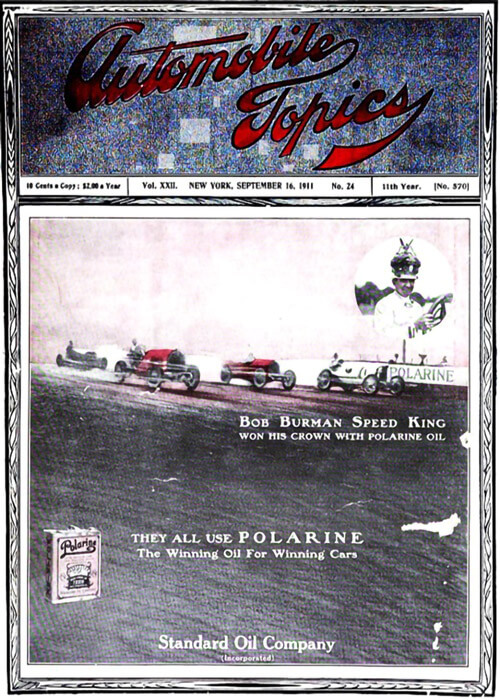
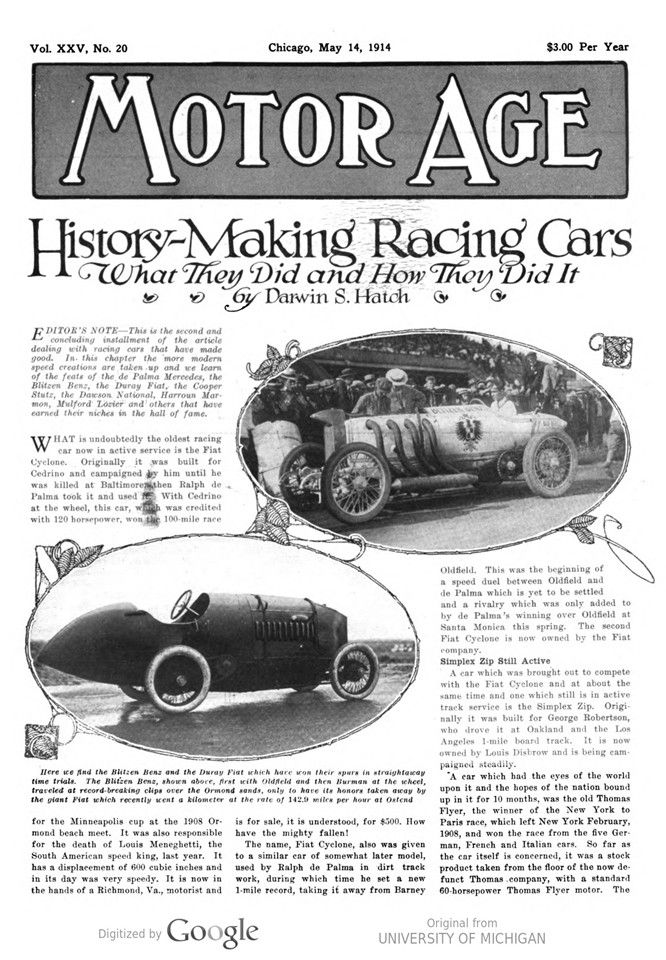
A car which caught the popular fancy on account of its name, its record, its appearance and the exploits of its drivers, is the Blitzen Benz. It has a record of having twice beaten the 1-mile straight-away record. The first time it was driven by Oldfield, who broke Marriott’s record, and then by Bob Burman, who broke the record made by Oldfield in the same car. The new records set up by Burman with the Blitzen Benz at Daytonia, Fla., April 24, 1911, still stand. He beat Oldfield’s 1-mile record of 27.33 seconds by making the mile 25.40 seconds. The 2 miles were covered in 51.28 seconds and the kilometer in 15.88. The record mile was made at the speed of 141.73 miles per hour, the fastest man had ever traveled until Duray’s recent feat at Ostend.
The Blitzen Benz is a four-cylinder car with a bore of 7.2835 inches, and a stroke of 7.8741 inches, the cylinders being east in pairs. The overhead valves are located on opposite sides, but there only is one camshaft. Two magnetos are used with a complete ignition system for each, there being one spark plug in each cylinder in each system, making eight plugs in all. There are four speeds to the gear- set with direct drive on high. The wheels are of wire, extra heavy and 32 by 4 inches in front and 34 by 5 inches in the rear. The wheelbase is 108 inches. The body is of the streamline design, having the pointed hood and pointed tail. The double chain drive is geared so that the ratio is 1 to 1 on high.
A car which has made a name for itself within the past year is the Stutz, with which Cooper won the road racing championship last season. This car made its first appearance at the Indianapolis speed- way race in 1913 with Donald Herr at the wheel. It only ran about seven laps of the 22-mile track at that time, but immediately after the race was shipped west, making its appearance at Tacoma on July 4 and 5, with Cooper at the wheel. After winning these events, Cooper drove it at every meet on the coast with almost uniform success. Its most recent appearance was in the Vanderbilt and grand prix races at Santa Monica. It was in this car that Cooper won six road races last year. This car has a four-cylinder motor of 4.814 by 5.5 inches, cylinders are T-head cast in pairs and the gear ratio is 2.25 to 1. The car weighs 2,350 pounds and carries 25 gallons of gasoline.
Alco Twice Triumphant
Harry Grant and the Alco rose to the top of fame’s crest. This combination of resourceful driver and efficient machine proving invincible in the fifth contest of the Vanderbilt cup, which was run over the Long Island course. Grant covered 278 miles at an average speed of 62.77 miles per hour. The 1910 contest, the red Vanderbilt of motoring history, was the sixth and last motor race on Long Island. Again the Alco with Grant at the wheel were unbeatable. After a lapse of 4 years the old car again was shown in the Vanderbilt at Santa Monica this spring, when, with Tony Jeanette driving, it also ran. This is a six-cylinder car, 4 by 5½ inches, giving it a piston displacement of 550. It was geared 2½ to 1.
The Indianapolis speedway has brought more than one car fame among the speed fans. The first one to gain national popularity from the 500-mile event was the winner of the first 500-mile race, the Marmon Wasp, driven by Ray Harroun on Memorial Day, 1911. This was a six-cylinder of 42 by 5-inch cylinders, giving it a horsepower of 48. The valves were on opposite sides of the T-head design and the ignition consisted of a magneto with a double distributor. A gearset like the regular Marmon construction was on the rear axle, providing three speeds forward. The gear ratio was 2.16 to 1, the wheelbase 116 inches, tires 34 by 4½ in front and 35 by 5 in the rear. This car made its first appearance at the spring meet at the Atlanta speedway in May, 1910, running second to de Palma in the big 90-horsepower Fiat in several events, and winning the 12-mile free-for-all from Lytle in the American and de Palma in a Fiat. It then appeared at the second Indianapolis meet May 30, 1910, winning the Remy brassard and Wheeler & Schebler trophy. The car was designed for high-speed work by the use of a long tail at the rear and sheet metal disks covering the wheels.
The second 500-mile race at Indianapolis produced another popular idol in Dawson’s National, which won the 5-century event at a speed of 78.7 miles per hour. The National had a four-cylinder motor of 5 by 64 inches bore and stroke, giving it a displacement of 490.8 inches and rating of 40 horsepower. The cylinders were cast in pairs, the valves were on oppo- site sides and they were 2 3/4 inches in diameter. The wheelbase was 110 and it was geared 2 to 1.
Goux‘ Victorious Peugeot
The 1913 500-mile race took the speed- way honors away from the American car and transplanted them to Goux and the Peugeot. The Peugeot motor is a block casting of four cylinders of 4¾ by 7 7/8 inches, giving a displacement of 448.13 cubic inches. There are four valves in every cylinder, two for the intake and two for the exhaust. The diameters of lift are the same in all, 2 1/8 by 25-64 inches. The valves are inclined at a 45-degree angle into the cylinder heads and are operated by cams on a single camshaft running over the top of the cylinders and driven by a vertical shaft from the crankshaft. The pistons are cut from solid blocks of steel, the valves are in duplicate throughout and the seats are on the underside of the cylinder casting, so that they are closed when raised.
Details of 500-Mile Victor
Oil is forced to the engine bearings at a pressure of 30 pounds per square inch, considerably higher than that of most American racers, which is in the neighborhood of 2 pounds. The timing is such that the intake valves and exhaust valves are open at the same time. The car is being the first American to finish in this ancient event designed to make about 115 miles per hour, the motor revolving at 2,250 r.p.m. and developing 162 horsepower. Charles Faroux, consulting engineer of the Peugeot factory, says that during the race Goux never was able to develop more than 125 horsepower or exceed 1,700 revolutions per minute on account of the track. The clutch is of the multiple-disk type and the gearset has four forward speeds. The gear ratio was approximately 2 to 1.
The Twelve-Cylinder Sunbeam
Brooklands‘ track, the fastest continuous course in the world, also has been responsible for the popularity of a number of cars. Probably the one that gained the most fame there is the twelve-cylinder Sunbeam. The cylinders are cast in sets of three and there are six cylinders in a row in V-type at an angle of 60 degrees. The cylinders are 3 1/8 by 5 7/8, giving the engine a piston displacement of 540 and a horsepower of 47 by the S. A. E. formula. There is only one camshaft, which lies between the bases of the cylinders, the valves thus being inside and rendered totally inaccessible by the exhaust pipe. Two carbureters are used, one at the rear end of each set of cylinders. From each carbureter, a pipe leads upward in an easy bend, turning midway in the cylinders to where it is attached to an ordinary inlet pipe turned upside down.
Details of English Champion
On the end of the camshaft a skew gear operates a cross shaft having a six-cylinder magneto at each end, so that the ignition is quite separate from each set of cylinders. In the matter of lubrication, this is different from standard, as there are two pumps, one forcing oil to all the bearings, while the other sucks oil from the ribbed sump and returns it to the reserve tank. This keeps a constant level in the engine, which prevents an oversupply and also removes the need of pumping oil to the engine by hand. The clutch is an ordinary cone with the usual Sunbeam gearset through a double-jointed propeller shaft to the rear axle, the latter has no differential, tires are 34 by 4 and the high-speed ratio is 2 to 1, so that the engine revolutions give 100 miles per hour at about 2,000 r.p.m.
The lines have been very carefully worked out to minimize wind resistance, the radiator being covered by a long, tapering shield and the car has a cigar-shaped tail at the rear. Even the ends of the frame have been pointed at the front and rear to reduce wind resistance. The car holds all medium distance records of Brooklands, including that of 107 miles within 1 hour, beating Percy Lambert’s record in the Talbot. It was driven by Chassagne, who will pilot the six-cylinder Sunbeam at Indianapolis this year.
Brooklands also was responsible for opening American eyes to another European car. To complete 100 miles in 1 hour long had been the coveted ambition of the motor car manufacturers since the recognition of protracted speed trials as the criterion of motor car efficiency. At Brooklands on February 15, 1913, the 25-horsepower Talbot, driven by the late Percy Lambert, covered 103.84 miles in a 60-minute run. This was the first car to travel 100 miles within the hour. In addition it set up new records for the 50-mile and 100-mile distances.
The chassis is said to be a stock 25 horsepower chassis, the motor being 4 by 5½ inches in size. In the record the engine speed was in the neighborhood of 2,800 revolutions per minute. Lambert, the driver, was killed October 31, 1913, in PA the same car while attempting to regain the 1-hour record, which had been taken away from him by the twelve-cylinder Sunbeam. The week before Lambert had set up a world’s record of 50 miles, averaging 110.9 miles per hour, thus regaining the 50-mile record, which also had been taken away from him by the Sunbeam.
Hemery’s Distinguished Benz
Brooklands also was the scene of the triumph of the 200-horsepower Benz, in which L. G. Hornsted wiped out former records for the standing start kilometer and the half mile. This is the identical car with which Victor Hemery made the records of 1909. Hornsted averaged 71.4 miles per hour for the kilometer and 70.47 miles per hour for the half mile, and also has established the world’s best for the flying 10 miles at 112.57 miles per hour, the flying 5 miles at 116.08 miles per hour, and the flying 2 miles at 122.05 miles per hour. The car has a bore of 3 3/8 and a stroke of 7 7/8 inches.
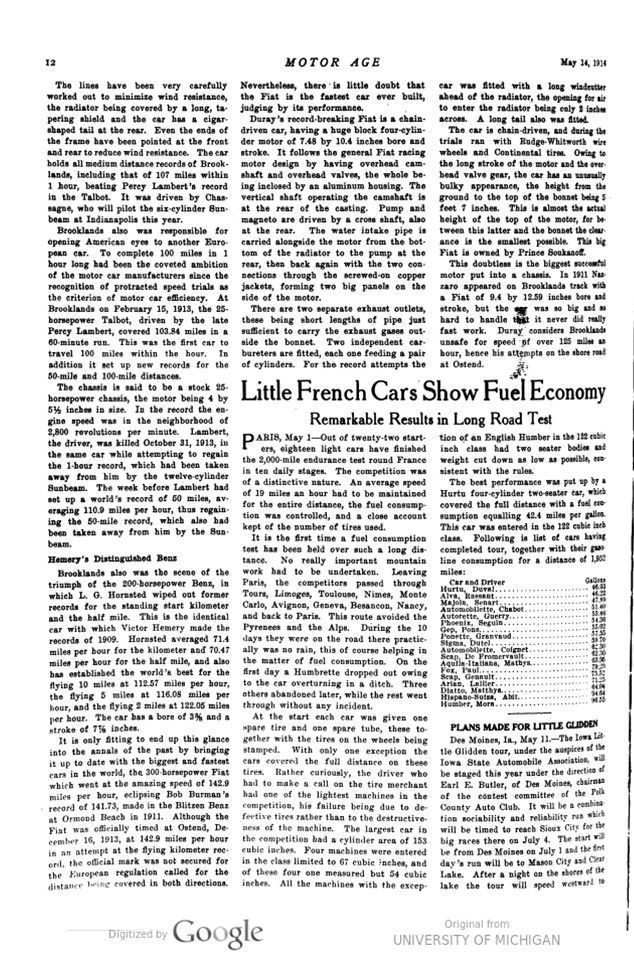
It is only fitting to end up this glance into the annals of the past by bringing it up to date with the biggest and fastest cars in the world, the 300-horsepower Fiat which went at the amazing speed of 142.9 miles per hour, eclipsing Bob Burman’s record of 141.73, made in the Blitzen Benz at Ormond Beach in 1911. Although the Fiat was officially timed at Ostend, December 16, 1913, at 142.9 miles per hour in an attempt at the flying kilometer record, the official mark was not secured for the European regulation called for the distance being covered in both directions. Nevertheless, there is little doubt that the Fiat is the fastest car ever built, judging by its performance.
Duray’s record-breaking Fiat is a chain-driven car, having a huge block four-cylinder motor of 7.48 by 10.4 inches bore and stroke. It follows the general Fiat racing motor design by having overhead cam- shaft and overhead valves, the whole being inclosed by an aluminum housing. The vertical shaft operating the camshaft is at the rear of the casting. Pump and magneto are driven by a cross shaft, also at the rear. The water intake pipe is carried alongside the motor from the bottom of the radiator to the pump at the rear, then back again with the two connections through the screwed-on copper jackets, forming two big panels on the side of the motor.
There are two separate exhaust outlets, these being short lengths of pipe just sufficient to carry the exhaust gases outside the bonnet. Two independent carbureters are fitted, each one feeding a pair of cylinders. For the record attempts the car was fitted with a long windcutter ahead of the radiator, the opening for air to enter the radiator being only 2 inches across. A long tail also was fitted.
The car is chain-driven, and during the trials ran with Rudge-Whitworth wire wheels and Continental tires. Owing to the long stroke of the motor and the overhead valve gear, the car has an unusually bulky appearance, the height from the ground to the top of the bonnet being 5 feet 7 inches. This is almost the actual height of the top of the motor, for between this latter and the bonnet the clearance is the smallest possible. This big Fiat is owned by Prince Soukanoff.
This doubtless is the biggest successful motor put into a chassis. In 1911 Nazzaro appeared on Brooklands track with a Fiat of 9.4 by 12.59 inches bore and stroke, but the ear was so big and so hard to handle that it never did really fast work. Duray considers Brooklands unsafe for speed of over 125 miles an hour, hence his attempts on the shore road at Ostend.

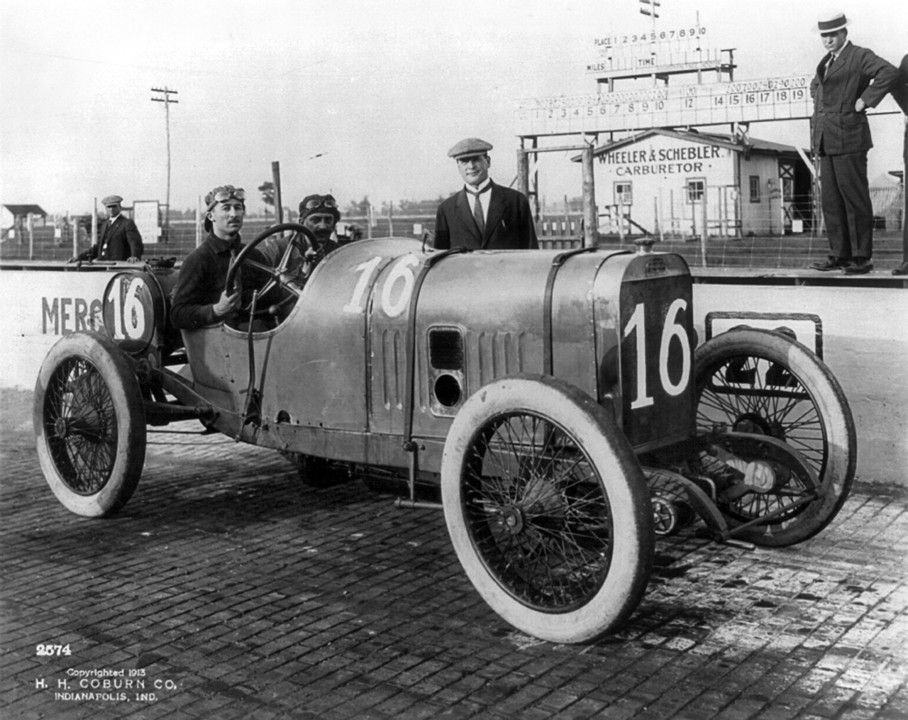

Photo captions.
Page 5.
Here we find the Blitzen Benz and the Duray Fiat which have won their spurs in straightaway time trials. The Blitzen Benz, shown above, first with Oldfield and then Burman at the wheel, traveled at record-breaking clips over the Ormond sands, only to have its honors taken away by the giant Fiat which recently went a kilometer at the rate of 142.9 miles per hour at Ostend
Page 6.
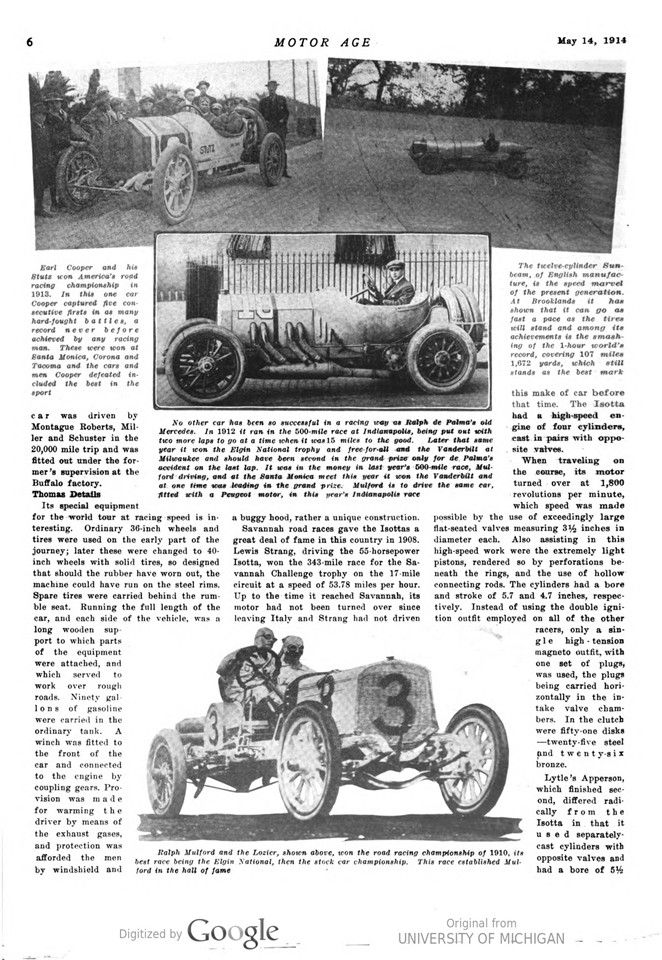
Earl Cooper and his Stutz won America’s road racing championship in 1913. In this one Cooper captured five consecutive firsts in as many hard-fought battles, a record never before achieved by any racing man. These were won at Santa Monica, Corona and Tacoma and the cars and men Cooper defeated included the best in the sport
No other car has been so successful in a racing way as Ralph de Palma’s old Mercedes. In 1912 it ran in the 500-mile race at Indianapolis, being put out with two more laps to go at a time when it was 15 miles to the good. Later that same year it won the Elgin National trophy and free-for-all and the Vanderbilt at Milwaukee and should have been second in the grand prize only for de Palma’s accident on the last lap. It was in the money in last year’s 500-mile race, Mulford driving, and at the Santa Monica meet this year it won the Vanderbilt and at one time was leading in the grand prize. Mulford is to drive the same car, fitted with a Peugeot motor, in this year’s Indianapolis race
The twelve-cylinder Sunbeam, of English manufacture, is the speed marvel of the present generation. At Brooklands it has shown that it can go a fast a pace as the tires will stand and among its achievements is the smashing of the 1-hour world’s record, covering 107 miles 1,672 yards, which still stands as the best mark
Ralph Mulford and the Lozier, shown above, won the road racing championship of 1910, its best race being the Elgin National, then the stock car championship. This race established Mulford in the hall of fame
Page 7.
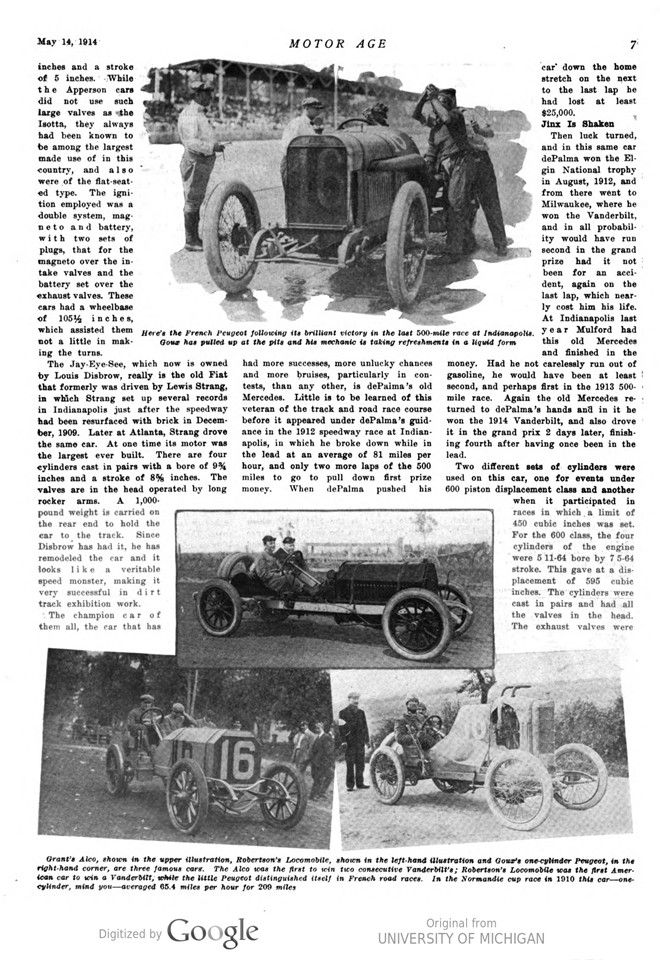
Here’s the French Peugeot following its brilliant victory in the last 500-mile race at Indianapolis. Goux has pulled up at the pits and his mechanic is taking refreshments in a liquid form
Grant’s Alco, shown in the upper illustration, Robertson’s Locomobile, shown in the left-hand illustration and Goux’s one-cylinder Peugeot, in the right-hand corner, are three famous cars. The Alco was the first to win two consecutive Vanderbilt’s; Robertson’s Locomobile was the first American car to win a Vanderbilt, while the little Peugeot distinguished itself in French road races. In the Normandie cup race in 1910 this car – one-cylinder, mind you – averaged 65.4 miles per hour for 209 miles
Page 8.
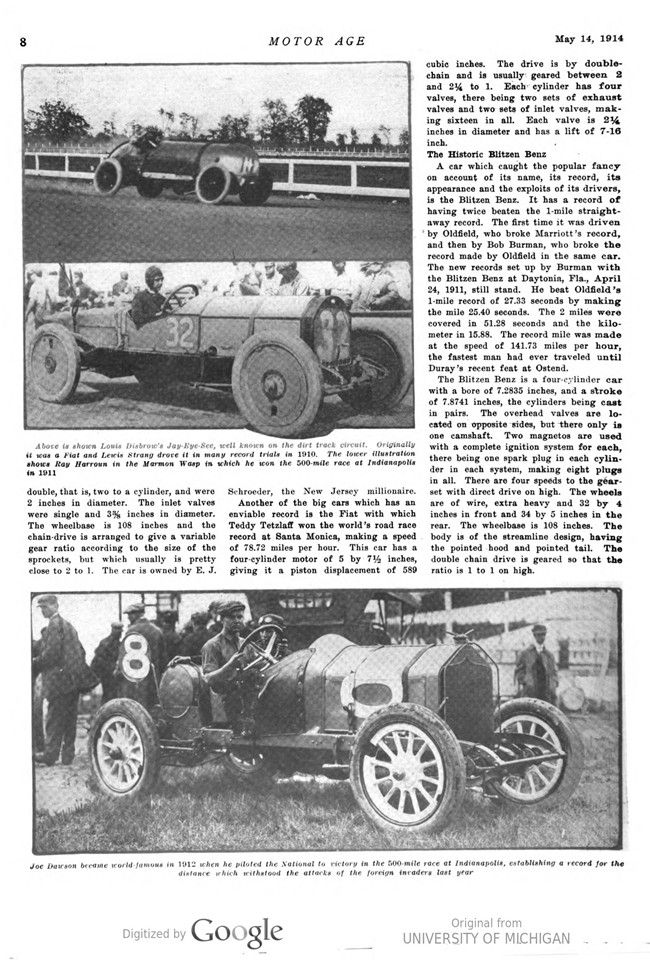
Above is shown Louis Disbrow’s Jay-Eye-See, well known on the dirt track circuit. Originally it was a Fiat and Lewis Strang drove it in many record trials in 1910. The lower illustration shows Ray Harroun in the Marmon Wasp in which he won the 500-mile race at Indianapolis in 1911
Joe Dawson became world-famous in 1912 when he piloted the National to victory in the 500-mile race at Indianapolis, establishing a record for the distance which withstood the attacks of the foreign invaders last year
Page 9.
Two Fiat Cyclones have made good in American dirt track racing. The one shown above formerly was driven by de Palma. It still is being campaigned and only recently Oldfield smashed the 2-mile record in it. The other Cyclone was built for Cedrino, who was killed at Baltimore. In this little car the late David Bruce-Brown first broke into the limelight at Ormond when he was only a schoolboy
De Palma has figured prominently in several cars. Here he is in the Simplex Zip which he drove when he was campaigning on the dirt tracks Disbrow now owns the Zip and it still is a speedy car
Page 10.
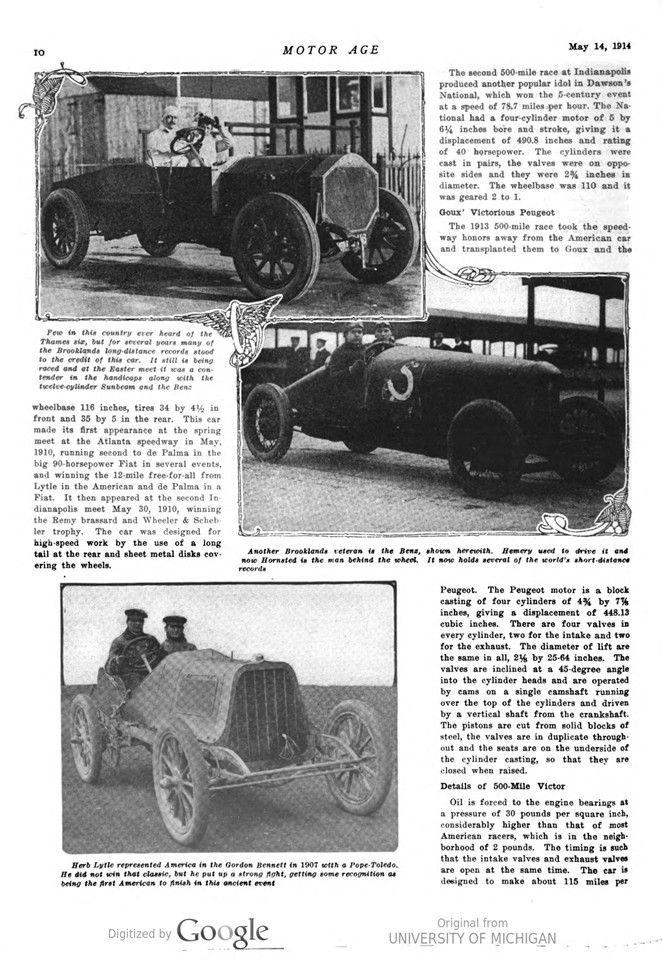
Few in this country ever heard of the Thames six, but for several years many of the Brooklands long-distance records stood to the credit of this car. It still is being raced and at the Easter meet it was a contender in the handicaps along with the twelve-cylinder Sunbeam and the Benz
Another Brooklands veteran is the Benz, shown herewith. Hemery used to drive it and now Hornsted is the man behind the wheel. It now holds several of the world’s short-distance records
Herb Lytle represented America in the Gordon Bennett in 1907 with a Pope-Toledo. He did not win that classic, but he put up a strong fight, getting some recognition as being the first American to finish in this ancient event
Page 11.
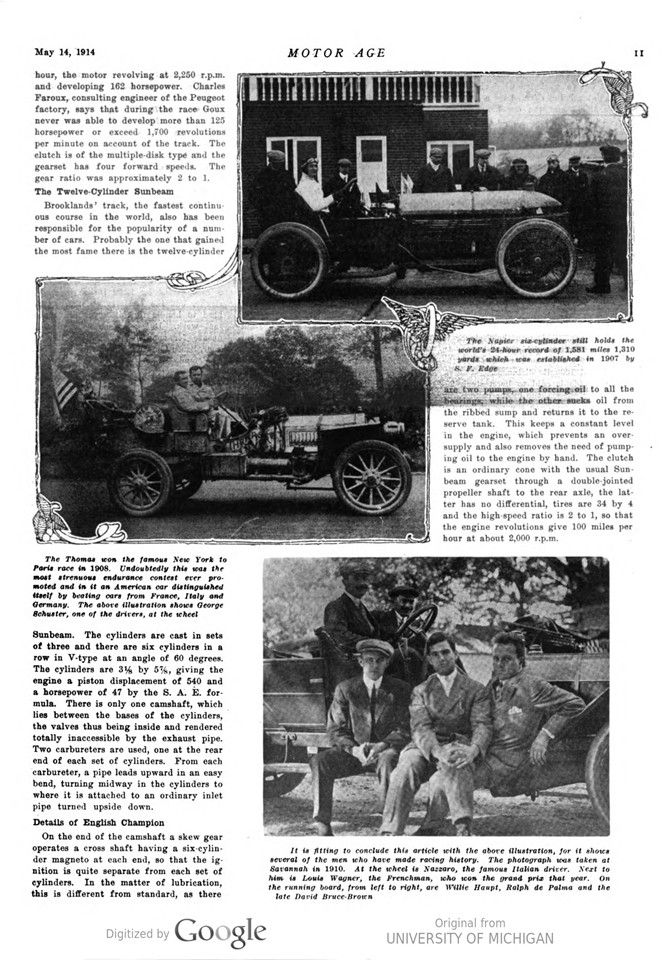
The Napier six-cylinder still holds the world’s 24-hour record of 1,581 miles 1,310 yards which was established in 1907 by S. F. Edge
The Thomas won the famous New York to Paris race in 1908. Undoubtedly this was the most strenuous endurance contest ever pro- moted and in it an American car distinguished itself by beating cars from France, Italy and Germany. The above illustration shows George Schuster, one of the drivers, at the wheel It is fitting to conclude this article with the above illustration, for it shows several of the men who have made racing history. The photograph was taken at Savannah in 1910. At the wheel is Nazzaro, the famous Italian driver. Next to him is Louis Wagner, the Frenchman, who won the grand prix that year. On the running board, from left to right, are Willie Haupt, Ralph de Palma and the late David Bruce-Brown