
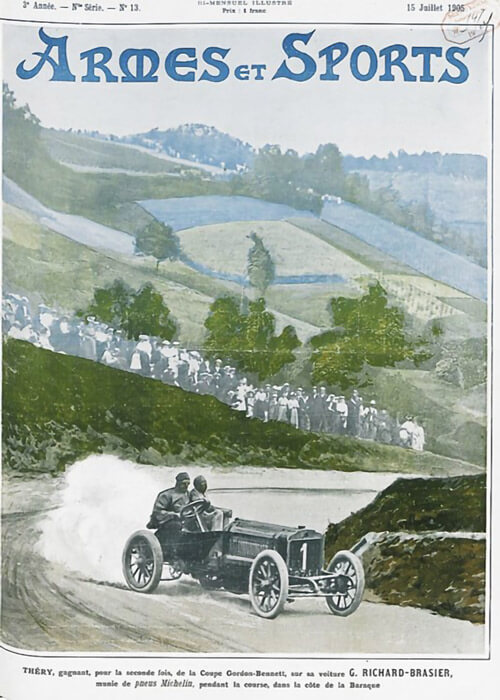
This September 1928 issue of the Journal of the SAE, deals with the up-to-then status of front wheel drive. In all, this very lenghty article comprises of no less that 25 pages, inclusive photograhs. All aspects are discussed; davantages and disadvantages are listed and compared. Almost all known front wheel drives in the US and on the continent are described. As for it’s length, the complete article is divided into four parts; here’s part I, wishing You an interesting read.


Text and jpegs by courtesy of hathitrust.org www.hathitrust.org, compiled by motorracinghistory.com
Journal of the SAE, Vol. XXIII (23), No. 3, September 1928.
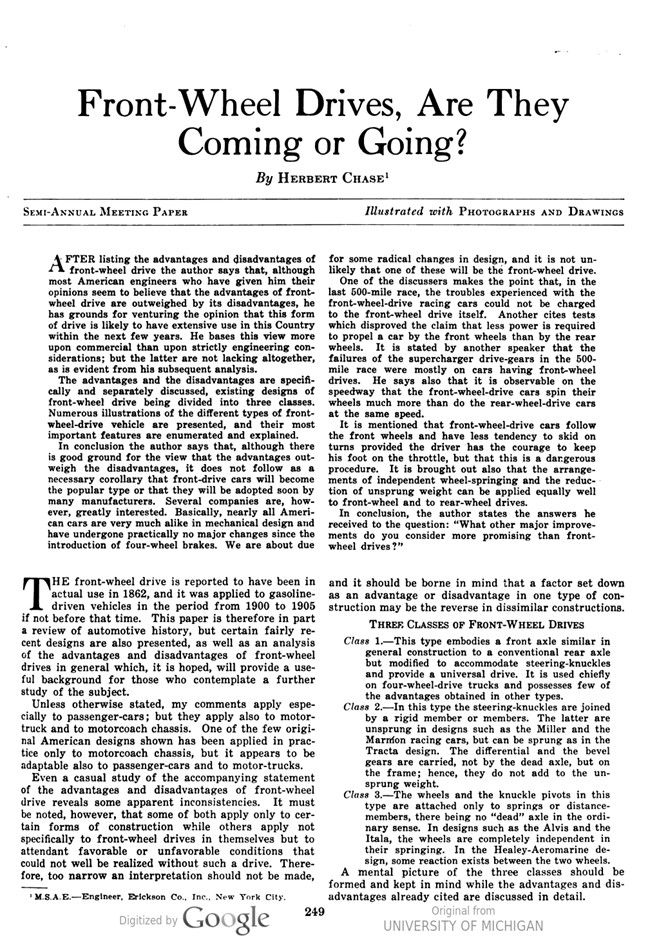
Front-Wheel Drives, Are They Coming or Going? – Part I
By HERBERT CHASE – M.S.A.E.-Engineer, Erickson Co., Inc., New York City.
SEMI-ANNUAL MEETING PAPER Illustrated with PHOTOGRAPHS AND DRAWINGS
AFTER listing the advantages and disadvantages of front-wheel drive the author says that, although most American engineers who have given him their opinions seem to believe that the advantages of front-wheel drive are outweighed by its disadvantages, he has grounds for venturing the opinion that this form of drive is likely to have extensive use in this Country within the next few years. He bases this view more upon commercial than upon strictly engineering considerations; but the latter are not lacking altogether, as is evident from his subsequent analysis.
The advantages and the disadvantages are specifically and separately discussed, existing designs of front-wheel drive being divided into three classes. Numerous illustrations of the different types of front-wheel-drive vehicle are presented, and their most important features are enumerated and explained.
In conclusion the author says that, although there is good ground for the view that the advantages outweigh the disadvantages, it does not follow as a necessary corollary that front-drive cars will become the popular type or that they will be adopted soon by many manufacturers. Several companies are, however, greatly interested. Basically, nearly all American cars are very much alike in mechanical design and have undergone practically no major changes since the introduction of four-wheel brakes. We are about due for some radical changes in design, and it is not unlikely that one of these will be the front-wheel drive.
One of the discussers makes the point that, in the last 500-mile race, the troubles experienced with the front-wheel-drive racing cars could not be charged to the front-wheel drive itself. Another cites tests which disproved the claim that less power is required to propel a car by the front wheels than by the rear wheels. It is stated by another speaker that the failures of the supercharger drive-gears in the 500-mile race were mostly on cars having front-wheel drives. He says also that it is observable on the speedway that the front-wheel-drive cars spin their wheels much more than do the rear-wheel-drive cars at the same speed.
It is mentioned that front-wheel-drive cars follow the front wheels and have less tendency to skid on turns provided the driver has the courage to keep his foot on the throttle, but that this is a dangerous procedure. It is brought out also that the arrangements of independent wheel-springing and the reduction of unsprung weight can be applied equally well to front-wheel and to rear-wheel drives.
In conclusion, the author states the answers he received to the question: „What other major improvements do you consider more promising than front-wheel drives?“
THE front-wheel drive is reported to have been in actual use in 1862, and it was applied to gasoline-driven vehicles in the period from 1900 to 1905 if not before that time. This paper is therefore in part a review of automotive history, but certain fairly recent designs are also presented, as well as an analysis of the advantages and disadvantages of front-wheel drives in general which, it is hoped, will provide a useful background for those who contemplate a further study of the subject.
Unless otherwise stated, my comments apply especially to passenger-cars; but they apply also to motor-truck and to motorcoach chassis. One of the few original American designs shown has been applied in practice only to motorcoach chassis, but it appears to be adaptable also to passenger-cars and to motor-trucks.
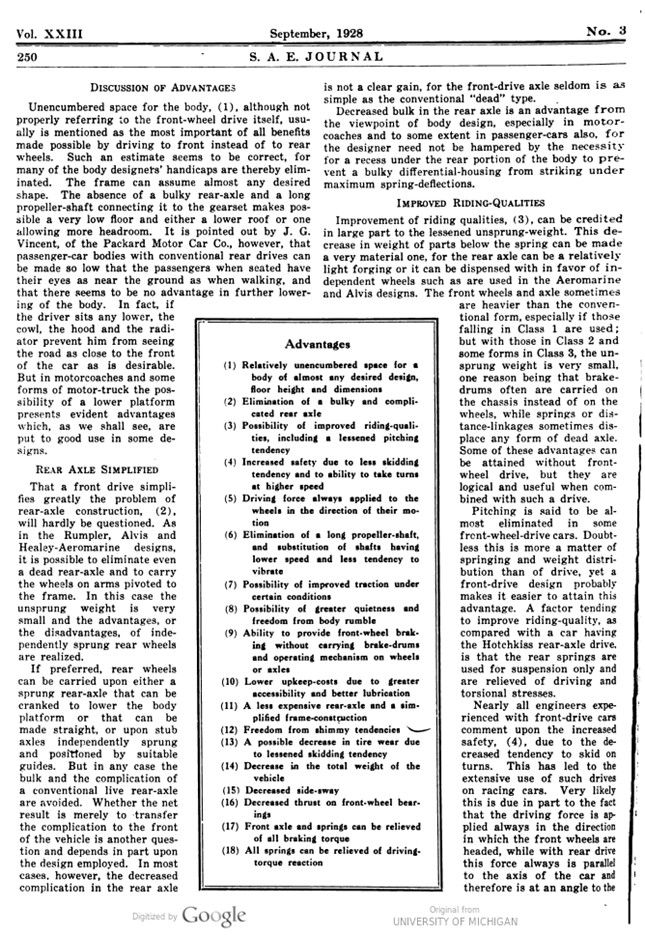
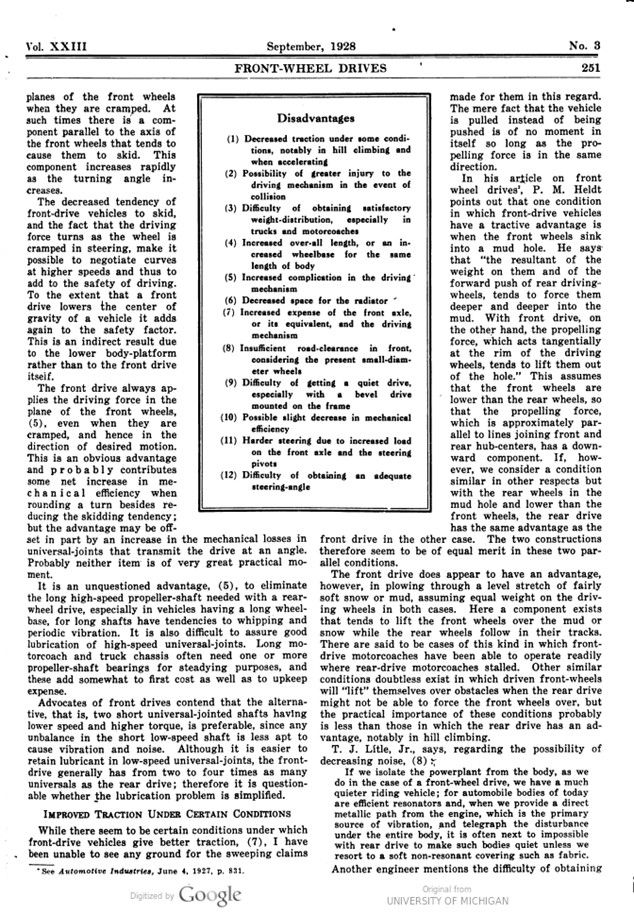
Even a casual study of the accompanying statement of the advantages and disadvantages of front-wheel drive reveals some apparent inconsistencies. It must be noted, however, that some of both apply only to certain forms of construction while others apply not specifically to front-wheel drives in themselves but to attendant favorable or unfavorable conditions that could not well be realized without such a drive. Therefore, too narrow an interpretation should not be made, and it should be borne in mind that a factor set down as an advantage or disadvantage in one type of construction may be the reverse in dissimilar constructions.
Advantages
(1) Relatively unencumbered space for a body of almost any desired design, floor height and dimensions
(2) Elimination of a bulky and complicated rear axle
(3) Possibility of improved riding-qualities, including a lessened pitching tendency
(4) Increased safety due to less skidding tendency and to ability to take turns at higher speed
(5) Driving force always applied to the wheels in the direction of their motion
(6) Elimination of a long propeller-shaft, and substitution of shafts having lower speed and less tendency to vibrate
(7) Possibility of improved traction under certain conditions
(8) Possibility of greater quietness and freedom from body rumble
(9) Ability to provide front-wheel braking without carrying brake-drums and operating mechanism on wheels or axles
(10) Lower upkeep-costs due to greater accessibility and better lubrication
(11) A less expensive rear-axle and a simplified frame-construction
(12) Freedom from shimmy tendencies
(13) A possible decrease in tire wear due to lessened skidding tendency
(14) Decrease in the total weight of the vehicle
(15) Decreased side-sway
(16) Decreased thrust on front-wheel bearings
(17) Front axle and springs can be relieved of all braking torque
(18) All springs can be relieved of driving- torque reaction
Disadvantages
(1) Decreased traction under some conditions, notably in hill climbing and when accelerating
(2) Possibility of greater injury to the driving mechanism in the event of collision
(3) Difficulty of obtaining satisfactory weight-distribution, especially in trucks and motorcoaches
(4) Increased overall length, or an increased wheelbase for the same length of body
(5) Increased complication in the driving mechanism
(6) Decreased space for the radiator
(7) Increased expense of the front axle, or its equivalent, and the driving mechanism
(8) Insufficient road-clearance in front, considering the present small-diameter wheels
(9) Difficulty of getting a quiet drive, especially with a bevel drive mounted on the frame
(10) Possible slight decrease in mechanical efficiency
(11) Harder steering due to increased load on the front axle and the steering pivots
(12) Difficulty of obtaining an adequate steering-angle
THREE CLASSES OF FRONT-WHEEL DRIVES
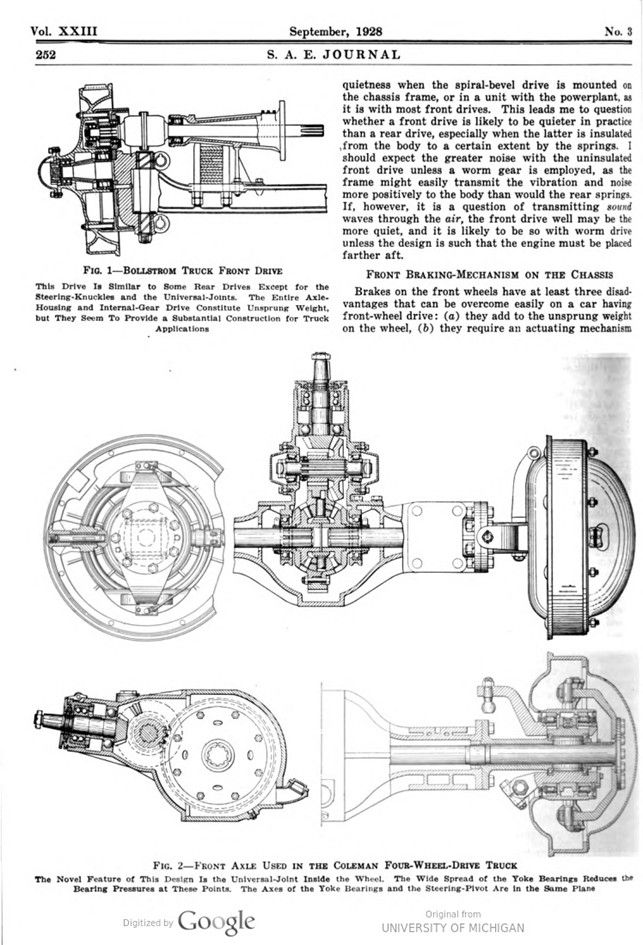
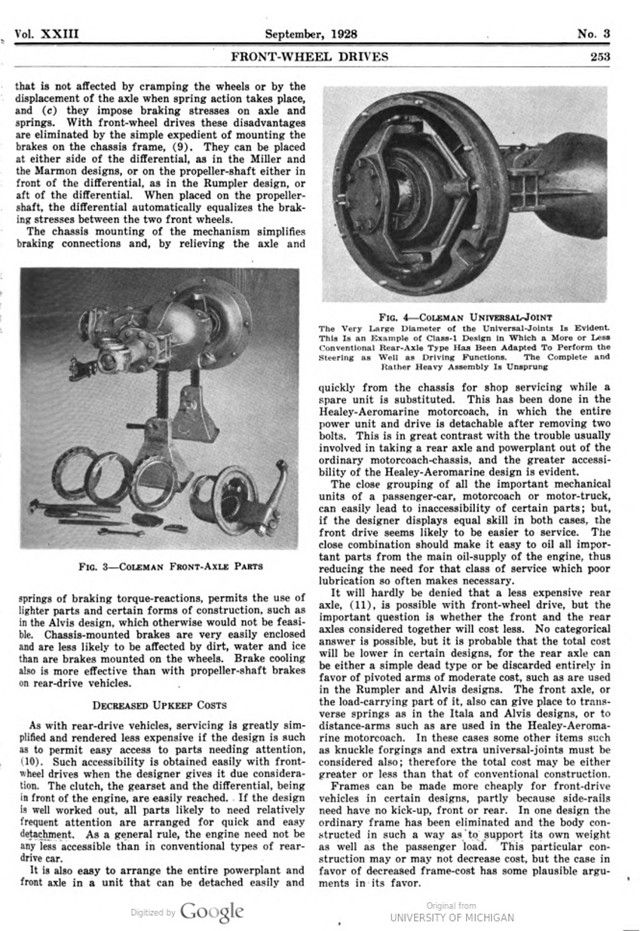
Class 1.- This type embodies a front axle similar in general construction to a conventional rear axle but modified to accommodate steering-knuckles and provide a universal drive. It is used chiefly on four-wheel-drive trucks and possesses few of the advantages obtained in other types.
Class 2. – In this type the steering-knuckles are joined by a rigid member or members. The latter are unsprung in designs such as the Miller and the Marmon racing cars but can be sprung as in the Tracta design. The differential and the bevel gears are carried, not by the dead axle, but on the frame; hence, they do not add to the unsprung weight.
Class 3.- The wheels and the knuckle pivots in this type are attached only to springs or distance-members, there being no „dead“ axle in the ordinary sense. In designs such as the Alvis and the Itala, the wheels are completely independent in their springing. In the Healey-Aeromarine de- sign, some reaction exists between the two wheels.
A mental picture of the three classes should be formed and kept in mind while the advantages and disadvantages already cited are discussed in detail.
DISCUSSION OF ADVANTAGES
Unencumbered space for the body, (1), although not properly referring to the front-wheel drive itself, usually is mentioned as the most important of all benefits made possible by driving to front instead of to rear wheels. Such an estimate seems to be correct, for many of the body designers‘ handicaps are thereby eliminated. The frame can assume almost any desired shape. The absence of a bulky rear-axle and a long propeller-shaft connecting it to the gearset makes possible a very low floor and either a lower roof or one allowing more headroom. It is pointed out by J. G. Vincent, of the Packard Motor Car Co., however, that passenger-car bodies with conventional rear drives can be made so low that the passengers when seated have their eyes as near the ground as when walking, and that there seems to be no advantage in further lowering of the body. In fact, if the driver sits any lower, the cowl, the hood and the radiator prevent him from seeing the road as close to the front of the car as is desirable. But in motorcoaches and some forms of motor-truck the possibility of a lower platform presents evident advantages which, as we shall see, are put to good use in some designs.
REAR AXLE SIMPLIFIED
That a front drive simplifies greatly the problem of rear-axle construction, (2), will hardly be questioned. As in the Rumpler, Alvis and Healey-Aeromarine designs, it is possible to eliminate even a dead rear-axle and to carry the wheels on arms pivoted to the frame. In this case the unsprung weight is very small and the advantages, or the disadvantages, of independently sprung rear wheels are realized.
If preferred, rear wheels can be carried upon either a sprung rear-axle that can be cranked to lower the body platform or that can be made straight, or upon stub axles independently sprung and positioned by suitable guides. But in any case, the bulk and the complication of a conventional live rear-axle are avoided. Whether the net result is merely to transfer the complication to the front of the vehicle is another question and depends in part upon the design employed. In most cases, however, the decreased complication in the rear axle is not a clear gain, for the front-drive axle seldom is as simple as the conventional „dead“ type.
Decreased bulk in the rear axle is an advantage from the viewpoint of body design, especially in motor-coaches and to some extent in passenger-cars also, for the designer need not be hampered by the necessity for a recess under the rear portion of the body to prevent a bulky differential-housing from striking under maximum spring-deflections.
IMPROVED RIDING-QUALITIES
Improvement of riding qualities, (3), can be credited in large part to the lessened unsprung weight. This decrease in weight of parts below the spring can be made a very material one, for the rear axle can be a relatively light forging or it can be dispensed with in favor of independent wheels such as are used in the Aeromarine and Alvis designs. The front wheels and axle sometimes are heavier than the conventional form, especially if those falling in Class 1 are used; but with those in Class 2 and some forms in Class 3, the unsprung weight is very small, one reason being that brake-drums often are carried on the chassis instead of on the wheels, while springs or distance-linkages sometimes displace any form of dead axle. Some of these advantages can be attained without front- wheel drive, but they are logical and useful when combined with such a drive.
Pitching is said to be almost eliminated in some front-wheel-drive cars. Doubtless this is more a matter of springing and weight distribution than of drive, yet a front-drive design probably makes it easier to attain this advantage. A factor tending to improve riding quality, as compared with a car having the Hotchkiss rear-axle drive, is that the rear springs are used for suspension only and are relieved of driving and torsional stresses.
Nearly all engineers experienced with front-drive cars comment upon the increased safety, (4), due to the decreased tendency to skid on turns. This has led to the extensive use of such drives on racing cars. Very likely this is due in part to the fact that the driving force is applied always in the direction in which the front wheels are headed, while with rear drive this force always is parallel to the axis of the car and therefore is at an angle to the planes of the front wheels when they are cramped. At such times there is a ponent parallel to the axis of the front wheels that tends to cause them to skid. This component increases rapidly as the turning angle increases.
The decreased tendency of front-drive vehicles to skid, and the fact that the driving force turns as the wheel is cramped in steering, make it possible to negotiate curves at higher speeds and thus to add to the safety of driving. To the extent that a front drive lowers the center of gravity of a vehicle it adds again to the safety factor. This is an indirect result due to the lower body-platform rather than to the front drive itself.
The front drive always applies the driving force in the plane of the front wheels, (5), even when they are cramped, and hence in the direction of desired motion. This is an obvious advantage and probably contributes some net increase in mechanical efficiency when rounding a turn besides reducing the skidding tendency; but the advantage may be off-set in part by an increase in the mechanical losses in universal-joints that transmit the drive at an angle. Probably neither item is of very great practical moment.
It is an unquestioned advantage, (5), to eliminate the long high-speed propeller-shaft needed with a rear- wheel drive, especially in vehicles having a long wheel- base, for long shafts have tendencies to whipping and periodic vibration. It is also difficult to assure good lubrication of high-speed universal joints. Long motorcoach and truck chassis often need one or more propeller-shaft bearings for steadying purposes, and these add somewhat to first cost as well as to upkeep expense.
Advocates of front drives contend that the alternative, that is, two short universal-jointed shafts having lower speed and higher torque, is preferable, since any unbalance in the short low-speed shaft is less apt to cause vibration and noise. Although it is easier to retain lubricant in low-speed universal-joints, the front-drive generally has from two to four times as many universals as the rear drive; therefore, it is questionable whether the lubrication problem is simplified.
IMPROVED TRACTION UNDER CERTAIN CONDITIONS
While there seem to be certain conditions under which front-drive vehicles give better traction, (7), I have been unable to see any ground for the sweeping claims made for them in this regard. The mere fact that the vehicle is pulled instead of being pushed is of no moment in itself so long as the propelling force is in the same direction.
In his article on front wheel drives, (See Automotive Industries, June 4, 1927, p. 831), P. M. Heldt points out that one condition in which front-drive vehicles have a tractive advantage is when the front wheels sink into a mud hole. He says that „the resultant of the weight on them and of the forward push of rear driving-wheels, tends to force them deeper and deeper into the mud. With front drive, on the other hand, the propelling force, which acts tangentially at the rim of the driving wheels, tends to lift them out of the hole.“ This assumes that the front wheels are lower than the rear wheels, so that the propelling force, which is approximately parallel to lines joining front and rear hub-centers, has a downward component. If, however, we consider a condition similar in other respects but with the rear wheels in the mud hole and lower than the front wheels, the rear drive has the same advantage as the front drive in the other case. The two constructions therefore seem to be of equal merit in these two parallel conditions.
The front drive does appear to have an advantage, however, in plowing through a level stretch of fairly soft snow or mud, assuming equal weight on the driving wheels in both cases. Here a component exists that tends to lift the front wheels over the mud or snow while the rear wheels follow in their tracks. There are said to be cases of this kind in which front-drive motorcoaches have been able to operate readily where rear-drive motorcoaches stalled. Other similar conditions doubtless exist in which driven front-wheels will „lift“ themselves over obstacles when the rear drive might not be able to force the front wheels over, but the practical importance of these conditions probably is less than those in which the rear drive has an advantage, notably in hill climbing.
T. J. Litle, Jr., says, regarding the possibility of decreasing noise, (8):
If we isolate the powerplant from the body, as we do in the case of a front-wheel drive, we have a much quieter riding vehicle; for automobile bodies of today are efficient resonators and, when we provide a direct metallic path from the engine, which is the primary source of vibration, and telegraph the disturbance under the entire body, it is often next to impossible with rear drive to make such bodies quiet unless we resort to a soft non-resonant covering such as fabric.
Another engineer mentions the difficulty of obtaining quietness when the spiral-bevel drive is mounted on the chassis frame, or in a unit with the powerplant, as it is with most front drives. This leads me to question whether a front drive is likely to be quieter in practice than a rear drive, especially when the latter is insulated from the body to a certain extent by the springs. I should expect the greater noise with the uninsulated front drive unless a worm gear is employed, as the frame might easily transmit the vibration and noise more positively to the body than would the rear springs. If, however, it is a question of transmitting sound waves through the air, the front drive well may be the more quiet, and it is likely to be so with worm drive unless the design is such that the engine must be placed farther aft.
FRONT BRAKING-MECHANISM ON THE CHASSIS
Brakes on the front wheels have at least three disadvantages that can be overcome easily on a car having front-wheel drive: (a) they add to the unsprung weight on the wheel, (b) they require an actuating mechanism that is not affected by cramping the wheels or by the displacement of the axle when spring action takes place, and (c) they impose braking stresses on axle and springs. With front-wheel drives these disadvantages are eliminated by the simple expedient of mounting the brakes on the chassis frame, (9). They can be placed at either side of the differential, as in the Miller and the Marmon designs, or on the propeller-shaft either in front of the differential, as in the Rumpler design, or aft of the differential. When placed on the propeller-shaft, the differential automatically equalizes the braking stresses between the two front wheels.
The chassis mounting of the mechanism simplifies braking connections and, by relieving the axle and springs of braking torque-reactions, permits the use of lighter parts and certain forms of construction, such as in the Alvis design, which otherwise would not be feasible. Chassis-mounted brakes are very easily enclosed and are less likely to be affected by dirt, water and ice than are brakes mounted on the wheels. Brake cooling also is more effective than with propeller-shaft brakes on rear-drive vehicles.
DECREASED UPKEEP COSTS
As with rear-drive vehicles, servicing is greatly simplified and rendered less expensive if the design is such as to permit easy access to parts needing attention, (10). Such accessibility is obtained easily with front-wheel drives when the designer gives it due consideration. The clutch, the gearset and the differential, being in front of the engine, are easily reached. If the design is well worked out, all parts likely to need relatively frequent attention are arranged for quick and easy detachment. As a general rule, the engine need not be any less accessible than in conventional types of rear-drive car.
It is also easy to arrange the entire powerplant and front axle in a unit that can be detached easily and quickly from the chassis for shop servicing while a spare unit is substituted. This has been done in the Healey-Aeromarine motorcoach, in which the entire power unit and drive is detachable after removing two bolts. This is in great contrast with the trouble usually involved in taking a rear axle and powerplant out of the ordinary motorcoach-chassis, and the greater accessibility of the Healey-Aeromarine design is evident.
The close grouping of all the important mechanical units of a passenger-car, motorcoach or motor-truck, can easily lead to inaccessibility of certain parts; but, if the designer displays equal skill in both cases, the front drive seems likely to be easier to service. The close combination should make it easy to oil all important parts from the main oil-supply of the engine, thus reducing the need for that class of service which poor lubrication so often makes necessary.
It will hardly be denied that a less expensive rear axle, (11), is possible with front-wheel drive, but the important question is whether the front and the rear axles considered together will cost less. No categorical answer is possible, but it is probable that the total cost will be lower in certain designs, for the rear axle can be either a simple dead type or be discarded entirely in favor of pivoted arms of moderate cost, such as are used in the Rumpler and Alvis designs. The front axle, or the load-carrying part of it, also can give place to transverse springs as in the Itala and Alvis designs, or to distance-arms such as are used in the Healey-Aeromarine motorcoach. In these cases, some other items such as knuckle forgings and extra universal-joints must be considered also; therefore, the total cost may be either greater or less than that of conventional construction. Frames can be made more cheaply for front-drive vehicles in certain designs, partly because side-rails need have no kick-up, front or rear. In one design the ordinary frame has been eliminated and the body constructed in such a way as to support its own weight as well as the passenger load. This particular construction may or may not decrease cost, but the case in favor of decreased frame-cost has some plausible arguments in its favor.