The American automotive magazine „Motor Age“ covered the 1904 Gordon Bennet Cup race as well as its preparations and English and French elimination trials. This is a summary of three articles, published on the French Elimination trial, on May 26, March 17 and February 4, 1904. Even results of one of the many discussions in the French Parliament are highlighted, showing that those days, the French automobile industry was a very important governemental issue.
Text and photos with courtesy of hathitrust hathitrust.org, compiled by motorracingistory.com.
MOTOR AGE VOL. V. NO. 21. MAY 26, 1904.
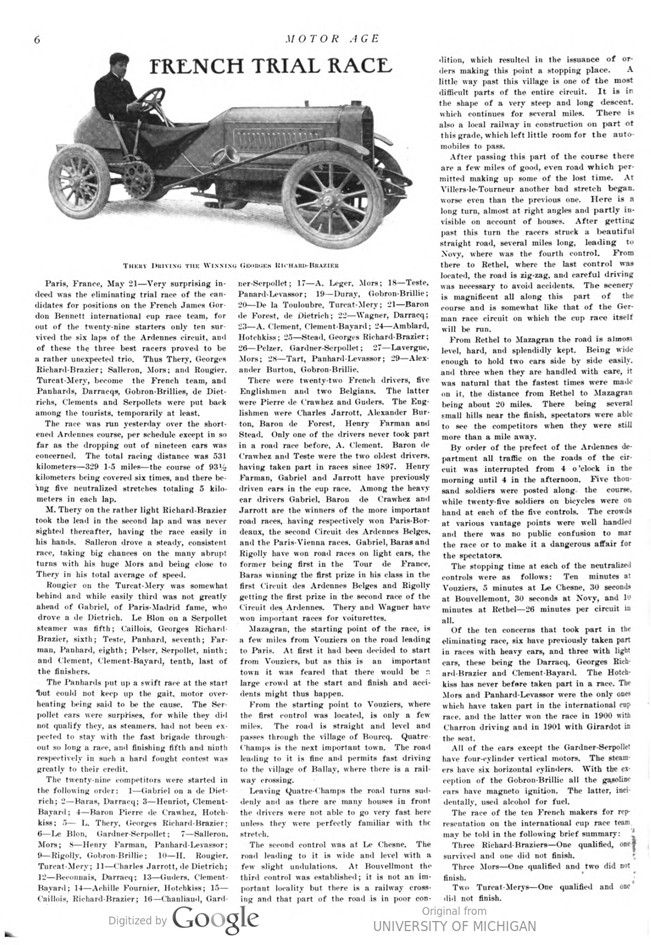
FRENCH TRIAL RACE
Paris, France, May 21 – Very surprising indeed was the eliminating trial race of the candidates for positions on the French James Gordon Bennett international cup race team, for out of the twenty-nine starters only ten survived the six laps of the Ardennes circuit, and of these the three best racers proved to be a rather unexpected trio. Thus Thery, Georges Richard-Brazier; Salleron, Mors; and Rougier, Turcat-Mery, become the French team, and Panhards, Darracqs, Gobron-Brillies, de Dietrichs, Clements and Serpollets were put back among the tourists, temporarily at least.
The race was run yesterday over the shortened Ardennes course, per schedule except in so far as the dropping out of nineteen cars was concerned. The total racing distance was 531 kilometers – 329 1-5 miles – the course of 932 kilometers being covered six times, and there being five neutralized stretches totaling 5 kilometers in each lap.
M. Thery on the rather light Richard-Brazier took the lead in the second lap and was never sighted thereafter, having the race easily in his hands. Salleron drove a steady, consistent race, taking big chances on the many abrupt turns with his huge Mors and being close to Thery in his total average of speed. Rougier on the Turcat-Mery was somewhat behind and while easily third was not greatly ahead of Gabriel, of Paris-Madrid fame, who drove a de Dietrich. Le Blon on a Serpollet steamer was fifth; Caillois, Georges Richard- Brazier, sixth; Teste, Panhard, seventh; Farman, Panhard, eighth; Pelser, Serpollet, ninth; and Clement, Clement-Bayard, tenth, last of the finishers.
The Panhards put up a swift race at the start ‚but could not keep up the gait, motor overheating being said to be the cause. The Serpollet cars were surprises, for while they did not qualify they, as steamers, had not been expected to stay with the fast brigade throughout so long a race, and finishing fifth and ninth respectively in such a hard fought contest was greatly to their credit.
The twenty-nine competitors were started in the following order: 1-Gabriel on a de Diet- rich; 2-Baras, Darracq; 3-Henriot, Clement- Bayard; 4-Baron Pierre de Crawhez, Hotch- kiss; 5 L. Thery, Georges Richard-Brazier; 6-Le Blon, Gardner-Serpollet; 7-Salleron, Mors; 8-Henry Farman, Panhard-Levassor; 9-Rigolly, Gobron-Brillie; 10-H. Rougier, road leading to it is wide and level with a Turcat-Mery; 11-Charles Jarrott, de Dietrich; few slight undulations. At Bouvellmont the 12-Beconnais, Darracq; 13-Guders, Clement- Bayard; 14-Achille Fournier, Hotchkiss; 15- Caillois, Richard-Brazier; 16-Chanliaud, Gardner-Serpollet; 17-A. Leger, Mors; 18-Teste, Panard-Levassor; 19-Duray, Gobron-Brillie; 20-De la Touloubre, Turcat-Mery; 21-Baron de Forest, de Dietrich; 22-Wagner, Darracq; 23-A. Clement, Clement-Bayard; 24-Amblard, Hotchkiss; 25-Stead, Georges Richard-Brazier; 26 Pelzer; Gardner-Serpollet; 27-Lavergne, Mors; 28-Tart, Panhard-Levassor; 29-Alexander Burton, Gobron-Brillie.
There were twenty-two French drivers, five Englishmen and two Belgians. The latter were Pierre de Crawhez and Guders. The Englishmen were Charles Jarrott, Alexander Burton, Baron de Forest, Henry Farman and Stead. Only one of the drivers never took part in a road race before, A. Clement. Baron de Crawhez and Teste were the two oldest drivers, having taken part in races since 1897. Henry Farman, Gabriel and Jarrott have previously driven cars in the cup race. Among the heavy car drivers Gabriel, Baron de Crawhez and Jarrott are the winners of the more important road races, having respectively won Paris-Bordeaux, the second Circuit des Ardennes Belges, and the Paris-Vienna races. Gabriel, Baras and Rigolly have won road races on light cars, the former being first in the Tour de France, Baras winning the first prize in his class in the first Circuit des Ardennes Belges and Rigolly getting the first prize in the second race of the Circuit des Ardennes. Thery and Wagner have won important races for voiturettes.
Mazagran, the starting point of the race, is a few miles from Vouziers on the road leading to Paris. At first it had been decided to start from Vouziers, but as this is an important town it was feared that there would be large crowd at the start and finish and accidents might thus happen.
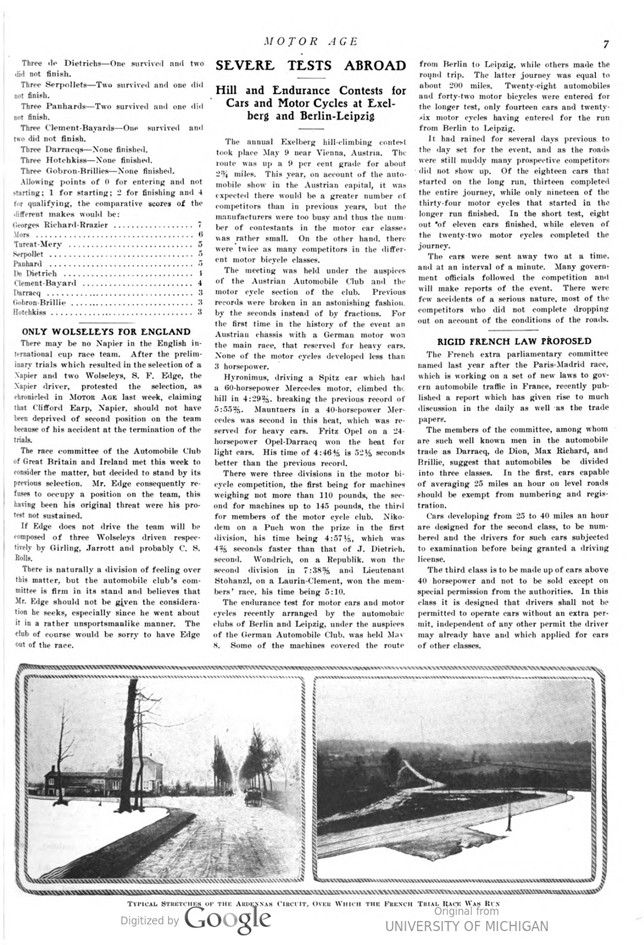
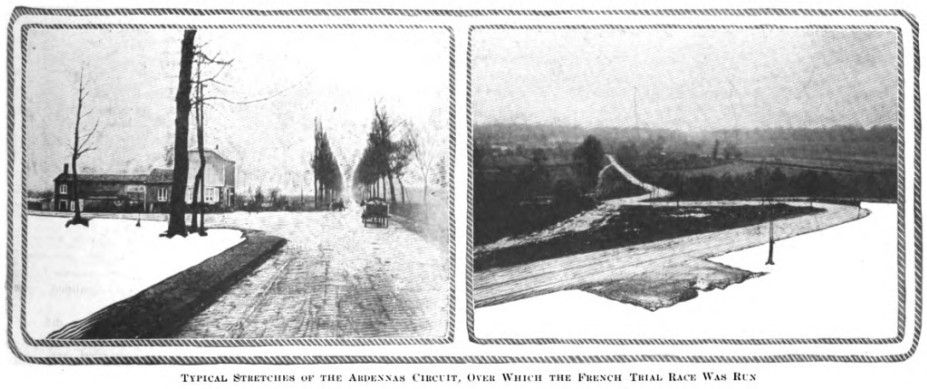
From the starting point to Vouziers, where the first control was located, is only a few miles. The road is straight and level and passes through the village of Bourcq. Quatre-Champs is the next important town. The road leading to it is fine and permits fast driving to the village of Ballay, where there is a railway crossing.
Leaving Quatre-Champs the road turns suddenly and as there are many houses in front the drivers were not able to go very fast here unless they were perfectly familiar with the stretch.
The second control was at Le Chesne. The third control was established; it is not an important locality but there is a railway crossing and that part of the road is in poor condition, which resulted in the issuance of orders making this point a stopping place. A little way past this village is one of the most difficult parts of the entire circuit. It is in the shape of a very steep and long descent, which continues for several miles. There is also a local railway in construction on part of this grade, which left little room for the automobiles to pass.
After passing this part of the course there are a few miles of good, even road which permitted making up some of the lost time. At Villers-le-Tourneur another bad stretch began. worse even than the previous one. Here is a long turn, almost at right angles and partly invisible on account of houses. After getting past this turn the racers struck a beautiful straight road, several miles long, leading to. Novy, where was the fourth control. From there to Rethel, where the last control was located, the road is zig-zag, and careful driving was necessary to avoid accidents. The scenery is magnificent all along this part of the course and is somewhat like that of the German race circuit on which the cup race itself will be run. From Rethel to Mazagran the road is almost level, hard, and splendidly kept. Being wide enough to hold two cars side by side easily, and three when they are handled with care, it was natural that the fastest times were made on it, the distance from Rethel to Mazagran being about 20 miles. There being several small hills near the finish, spectators were able to see the competitors when they were still more than a mile away.
By order of the prefect of the Ardennes department all traffic on the roads of the circuit was interrupted from 4 o’clock in the morning until 4 in the afternoon. Five thousand soldiers were posted along the course, while twenty-five soldiers on bicycles were on hand at each of the five controls. The crowds at various vantage points were well handled and there was no public confusion to mar the race or to make it a dangerous affair for the spectators.
The stopping time at each of the neutralized controls were as follows: Ten minutes a Vouziers, 5 minutes at Le Chesne, 30 seconds at Bouvellemont, 30 seconds at Novy, and 10 minutes at Rethel – 26 minutes per circuit in all.
Of the ten concerns that took part in the eliminating race, six have previously taken part in races with heavy cars, and three with light cars, these being the Darracq, Georges Richard-Brazier and Clement-Bayard. The Hotch kiss has never before taken part in a race. The Mors and Panhard-Levassor were the only one which have taken part in the international cup race, and the latter won the race in 1900 with Charron driving and in 1901 with Girardot in the seat.
All of the cars except the Gardner-Serpollet have four-cylinder vertical motors. The steamers have six horizontal cylinders. With the exception of the Gobron-Brillie all the gasoline cars have magneto ignition. The latter, incidentally, used alcohol for fuel. The race of the ten French makers for representation on the international cup race tear may be told in the following brief summary:
Three Richard-Braziers – One qualified, one survived and one did not finish.
Three Mors – One qualified and two did not finish.
Two Turcat-Merys – One qualified and one did not finish.
Three de Dietrichs – One survived and two did not finish.
Three Serpollets – Two survived and one did not finish.
Three Panhards – Two survived and one did not finish.
Three Clement-Bayards – One survived and two did not finish.
Three Darracqs – None finished. – Three Hotchkiss – None finished. – Three Gobron-Brillies – None finished.
Allowing points of 0 for entering and not starting; 1 for starting; 2 for finishing and 4 for qualifying, the comparative scores of the different makes would be:
Georges Richard-Brazier 7 – Mors 6 – Turcat-Mery 5 – Serpollet 5 – Panhard 5 – De Dietrich 4 – Clement-Bayard 3 – Darracq 3 – Gobron-Brillie 3
Photos.
Page 6. THERY DRIVING THE WINNING GEORGES RICHARD-BRAZIER
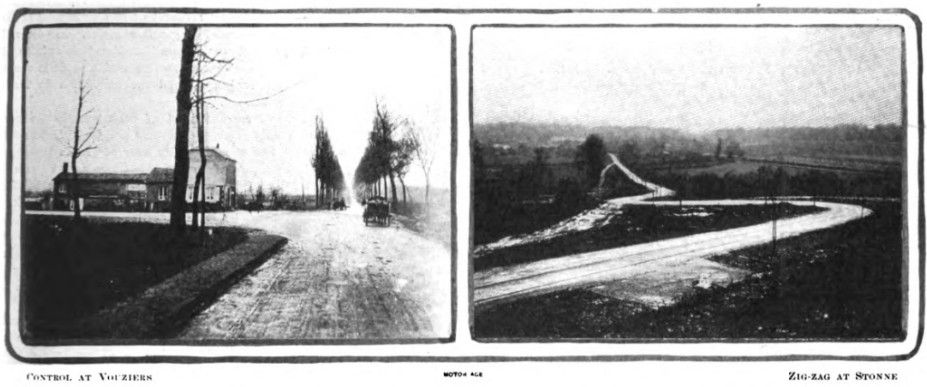
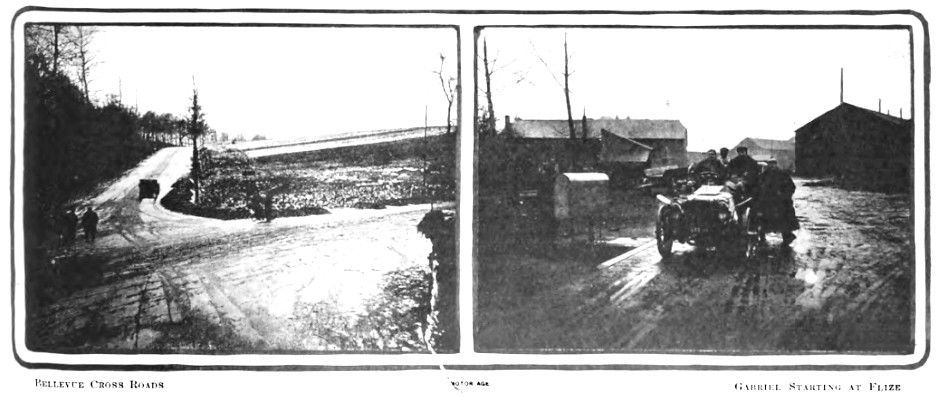
Page 7. TYPICAL STRETCHES OF THE ARDENNAS CIRCUIT, OVER WHICH THE FRENCH TRIAL RACE WAS RUN
MOTOR AGE VOL. V. NO. 11. MARCH 17, 1904.
FRENCH MOTORISTS WIN – After Thorough Discussion Parliament Permits Eliminating Race To Be Held on French Ardennes Course and Instructs Ministry To Issue Permit – Big Tour From Paris to Homburg
Not since the French ministry and the chamber decided last May that no more automobile races were to be run in France has there been such excitement in the French automobile world as there was the last day of February. On that day a delegation consisting of Marquis de Dion, Count R. de Vogue, Abel Ballif, and the senators and deputies from Ardennes county visited Prime Minister Combes for the purpose of obtaining his permission to have the French elimination race held over the Ardennes circuit. After several of the distinguished members of the delegation had made addresses in favor of the race and pointed out that it was not only necessary to insure the success of the event in Germany, and after Marquis de Dion had explained that all the manufacturers interested would much rather have the event run on French territory than on foreign, the premier replied that only a vote of parliament would enable him to change his position concerning racing.
A hurried conference took place and for several hours the telephone played an important part in a call for a meeting of representatives of ten of the leading manufacturers for the next day at 11 o’clock.
On the appointed hour there were probably more prominent members of the automobile world gathered than ever before. Emil Mors, for the Mors company; Baron de Turckheim, for the de Dietrich company and also for the Turcat-Mery company; A. Clement, for the Clement-Bayard company; M. Darracq, for the Darracq company; M. Serpollet, for the Gardner-Serpollet company; J. Cuenod, for the Hotchkiss company; M. Brasier, for the Richard-Brasier company, and M. Gobron, for the Gobron-Brillie company answered the call. Many other members of different trade associations, clubs, and the press were on hand.
The majority of those present were of the opinion that it would be unwise to take the matter to parliament. The minority, headed by Marquis de Dion, claimed it was the only step to take, and the marquis finally converted most of those interested to his views. While a hurried conference of the automobile club’s committee took place, a delegation consisting of Darracq, Gobron and de Turckheim was received. The sports committee was urged to have the elimination race held over the roads of the Belgian Ardennes circuit. A long debate took place, during which word was received from Marquis de Dion that he was in parliament talking matters over with the different leaders.
About 5 o’clock de Dion ran into the conference room. „We win the day,“ he exelaimed. „The right and the left unite on the question; the center is entirely in accord with our views, while the socialists are our strongest supporters. The battle is won.“
At 7 o’clock the president of the chamber announced that he had received the following resolution from Deputy A. Poulain: „The chamber, considering that the French automobile industry is placed in the necessity of choosing a circuit for its annual events, considering that the running of these events in foreign countries would be a severe blow to French interests, considering on the other hand that the circuit chosen by the interested parties in the Ardennes department offers all the conditions of security and guarantee as to the roads and the population, the chamber invites the government to give the permission for holding the circuit des Ardennes race.“
Prime Minister Combes then said: „I make no opposition concerning this resolution, but I would like the chamber to express its intention, so that I may be relieved of responsibility. If the motion prevails, I will take every imaginable precaution. After the Paris-Madrid race, I made up my mind that I would not allow races without the chamber’s authority.“
Marquis de Dion said: „The event is not arranged for the amusement of the public; it is a matter concerning the automobile industry and the 200,000 workingmen whose living depends upon it. It would be disastrous to have this race run in foreign lands, as it would surely result in the public losing interest in the industry, which must be avoided at all cost.“ There were a few more speakers and then the resolution was carried.
It was the most complete victory automobiling ever won in any parliament, for all of the 500 or more members present, with a single exception, voted in favor of the resolution.
The Ardennes meeting has been set for May 20. The weighing of the cars will take place on the preceding day and on account of the great number of competitors, they will be started according to the numbers they draw. The Automobile Club of France has arranged a tour to Homburg and return to Paris for the international event. It will last 15 days and is reserved to cars driven or accompanied by a member either of the Automobile Club of France or of the German Automobile Club. The itinerary of the excursion is the following: Start, June 13, Paris to Rheims; June 14, Rheims to Treves, Germany, June 15, Treves to Homburg; June 16, witness weighing of the racing machines for the race. Those who do not wish to witness this feature will make an excursion to Heidelberg, Weisbaden or Darmstadt; June 17, Gordon Bennett race; June 18, excursion over the course of the race and dinner at Homburg; June 19, race and test meeting at Frankfort; June 20, elegance competition; June 21, Homburg to Nuremberg; June 22, stop in Nuremberg; June 23, Nuremberg to Stuttgart; June 24, Stuttgart to Baden; June 25, Baden to Tri- berg; June 26, Triberg to Freiburg; June 27, Freiburg to Nancy, France; June 28, Nancy to Paris.
The expenses for one person for the tour from Paris to Homburg, including stop-over in the latter town, will be as follows: Room with one bed, storage of car and transportation of baggage, $146; same service but with- out storage, $134; room with one bed, not including storage or baggage service, $125; expenses for the complete tour, which means the trip both ways, will cost $187 for a room with one bed, storage and baggage service; without the storage service, room with one bed, $171; without either storage or baggage service, $159; expenses for a mechanic, who will attend to the cars of three automobilists, $25 for the trip to Homburg and $39 for the complete excursion.
The Manx legislature passed a bill on March 15 permitting the English eliminating trials for the Gordon Bennett cup race to be held on the Isle of Man.
MOTOR AGE VOL. V. NO. 5. FEBRUARY 4, 1904.
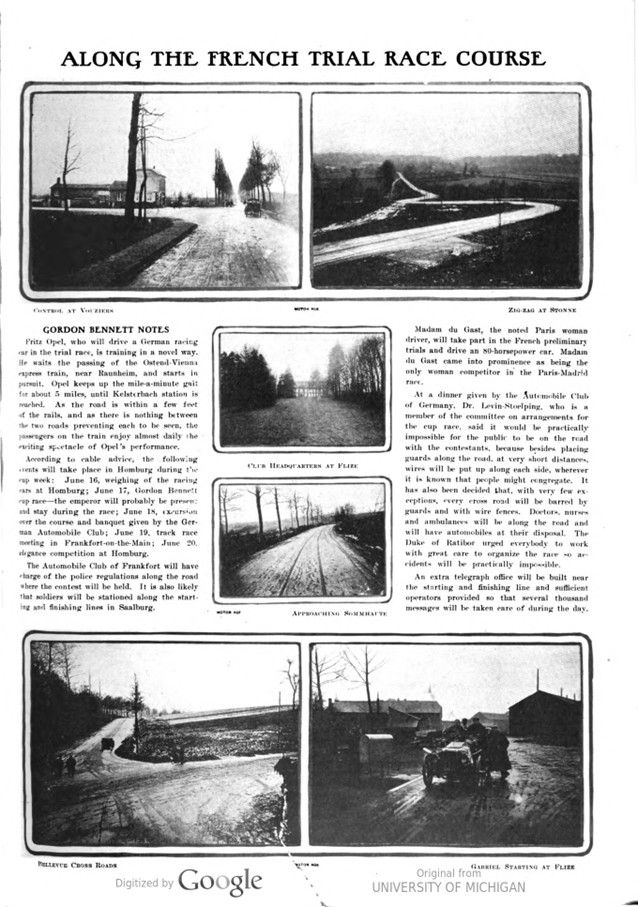
ALONG THE FRENCH TRIAL RACE COURSE
GORDON BENNETT NOTES
Fritz Opel, who will drive a German racing car in the trial race, is training in a novel way. He waits the passing of the Ostend-Vienna express train, near Raunheim, and starts in pursuit. Opel keeps up the mile-a-minute gait for about 5 miles, until Kelsterbach station is reached. As the road is within a few feet of the rails, and as there is nothing between the two roads preventing each to be seen, the passengers on the train enjoy almost daily the exciting spectacle of Opel’s performance.
According to cable advice, the following vents will take place in Homburg during the cup week: June 16, weighing of the racing cars at Homburg; June 17, Gordon Bennett cup race – the emperor will probably be present and stay during the race; June 18, excursion over the course and banquet given by the Ger- man Automobile Club; June 19, track race meeting in Frankfort-on-the-Main; June 20. elegance competition at Homburg.
The Automobile Club of Frankfort will have charge of the police regulations along the road where the contest will be held. It is also likely that soldiers will be stationed along the starting and finishing lines in Saalburg.
Madam du Gast, the noted Paris woman driver, will take part in the French preliminary trials and drive an 80-horsepower car. Madam du Gast came into prominence as being the only woman competitor in the Paris-Madrid race.
At a dinner given by the Automobile Club of Germany, Dr. Levin-Stoelping, who is a member of the committee on arrangements for the cup race, said it would be practically impossible for the public to be on the road with the contestants, because besides placing guards along the road, at very short distances, wires will be put up along each side, wherever it is known that people might congregate. It has also been decided that, with very few exceptions, every cross road will be barred by guards and with wire fences. Doctors, nurses and ambulances will be along the road and will have automobiles at their disposal. The Duke of Ratibor urged everybody to work with great care to organize the race so accidents will be practically impossible.
An extra telegraph office will be built near the starting and finishing line and sufficient operators provided so that several thousand messages will be taken care of during the day.
Photos.
CONTROL AT VOUZIERS – ZIG-ZAG AT STONNE
CLUB HEADQUARTERS AT FLIZE – APPROACHING SOММНАUТЕ
BELLEVUE CROSS ROADS – GABRIEL STARTING AT FLIZE