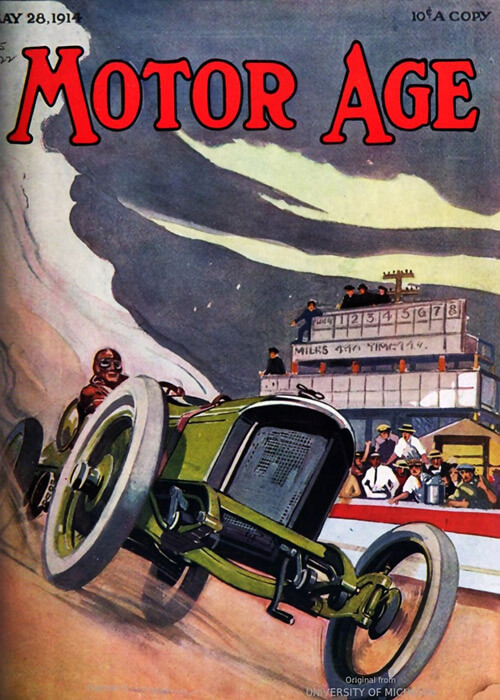
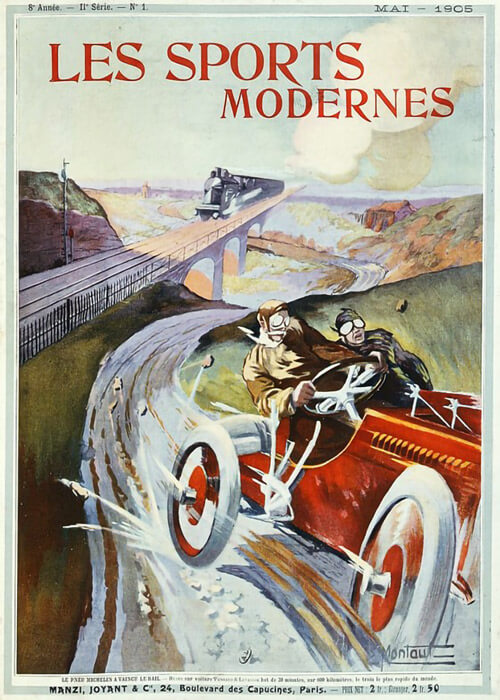
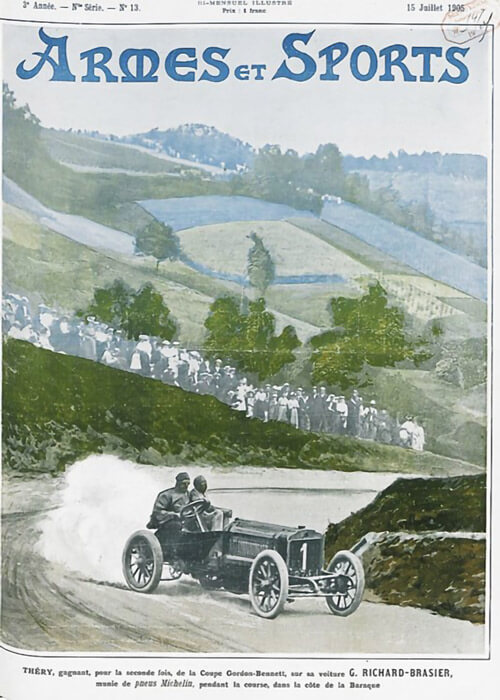
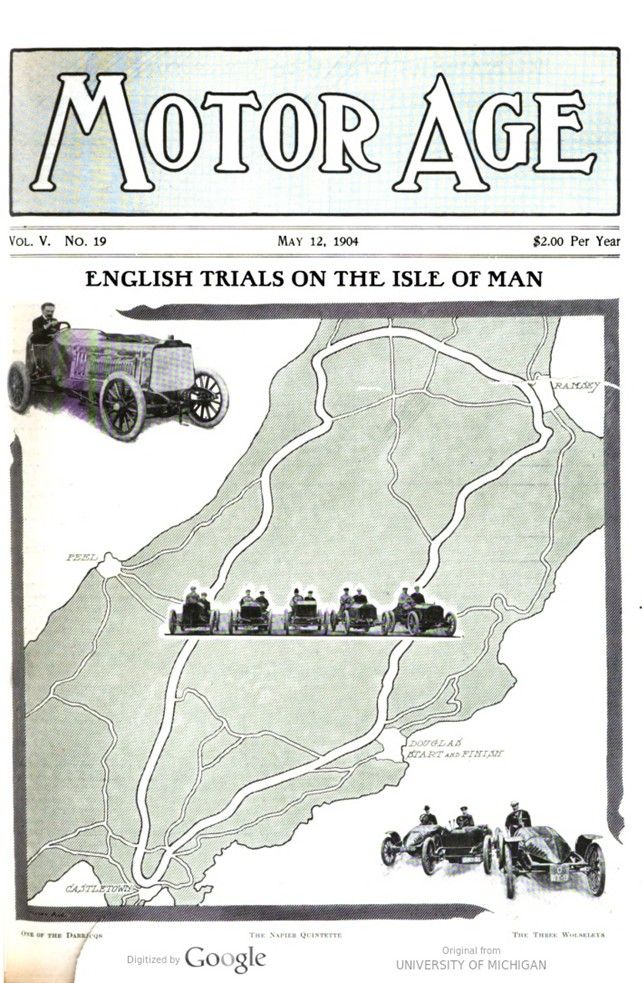
In these May 12 and May 19 issues of Motor Age“ , the English Elimination Trials are covered. A description of the course itself and of the eleven cars that entered the trials; the Napiers, Wolseleys and the Darracqs. Finally Selwyn Francis Edge in a Napier; Sidney Girling and Charles Jarrott each in a Wolseley were selected for the Cup race.
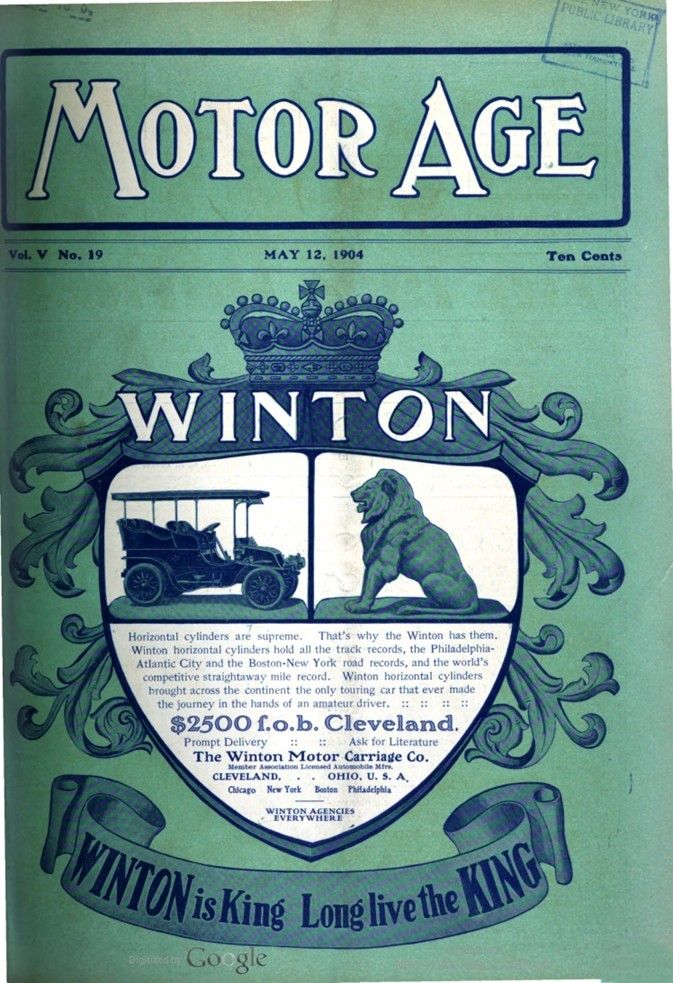
Text and photos with courtesy of hathitrust hathitrust.org, compiled by motorracingistory.com.
MOTOR AGE VOL. V. NO. 19. MAY 12, 1904.
ENGLISH TRIALS ON THE ISLE OF MAN
NAPIERS BEST THE FIRST FIRST DAY
LONDON, May 10 – Cablegram – The British eliminating trials, begun today on the Isle of Man, resulted in one Napier, one Wolseley and all three Darracqs being declared out, while four Napiers and two Wolseleys made clean enough records to keep them in the trial events.
The weather condition was most favorable arche roads, after who work, were in There were excellent shape for top speed. big crowds at the trials, all hostelries being crowded. The course for the 48½ miles was well patrolled and the arrangements at the start were all that could be desired.
The line-up for the start was as follows: J. W. Stocks, Napier; John Hargreaves, Na- pier; W. Clifford Earp, Napier; E. Campbell Muir, Wolseley; S. F. Edge, Napier; Sidney Girling, Wolseley; Charles Jarratt, Wolseley; M. Homery, Darracq; M. Edmond, Darracq; Mark Mahew, Napier; C. Rawlinson, Darracq.
The work laid out for today was to run the cars 8 hours over the 48-mile course, going five rounds. Edge and Jarratt covered the first round in 1 hour 17 minutes, keeping close together all the way and making all controls according to the rules. Haargreaves, Girling and Earp followed in a bunch 3 minutes later. Stocks‘ time was 1 hour 22 minutes, and Homery came in 7 minutes later. Both Muir and Girling suffered punctures, but the latter made a quick repair and lost little time.
The five Napiers and two Wolseley cars, Jarrott and Girling, survived the second round. In the third round Edge gained 24 minutes on Stocks, with the others but a few minutes back.
At the end of the fourth circuit, Edge was leading Stocks, his time being 5 hours 59 minutes, and Stocks‘ 6 hours 4 minutes, so that Stocks covered this lap considerably faster than Edge, having made up all but 5 minutes of his previously lost time.
In the fifth and last lap Stocks‘ machine sprung a leak in a radiator tube, Edge lost considerable time through a puncture, Girling had to go along with only three cylinders working, and Earp, going well, made substantial gains.
The fifth and last round was finished by Earp, Stocks and Edge in a bunch in the order named in 7 hours 53 minutes, Edge’s puncture and Stocks‘ leaky tube having permitted Earp to get to the front. Jarrott finished in 7 hours 5 minutes, and Girling in 7 hours 59 minutes.
Tomorrow the hill-climbing tests will take place at Ramsey, where the road rises on the average over 200 feet per mile for 6 miles. This road is up a veritable mountain side and will thoroughly test any car’s ability.
Thursday the speed trials take place over the Douglas promenades, which are some 2 miles in length, giving opportunity to run a car at top speed for a full mile.
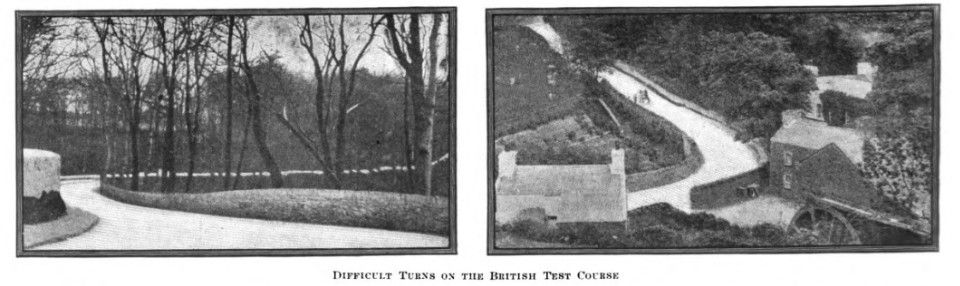
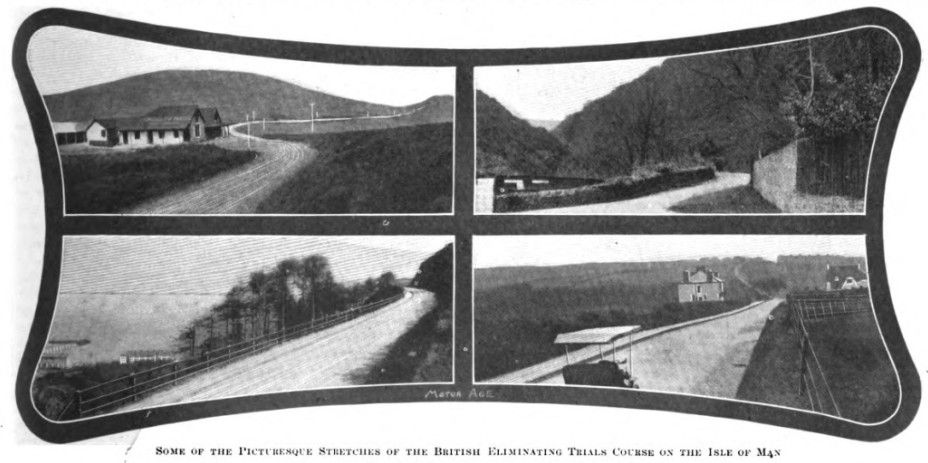
ISLE OF MAN COURSE
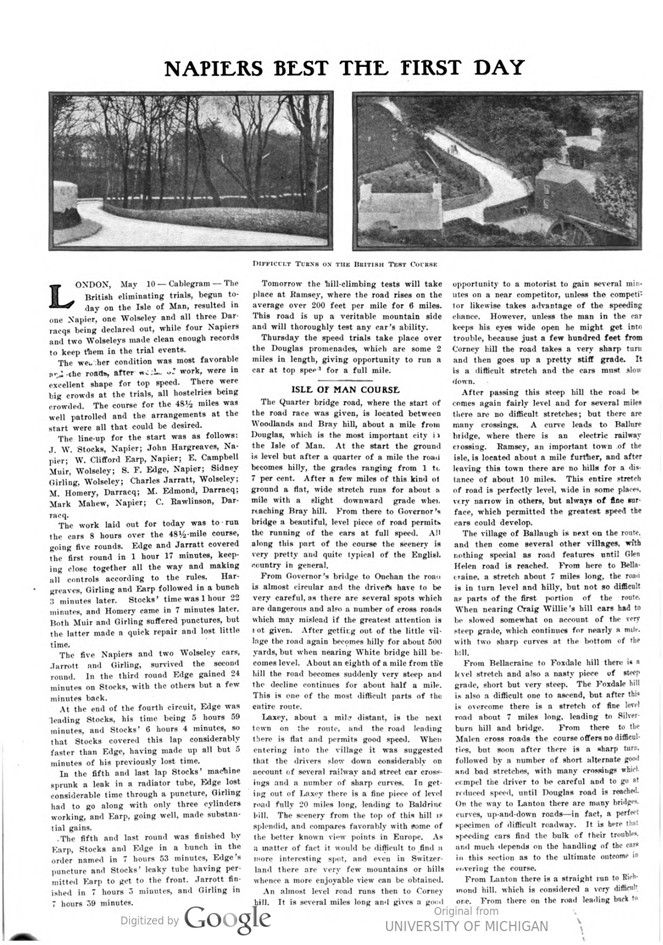
The Quarter bridge road, where the start of the road race was given, is located between Woodlands and Bray hill, about a mile from Douglas, which is the most important city in the Isle of Man. At the start the ground is level but after a quarter of a mile the road becomes hilly, the grades ranging from 1 to 7 per cent. After a few miles of this kind of ground a flat, wide stretch runs for about a mile with a slight downward grade when reaching Bray hill.
From there to Governor’s bridge a beautiful, level piece of road permits the running of the cars at full speed. along this part of the course the scenery is very pretty and quite typical of the English. country in general. All From Governor’s bridge to Onchan the road is almost circular, and the drivers have to be very careful, as there are several spots which are dangerous and also a number of cross roads which may mislead if the greatest attention is rot given. After getting out of the little village the road again becomes hilly for about 500 yards, but when nearing White bridge hill becomes level. About an eighth of a mile from the hill the road becomes suddenly very steep, and the decline continues for about half a mile. This is one of the most difficult parts of the entire route.
Laxey, about a mile distant, is the next town on the route, and the road leading there is flat and permits good speed. When entering into the village it was suggested that the drivers slow down considerably on account of several railway and streetcar crossings and a number of sharp curves. In getting out of Laxey there is a fine piece of level road fully 20 miles long, leading to Baldrine bill. The scenery from the top of this hill is splendid, and compares favorably with some of the better known view points in Europe. As a matter of fact it would be difficult to find a more interesting spot, and even in Switzerland there are very few mountains or hills whence a more enjoyable view can be obtained.
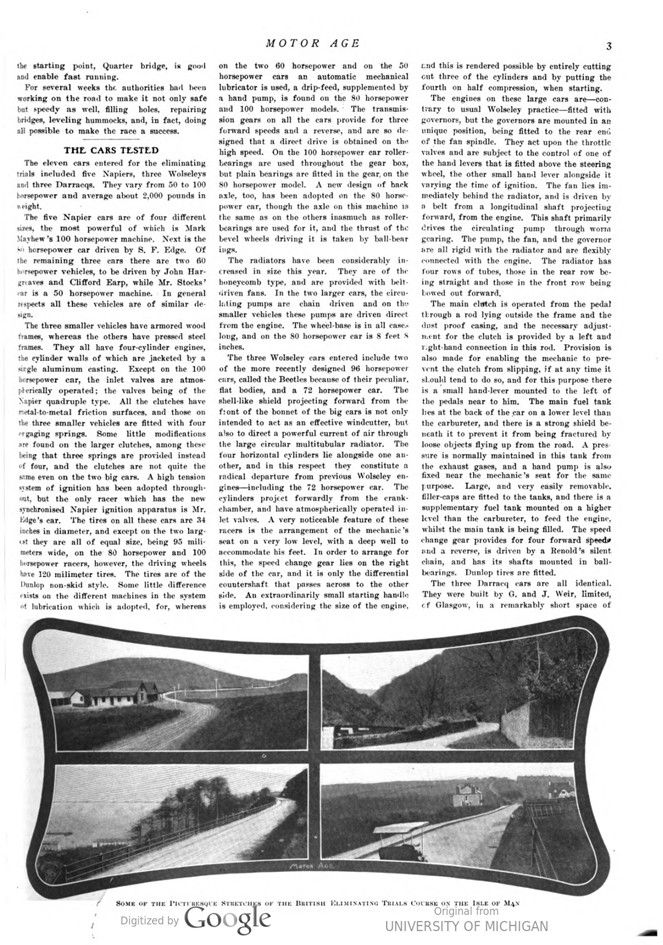
An almost level road runs then to Corney hill. It is several miles long and gives a good opportunity to a motorist to gain several minutes on a near competitor, unless the competitor likewise takes advantage of the speeding chance. However, unless the man in the car keeps his eyes wide open, he might get into trouble, because just a few hundred feet from Corney hill the road takes a very sharp turn and then goes up a pretty stiff grade. It is a difficult stretch and the cars must slow down.
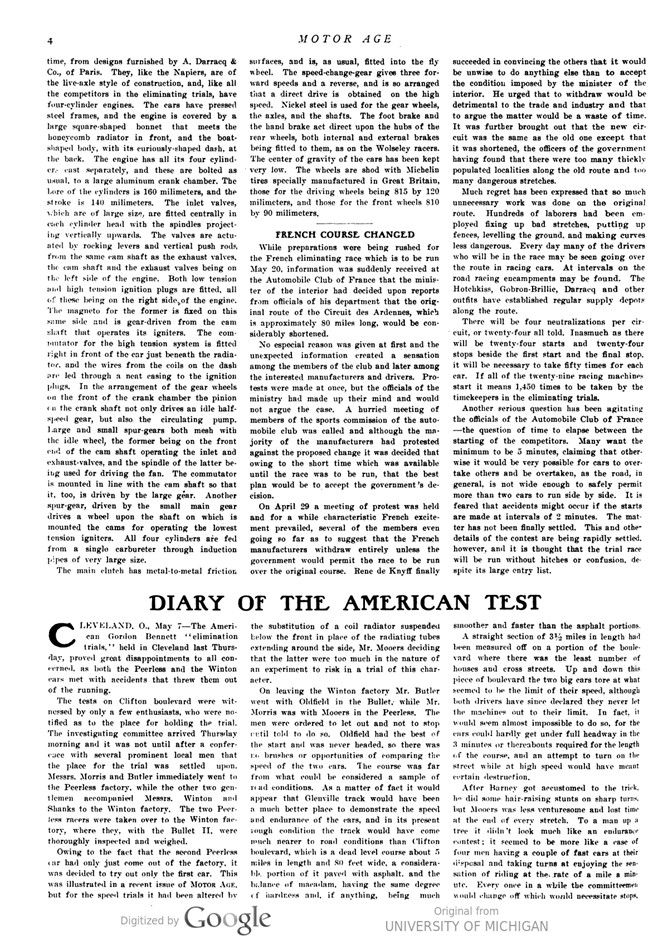
After passing this steep hill the road becomes again fairly level and for several miles there are no difficult stretches; but there are many crossings. A curve leads to Ballure bridge, where there is electric railway crossing. Ramsey, an important town of the isle, is located about a mile further, and after leaving this town there are no hills for a distance of about 10 miles. This entire stretch of road is perfectly level, wide in some places, very narrow in others, but always of fine surface, which permitted the greatest speed the cars could develop.
The village of Ballaugh is next on the route, and then come several other villages, with nothing special as road features until Glen Helen Road is reached. From here to Bellacraine, a stretch about 7 miles long, the road is in turn level and hilly, but not so difficult as parts of the first portion of the route. When nearing Craig Willie’s hill cars had to be slowed somewhat on account of the very steep grade, which continues for nearly a mile. with two sharp curves at the bottom of the hill.
From Bellacraine to Foxdale hill there is a level stretch and also a nasty piece of steep grade, short but very steep. The Foxdale hill is also a difficult one to ascend, but after this is overcome there is a stretch of fine level road about 7 miles long, leading to Silverburn hill and bridge. From there to the Malen cross roads the course offers no difficulties, but soon after there is a sharp turn. followed by a number of short alternate good and bad stretches, with many crossings which compel the driver to be careful and to go at reduced speed, until Douglas road is reached. On the way to Lanton there are many bridges. curves, up-and-down roads – in fact, a perfect specimen of difficult roadway. It is here that speeding cars find the bulk of their troubles. and much depends on the handling of the cars in this section as to the ultimate outcome in covering the course.
From Lanton there is a straight run to Richmond hill, which is considered a very difficult From there on the road leading back to the starting point, Quarter bridge, is good and enable fast running. For several weeks the authorities had been working on the road to make it not only safe but speedy as well, filling holes, repairing bridges, leveling hummocks, and, in fact, doing all possible to make the race a success.
THE CARS TESTED
The eleven cars entered for the eliminating trials included five Napiers, three Wolseleys and three Darracqs. They vary from 50 to 100 horsepower and average about 2,000 pounds in weight.
The five Napier cars are of four different sizes, the most powerful of which is Mark Mayhew’s 100 horsepower machine. Next is the 80 horsepower car driven by S. F. Edge. Of the remaining three cars there are two 60 horsepower vehicles, to be driven by John Hargreaves and Clifford Earp, while Mr. Stocks‘ car is a 50 horsepower machine. In general respects all these vehicles are of similar design.
The three smaller vehicles have armored wood frames, whereas the others have pressed steel frames. They all have four-cylinder engines, the cylinder walls of which are jacketed by a single aluminum casting. Except on the 100 horsepower car, the inlet valves are atmospherically operated; the valves being of the Napier quadruple type. All the clutches have metal-to-metal friction surfaces, and those on the three smaller vehicles are fitted with four engaging springs. Some little modifications are found on the larger clutches, among these being that three springs are provided instead of four, and the clutches are not quite the same even on the two big cars. A high-tension system of ignition has been adopted throughout, but the only racer which has the new synchronised Napier ignition apparatus is Mr. Edge’s car. The tires on all these cars are 34 inches in diameter, and except on the two largest they are all of equal size, being 95 millimeters wide, on the 80 horsepower and 100 horsepower racers, however, the driving wheels have 120 millimeter tires. The tires are of the Dunlop non-skid style. Some little difference exists on the different machines in the system of lubrication which is adopted, for, whereas on the two 60 horsepower and on the 50 horsepower cars an automatic mechanical lubricator is used, a drip-feed, supplemented by a hand pump, is found on the 80 horsepower and 100 horsepower models. The transmission gears on all the cars provide for three forward speeds and a reverse, and are so designed that a direct drive is obtained on the high speed. On the 100 horsepower car roller-bearings are used throughout the gear box, but plain bearings are fitted in the gear, on the 80 horsepower model. A new design of back axle, too, has been adopted on the 80 horsepower car, though the axle on this machine is the same as on the others inasmuch as roller-bearings are used for it, and the thrust of the bevel wheels driving it is taken by ball-bearings.
The radiators have been considerably increased in size this year. They are of the honeycomb type and are provided with belt- driven fans. In the two larger cars, the circulating pumps are chain driven and on the smaller vehicles these pumps are driven direct from the engine. The wheelbase is in all cases long, and on the 80 horsepower car is 8 feet 8 inches.
The three Wolseley cars entered include two of the more recently designed 96 horsepower cars, called the Beetles because of their peculiar, flat bodies, and a 72 horsepower car. The shell-like shield projecting forward from the front of the bonnet of the big cars is not only intended to act as an effective wind cutter, but also to direct a powerful current of air through the large circular multi-tubular radiator. The four horizontal cylinders lie alongside one another, and in this respect, they constitute a radical departure from previous Wolseley engines including the 72 horsepower car. The cylinders project forwardly from the crank-chamber, and have atmospherically operated inlet valves. A very noticeable feature of these racers is the arrangement of the mechanic’s seat on a very low level, with a deep well to accommodate his feet. In order to arrange for this, the speed change gear lies on the right side of the car, and it is only the differential countershaft that passes across to the other side. An extraordinarily small starting handle is employed, considering the size of the engine, and this is rendered possible by entirely cutting cut three of the cylinders and by putting the fourth on half compression, when starting.
The engines on these large cars are – contrary to usual Wolseley practice – fitted with governors, but the governors are mounted in an unique position, being fitted to the rear end of the fan spindle. They act upon the throttle valves and are subject to the control of one of the hand levers that is fitted above the steering wheel, the other small hand lever alongside it varying the time of ignition. The fan lies immediately behind the radiator, and is driven by a belt from a longitudinal shaft projecting forward, from the engine. This shaft primarily drives the circulating pump through worm gearing. The pump, the fan, and the governor are all rigid with the radiator and are flexibly connected with the engine. The radiator has four rows of tubes, those in the rear row being straight and those in the front row being bowed out forward.
The main clutch is operated from the pedal through a rod lying outside the frame and the dust proof casing, and the necessary adjustment for the clutch is provided by a left and right-hand connection in this rod. Provision is also made for enabling the mechanic to prevent the clutch from slipping, if at any time it should tend to do so, and for this purpose there is a small hand-lever mounted to the left of the pedals near to him. The main fuel tank lies at the back of the car on a lower level than the carbureter, and there is a strong shield beneath it to prevent it from being fractured by loose objects flying up from the road. A pressure is normally maintained in this tank from the exhaust gases, and a hand pump is also fixed near the mechanic’s seat for the same purpose. Large, and very easily removable, filler-caps are fitted to the tanks, and there is a supplementary fuel tank mounted on a higher level than the carbureter, to feed the engine, whilst the main tank is being filled. The speed change gear provides for four forward speeds and a reverse, is driven by a Renold’s silent chain, and has its shafts mounted in ball- bearings. Dunlop tires are fitted.
The three Darracq cars are all identical. They were built by G. and J. Weir, limited, of Glasgow, in a remarkably short space of time, from designs furnished by A. Darracq & Co., of Paris. They, like the Napiers, are of the live-axle style of construction, and, like all the competitors in the eliminating trials, have four-cylinder engines. The cars have pressed steel frames, and the engine is covered by a large square-shaped bonnet that meets the honeycomb radiator in front, and the boat-shaped body, with its curiously-shaped dash, at the back. The engine has all its four cylinders cast separately, and these are bolted as usual, to a large aluminum crank chamber. The Lore of the cylinders is 160 millimeters, and the stroke is 140 millimeters. The inlet valves, which are of large size, are fitted centrally in each cylinder head with the spindles projecting vertically upwards. The valves are actuated by rocking levers and vertical push rods, from the same cam shaft as the exhaust valves, the cam shaft and the exhaust valves being on the left side of the engine. Both low tension and high tension ignition plugs are fitted, all of these being on the right side of the engine. The magneto for the former is fixed on this same side and is gear-driven from the cam shaft that operates its igniters. The commutator for the high tension system is fitted right in front of the car just beneath the radiator, and the wires from the coils on the dash are led through a neat casing to the ignition plugs. In the arrangement of the gear wheels on the front of the crank chamber the pinion on the crank shaft not only drives an idle half-speed gear, but also the circulating pump. Large and small spur-gears both mesh with the idle wheel, the former being on the front end of the cam shaft operating the inlet and exhaust-valves, and the spindle of the latter being used for driving the fan. The commutator is mounted in line with the cam shaft so that it, too, is driven by the large gear. Another spur-gear, driven by the small main gear drives a wheel upon the shaft on which is mounted the cams for operating the lowest tension igniters. All four cylinders are fed from a single carbureter through induction pipes of very large size.
The main clutch has metal-to-metal friction surfaces, and is, as usual, fitted into the fly wheel. The speed-change-gear gives three forward speeds and a reverse, and is so arranged that a direct drive is obtained on the high speed. Nickel steel is used for the gear wheels, the axles, and the shafts. The foot brake and the hand brake act direct upon the hubs of the rear wheels, both internal and external brakes being fitted to them, as on the Wolseley racers. The center of gravity of the cars has been kept very low. The wheels are shod with Michelin tires specially manufactured in Great Britain, those for the driving wheels being 815 by 120 millimeters, and those for the front wheels 810 by 90 millimeters.
MOTOR AGE VOL. V. NO. 20. MAY 19, 1904.
BRITISH CARS SELECTED
S. F. Edge, Napier, and Sidney Girling and Charles Jarrott, Wolseley, Selected To Represent England in the International Cup Race-Story of Concluding Events of British Trials
London, England, May 13-One Napier car, driven by S. F. Edge, and two Wolseleys, driven respectively by Sidney Girling and Charles Jarrott, will constitute the British team in the James Gordon Bennett international cup race June 17. This was decided last evening by the race committee of the Automobile Club of Great Britain and Ireland, as a result of the 3 days‘ trial on the Isle of Man. As reserves will be two Napiers, manned by J. Hargreaves and J. W. Stocks.
The decision has not met with universal approval, however, as it is thought the Napier car driven by Earp should have been selected, inasmuch as it certainly made a better showing all around than one of the Wolseley machines which the committee decided should represent the country in the international event.
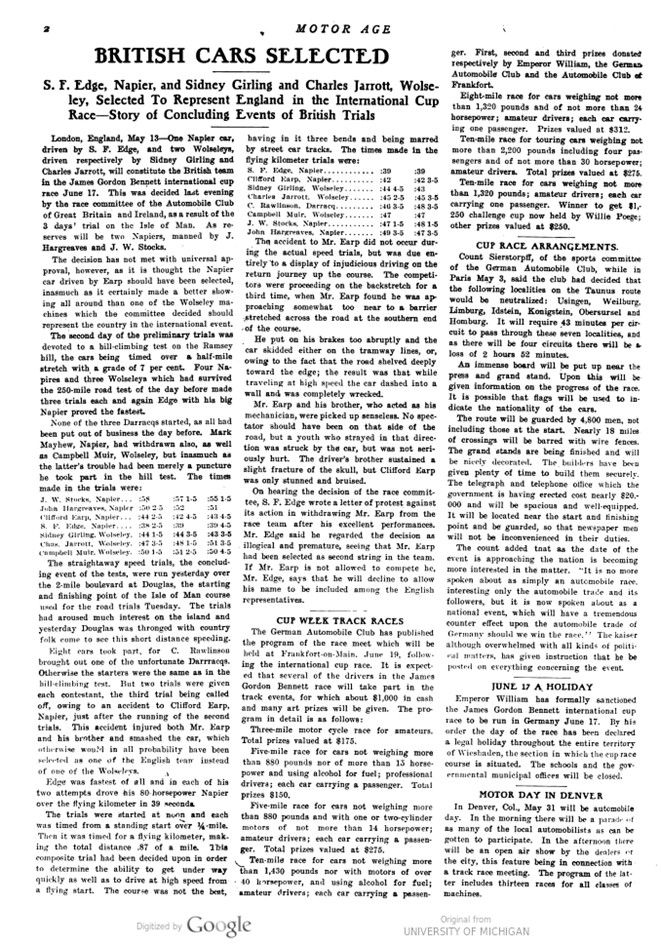
The second day of the preliminary trials was devoted to a hill-climbing test on the Ramsey hill, the cars being timed over a half-mile stretch with a grade of 7 per cent. Four Napiers and three Wolseleys which had survived the 250-mile road test of the day before made three trials each and again Edge with his big Napier proved the fastest.
None of the three Darracqs started, as all had been put out of business the day before. Mark Mayhew, Napier, had withdrawn also, as well as Campbell Muir, Wolseley, but inasmuch as the latter’s trouble had been merely a puncture, he took part in the hill test. The times made in the trials were:
J. W. Stocks, Napier… :58. :57 1-5 :55 1-5
John Hargreaves, Napier :50 2-5 :52 :51
Clifford Earp, Napier… :44 2-5 :42 4-5 :43 4-5
S. F. Edge, Napier… :38 2-5 :39 :39 4-5
Sidney Girling, Wolseley. :44 1-5 :44 3-5 :43 3-5
Chas. Jarrott, Wolseley. :47 3-5 :48 1-5 :51 3-5
Campbell Muir, Wolseley. :50 1-5 :51 2-5 :50 4-5
The straightaway speed trials, the concluding event of the tests, were run yesterday over the 2-mile boulevard at Douglas, the starting and finishing point of the Isle of Man course used for the road trials Tuesday. The trials had aroused much interest on the island and yesterday Douglas was thronged with country folk come to see this short distance speeding.
Eight cars took part, for C. Rawlinson brought out one of the unfortunate Darrracqs. Otherwise, the starters were the same as in the hill-climbing test. But two trials were given each contestant, the third trial being called off, owing to an accident to Clifford Earp, Napier, just after the running of the second trials. This accident injured both Mr. Earp and his brother and smashed the car, which otherwise would in all probability have been selected as one of the English team instead of one of the Wolseleys.
Edge was fastest of all and in each of his two attempts drove his 80-horsepower Napier over the flying kilometer in 39 seconds.
The trials were started at noon, and each was timed from a standing start over 4-mile. Then it was timed for a flying kilometer, making the total distance .87 of a mile. This composite trial had been decided upon in order to determine the ability to get under way quickly as well as to drive at high speed from a flying start. The course was not the best, having in it three bends and being marred by street car tracks. The times made in the flying kilometer trials were:
S. F. Edge, Napier… :39 :39
Clifford Earp, Napier… :42 :42 3-5
Sidney Girling, Wolseley. :44 4-5 :57 1-5
Charles Jarrott, Wolseley. :45 2-5 :43
C. Rawlinson, Darracq… :46 3-5 :48 3-5
Campbell Muir, Wolseley. :47 :47
J. W. Stocks, Napier… :47 1-5 :48 1-5
John Hargreaves, Napier. :49 3-5 :47 3-5
The accident to Mr. Earp did not occur during the actual speed trials, but was due entirely to a display of injudicious driving on the return journey up the course. The competitors were proceeding on the backstretch for a third time, when Mr. Earp found he was approaching somewhat too near to a barrier stretched across the road at the southern end of the course.
He put on his brakes too abruptly and the car skidded either on the tramway lines, or, owing to the fact that the road shelved deeply toward the edge; the result was that while traveling at high speed the car dashed into a wall and was completely wrecked.
Mr. Earp and his brother, who acted as his mechanician, were picked up senseless. No spectator should have been on that side of the road, but a youth who strayed in that direction was struck by the car, but was not seriously hurt. The driver’s brother sustained a slight fracture of the skull, but Clifford Earp was only stunned and bruised.
On hearing the decision of the race committee, S. F. Edge wrote a letter of protest against its action in withdrawing Mr. Earp from the race team after his excellent performances. Mr. Edge said he regarded the decision as illogical and premature, seeing that Mr. Earp had been selected as second string in the team. If Mr. Earp is not allowed to compete he, Mr. Edge, says that he will decline to allow his name to be included among the English representatives.