Text and jpegs by courtesy of hathitrust.org www.hathitrust.org, compiled by motorracinghistory.com
The Automobile, Vol. XXXIV (34), No. 12, March 23, 1916
Delage Cars Make Strong Team
Harry Harkness Has Newest European Racing Cars — Have Run Only One Race
Should Be in Perfect Condition For the Speedways
AS announced in THE AUTOMOBILE last week, the three Delage cars which took part in the last French grand prix are now in New York, and will make their appearance on the speedways very shortly. These cars have been imported by Harry Harkness, and will be managed by Carl Limberg, who will drive one of them. Drivers for the other two are not yet picked.
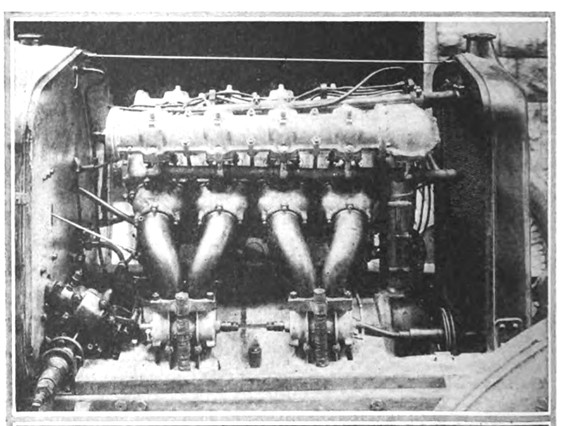
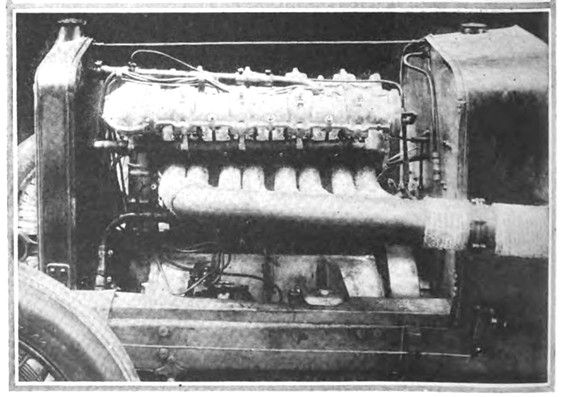
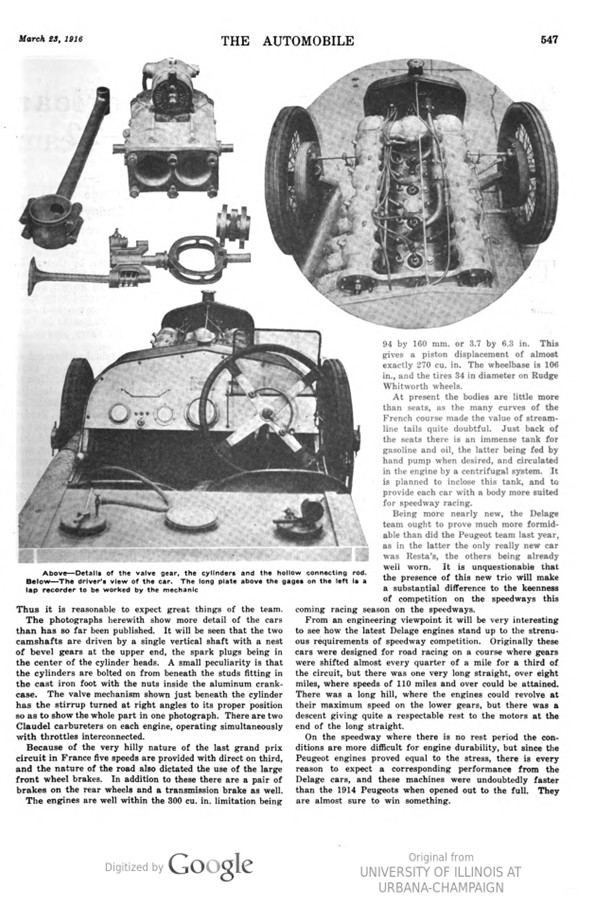
At the time of their first appearance, these cars were wrapped in much mystery, their details being kept very secret. Gradually it leaked out that their especial novelty was a set of sixteen poppet valves, each of which was both shut as well as opened by a cam, the spring forming only a cushion. Exactly how this was done has never been allowed to escape, though some diagrams were obtained showing the principle. One of these was published by THE AUTOMOBILE on July 9, 1914, and the photograph of the actual parts on the page opposite shows that the actual pieces are very much like the diagram. There are three cams to each pair of valves, the midmost lifts the valve by pushing down a stirrup that surrounds the cam, and the two outside cams bear upon the side pieces of the stirrup and pull the valves shut, acting through two springs.
In the practice spins before the race Bablot, who had one of the trio, astonished the fans by making a lap in minutes less than most of the others, and from that time onward the Delage team was reckoned to be about the fastest in the field. On the race day, however, some petty maladjustment of the carbureters made at the last moment upset all calculations, and the Delages did little to justify the high hopes of their backers.
Still everyone recognized that it was an accident, and that it was no fundamental fault that had caused the trouble. Since July 4, 1914, the speed machines have been resting under a coat of oil. They are essenially as good as the day they left the factory; they are more nearly new than any European car in America today. Thus it is reasonable to expect great things of the team.
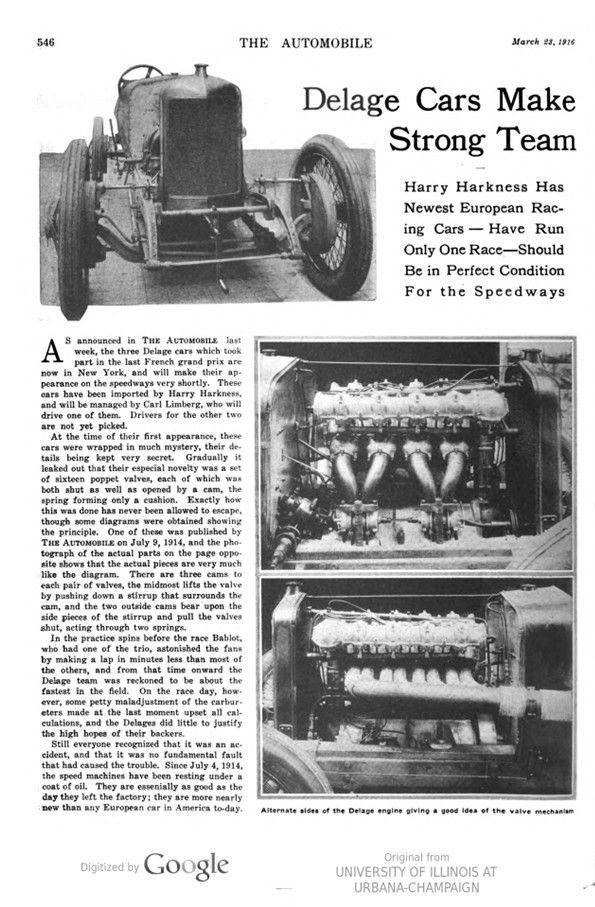
The photographs herewith show more detail of the cars than has so far been published. It will be seen that the two camshafts are driven by a single vertical shaft with a nest of bevel gears at the upper end, the spark plugs being in the center of the cylinder heads. A small peculiarity is that the cylinders are bolted on from beneath the studs fitting in the cast iron foot with the nuts inside the aluminum crankcase. The valve mechanism shown just beneath the cylinder has the stirrup turned at right angles to its proper position so as to show the whole part in one photograph. There are two Claudel carbureters on each engine, operating simultaneously with throttles interconnected.
Because of the very hilly nature of the last grand prix circuit in France five speeds are provided with direct on third, and the nature of the road also dictated the use of the large front wheel brakes. In addition to these there are a pair of brakes on the rear wheels and a transmission brake as well.
The engines are well within the 300 cu. in. limitation being 94 by 160 mm. or 3.7 by 6.3 in. This gives a piston displacement of almost exactly 270 cu. in. The wheelbase is 106 in., and the tires 34 in diameter on Rudge-Whitworth wheels.
At present the bodies are little more than seats, as the many curves of the French course made the value of streamline tails quite doubtful, Just back of the seats there is an immense tank for gasoline and oil, the latter being fed by hand pump when desired, and circulated in the engine by a centrifugal system. It is planned to inclose this tank, and to provide each car with a body more suited for speedway racing.
Being more nearly new, the Delage team ought to prove much more formidable than did the Peugeot team last year, as in the latter the only really new car was Resta’s, the others being already well worn. It is unquestionable that the presence of this new trio will make a substantial difference to the keenness of competition on the speedways this coming racing season on the speedways.
Photo captions.
Page 546.
Alternate sides of the Delage engine giving a good idea of the valve mechanism
Page 457.
Above – Details of the valve gear, the cylinders and the hollow connecting rod. Below – The driver’s view of the car. The long plate above the gages on the left is a lap recorder to be worked by the mechanic