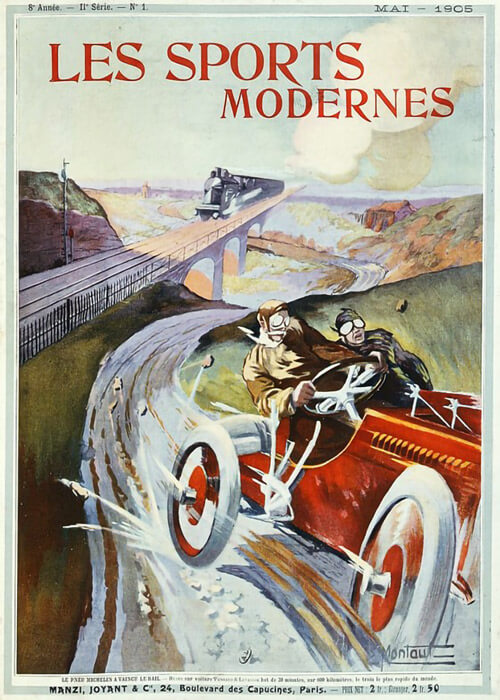
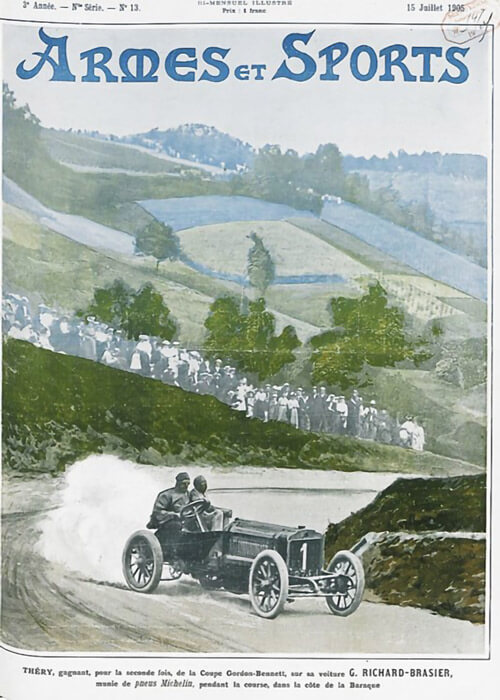
The magazine „L’Automobile, Revue des locomotions nouvelles“, mostly called „L’Automobile“ also published a whole serie of articles that accompanied the Gordon Bennet Cup for 1904. Meaning technical descriptions of participating cars, descriptions of some of the tracks for the eliminatory races, as well as reporting the actual Cup race itself. This one deals with the Gordon Bennet Cup Race on 17th June 1904
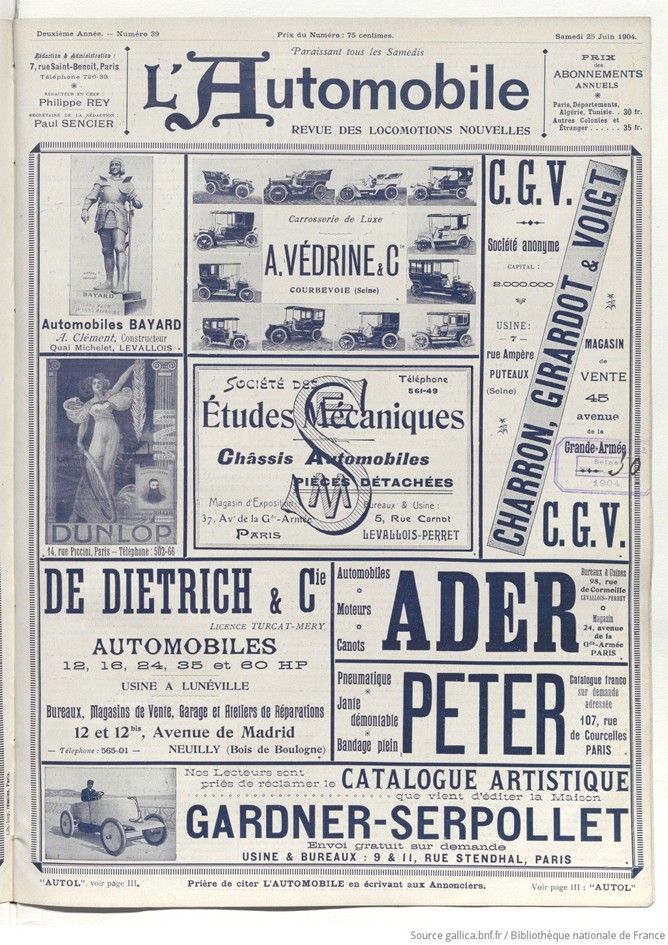
With courtesy of the Bibliothèque national francais – gallica.bnf.fr Text and photos compiled by motorracinghistory.com, translation by DeepL.com
L’AUTOMOBILE, Revue des locomotions nouvelles – Vol. 2, No. 39, June 25, 1904
Racing and Competitions. – The Gordon Bennett Cup in 1904, (June 17, 1904).
Victory for the French Industry
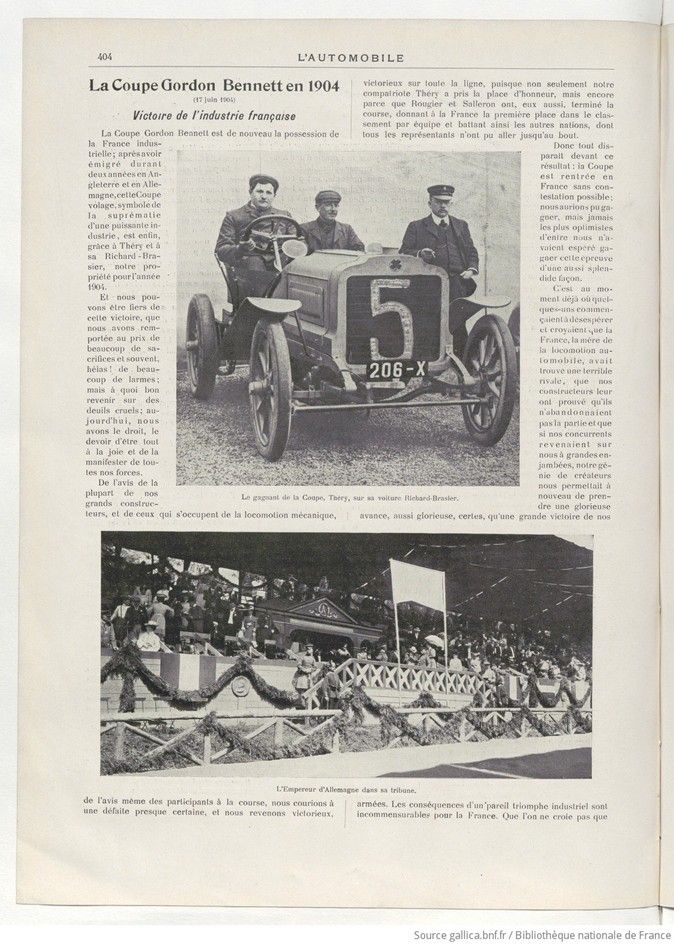
The Gordon Bennett Cup is once again in the hands of industrial France; after spending two years in England and Germany, this elusive Cup, a symbol of the supremacy of a powerful industry, is finally, thanks to Théry and his Richard-Brasier, ours for the year 1904.
And we can be proud of this victory, which we won at the cost of many sacrifices and, alas, often many tears; but what is the point of dwelling on cruel losses? Today, we have the right, the duty, to be filled with joy and to express it with all our might. In the opinion of most of our great builders, and of those involved in mechanical locomotion, and even in the opinion of the race participants, we were heading toward an almost certain defeat, and we return victorious, victorious across the board, since not only did our compatriot Thery take the top spot, but also because Rougier and Salleron, too, finished the race, giving France first place in the team standings and thus defeating the other nations, none of whose representatives were able to go the distance.
So everything pales in comparison to this result: the Cup has returned to France beyond any doubt; we could have won, but never had even the most optimistic among us hoped to win this event in such a splendid manner.
It was just when some were beginning to despair and believed that France, the mother of automobile transportation, had found a formidable rival, that our manufacturers proved to them they were not giving up the fight and that while our competitors were closing in on us with great strides, our creative genius would once again allow us to take a glorious lead, as glorious, indeed, as a great victory by our armies. The consequences of such an industrial triumph are immeasurable for France. Let no one believe that only those involved in the automobile industry will benefit, even though they form a sizeable force of over half a million people
All industries will also benefit greatly from this victory, for the French and foreigners who, having embraced this new mode of transportation, will purchase a motor car, travel across France, visit our beautiful country, and, by doing so, support the manufacturers, merchants, and farmers they encounter along the way. Having learned to love and know this country, to be enamored of our unique roads, they will remain attached to our land and understand that, just like the automobile, other French industries—whose products may be more expensive than elsewhere—are certainly far superior. The Frenchman, who undeniably possesses the genius for great discoveries, does not know how to take advantage of this unique gift; he creates and usually leaves it to his neighbors to perfect his discoveries, to refine them, and to distribute them—with huge profits—throughout the world.
Well then! Only automobile manufacturers have employed this method, which has been wonderfully successful for them, since we are at the forefront of this flourishing industry; that, in various sectors, our fellow citizens do not hesitate to promote their goods, to flood the markets with them, selling them at lower prices, and they will see that the public, which above all follows its own interest, will rush to our products, just as it rushes to the automobiles of our leading brands.
May the reader forgive me this digression, which I believe is useful, for there lies the festering wound that places our commerce and industry at a disadvantage compared to the English, the Americans, and the Germans.
Yes, certainly, the Gordon Bennett Cup represents a great and glorious battle for us, and as a German newspaper in Frankfurt-on-the-Main recently put it, this victory is, for the vanquished—for the Germans—an industrial Sedan.
Who knows which of the two Sedans is the more glorious for one people or the other? Moreover, nothing could better prove the vital importance of this event than the visit to Homburg by the German Emperor, Wilhelm II, who, that is certain, had come to watch the Cup with the firm conviction that German industry would be victorious.
And, all the more reason, he must have attached enormous importance to that victory to have gone to the trouble; he must have understood how great the future of this industry was, on which, for the moment, his people depend on us.
Even more conclusive proof for the naysayers who might respond that
William II attended the race as a sportsman, just as he would have attended the festivities in Kiel: as soon as the race ended, after warmly congratulating the winners, the emperor sent a congratulatory dispatch—which our readers will find below—to our President of the Republic, Mr. Loubet, who replied immediately.
There is no need to dwell on it; everyone understands the far-reaching significance of this political and courteous gesture.
Even the general public understood very well just how significant the role we played was.
I assure you that, last Friday, people in Paris paid very little attention to the Chartreux millions or the hearings of the Commission of Inquiry; the public was entirely focused on the big car race taking place over there in the Taunus, and all day long they waited with feverish impatience for the result.
On the boulevard, people greeted one another with nothing but this phrase: “And the Cup?
Do you have any news?“
At the end of the day, the special editions of our colleagues l’Auto and la Presse informed the public of the official results.
As soon as these were known, there was an outpouring of joy, the kind that only national events that stir the heart can provoke. It was truly very moving.
The next day, all the newspapers, regardless of their political leanings — even those that usually do not cover new forms of transportation — devoted two- and three-column front-page articles to the glory of French industry.
We must now credit this triumph not only to Théry, his marvelous Richard-Brasier wing, and the engineer who designed it, Mr. Brasier, but also to Rougier and his Turcat-Méry, Salleron and his Mors, Continental, Dunlop, Michelin, and the entire French automobile industry; all the engineers and all the workers who, through a joint effort, have worked tirelessly for its prosperity. We must also offer our unreserved congratulations to our great Automobile Club, which paved the way for this glorious victory by organizing the Circuit des Ardennes
Let us take this opportunity to note how different the outcome would have been had the Club stuck to its original plan of automatically selecting two Panhard cars to represent us in the Taunus.
That deplorable system had led us, last year, to a disaster—an honorable one, it is true; the result would have been the same this time if we had persisted on that false and unjust path.
Once again, our thanks to the Marquis de Dion, who, through his authority and independence, secured victory for the supporters of the qualifying rounds, and later—though he had no personal stake in the matter, since his cars were not entered—obtained from the Chamber, thanks to his status as a deputy, authorization to hold the qualifying rounds on the French Ardennes circuit. And now that we believe we have said what needed to be said, what was our duty to say, let us move on to the detailed report of the race for the Gordon Bennett Cup
What is the Gordon Bennett Cup, which was established in 1900 by Mr. James Gordon Bennett, the wealthy owner of the New-York Herald?
Nothing, really—just a mundane trophy consisting of a few 1,000-franc notes, which, at first, even in the mind of the generous donor, was not meant to be of paramount importance.
For two years, in 1900 and 1901, victory went uncontested to the French team, and it was precisely for this reason that the event interested no one.
In 1902, the Cup was contested during the Paris-Vienna race, on the Paris-Innsbruck route.
Finally, in 1903, the race took place in Ireland and was of great importance; we were defeated by Jenatzy in his Mercedes
We come to this year, when the Cup experienced an extraordinary slowdown.
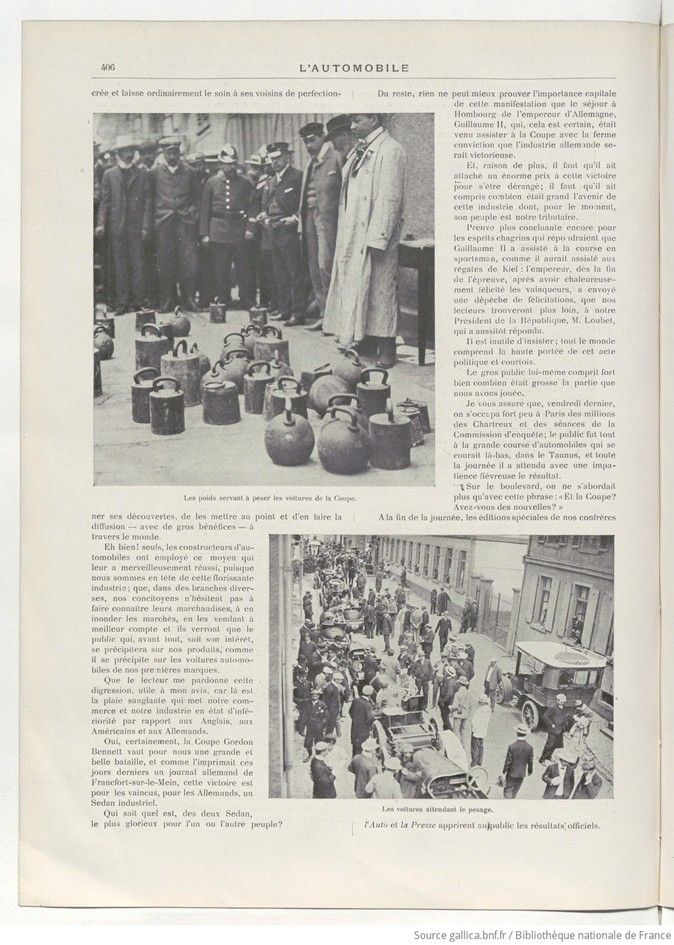
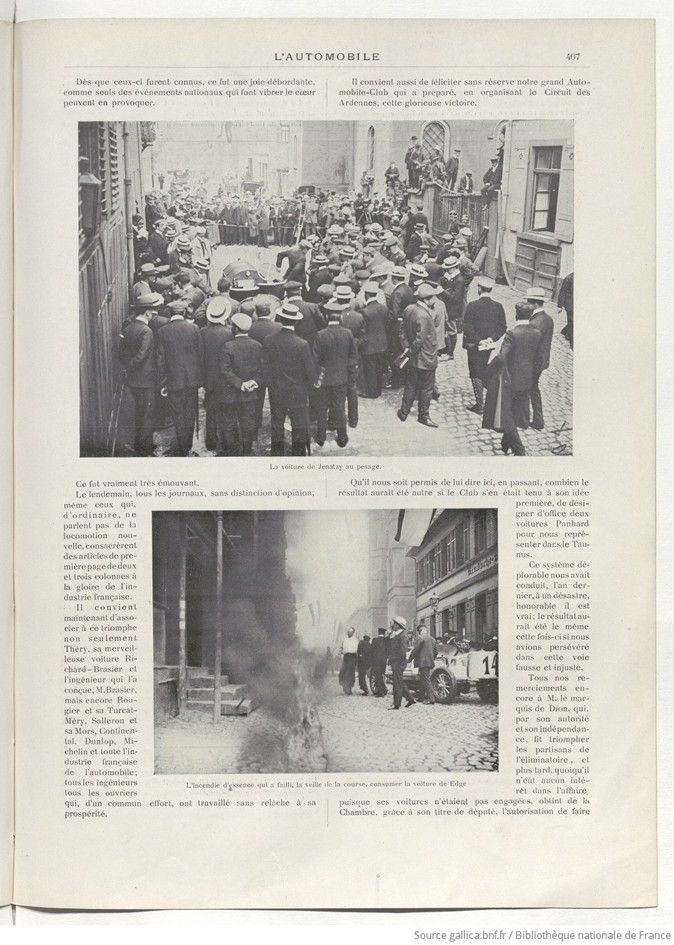
As early as Tuesday, June 14, a large number of drivers traveled to Homburg to attend the weighing of the wings, which took place on Thursday.
Not everything went off without a hitch, or even accidents.
First of all, there was great excitement when Edge’s car caught fire after a clumsy smoker tossed his cigarette into the gasoline.
Fortunately, the fire was extinguished before it could spread, and the car was not damaged.
Next, two complaints were filed by the president of the French Sports Commission, Mr. René de Knyff, against the Austrian Mercedes cars, which had arrived at the weigh-in without a seat for the mechanic and were equipped with the same pressure gauge as the German Mercedes cars.
Seats were added, the pressure gauges were removed, and everything went smoothly.
At the weigh-in, the crowd was enormous; in short, all the cars were weighed, except for Dufaux’s, which was to represent Switzerland and which unfortunately had a broken steering mechanism.
During that pre-race gathering, over a thousand cars completed the grueling race course in every direction; the Emperor himself also completed it in a car, amid general enthusiasm.
The weather had cleared up, the roads were dry, preparations were complete; all that remained was to wait for sunrise to give the start. It was given, at the following times, to the following eighteen cars: (see the table here left).
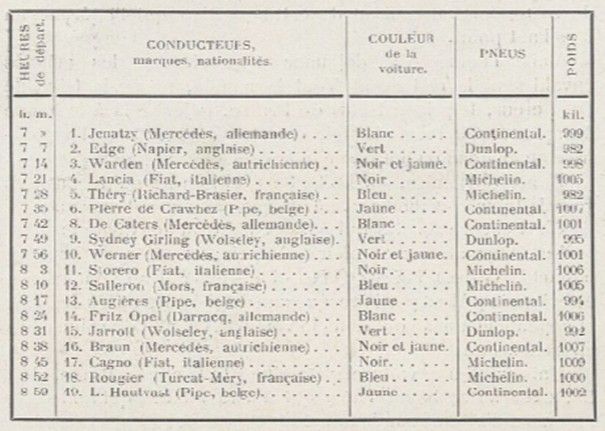
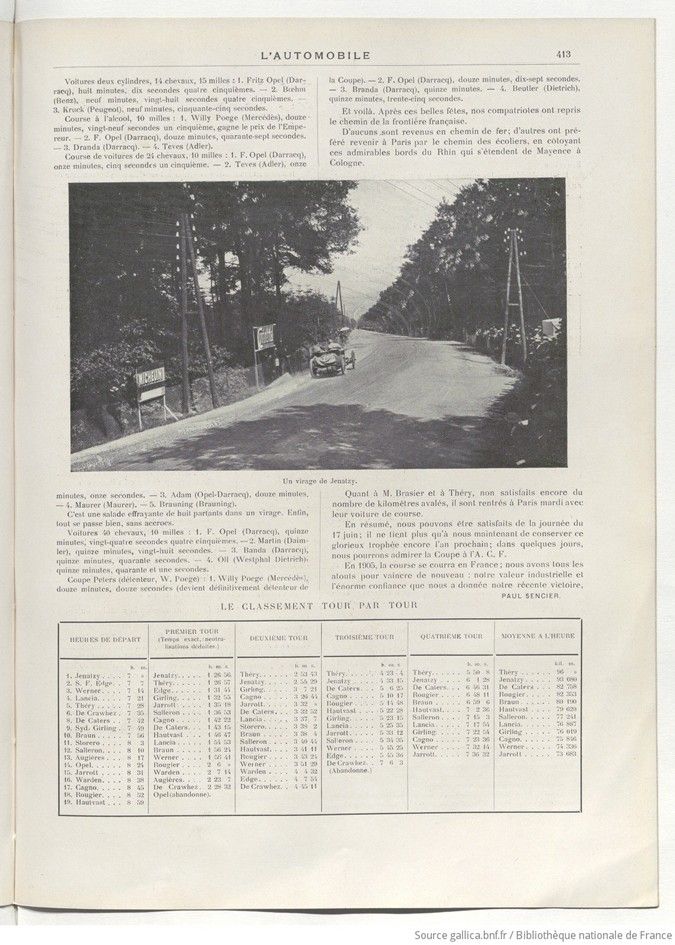
At last, the big day has arrived—the day that allowed France to reclaim the Cup.
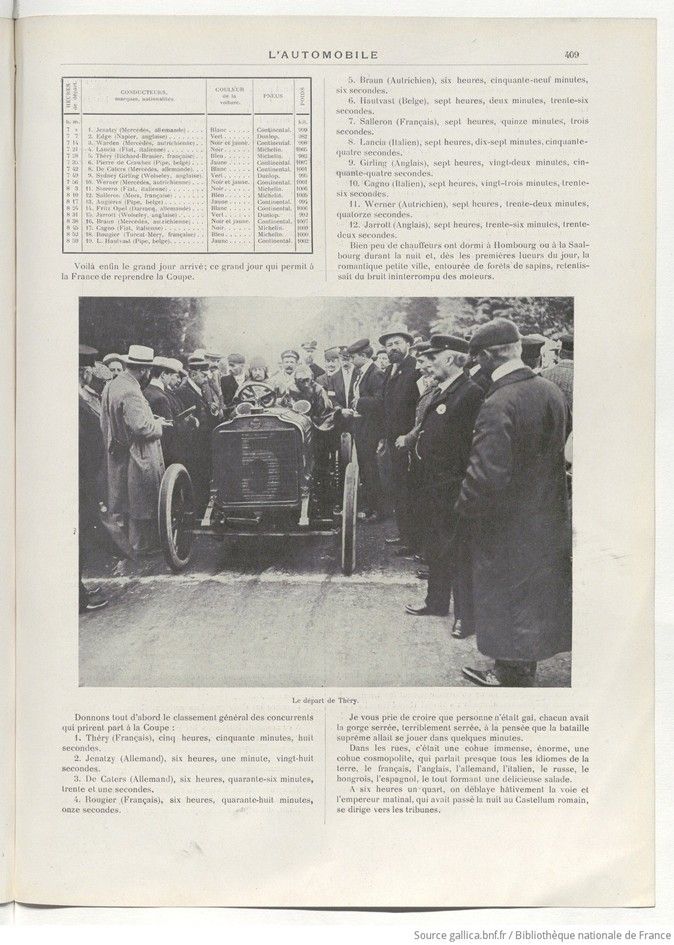
First, here is the overall ranking of the competitors who took part in the Cup:
1. Thery (French), five hours, fifty minutes, eight seconds.
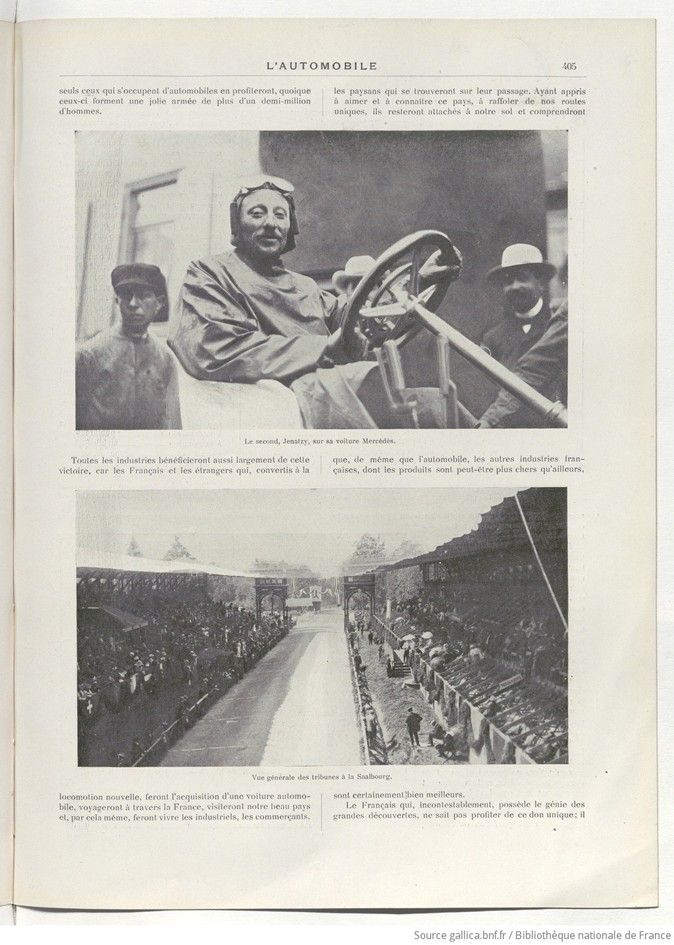
2. Jenatzy (German), six hours, one minute, twenty-eight seconds.
3. De Caters (German), six hours, forty-six minutes, thirty-one seconds.
4. Rougier (French), six hours, forty-eight minutes, eleven seconds.
5. Braun (Austrian), six hours, fifty-nine minutes, six seconds.
6. Hautvast (Belgian), seven hours, two minutes, thirty-six seconds.
7. Salleron (French), seven hours, fifteen minutes, three seconds.
S. Lancia (Italian), seven hours, seventeen minutes, fifty-four seconds.
9. Girling (English), seven hours, twenty-two minutes, fifty-four seconds.
10. Cagno (Italian), seven hours, twenty-three minutes, thirty-six seconds.
11. Werner (Austrian), seven hours, thirty-two minutes, fourteen seconds.
12. Jarrott (English), seven hours, thirty-six minutes, thirty-two seconds.
Very few drivers slept in Homburg or Saalburg during the night, and as soon as the first light of day appeared, the romantic little town, surrounded by pine forests, resounded with the uninterrupted roar of engines.
Please believe me when I say that no one was cheerful; everyone had a lump in their throat, a terrible lump, at the thought that the final battle was about to be fought in a few minutes.
In the streets, there was an immense, enormous throng, a cosmopolitan crowd speaking almost every language on earth—French, English, German, Italian, Russian, Hungarian, Spanish—all blending into a delightful jumble.
At a quarter past six, the path was hastily cleared, and the early-rising emperor, who had spent the night at the Roman Castellum, made his way toward the grandstands.
Wilhelm II was on horseback, in the uniform of a hussar colonel; he was cheered and smiling, very affable, and he waved.
A few minutes later, the Empress arrives in a carriage beautifully drawn by Daumont horses, followed by Princes Henry of Prussia and Frederick Charles of Hesse, who make their way toward the road, inspect the carriages, and shake hands with the competitors.
Meanwhile, time marches on and the grandstands lining the road fill to bursting.
The grandstands, which were built according to the emperor’s plans, overlook the road and are connected by a bridge that spans it; they look very grand and, moreover, cost over 150,000 francs to build.
Just a few more minutes and the starting signal will be given to Jenatzy; the competitors, whose names we listed above, are lining up.
It is our compatriot Tampier who will give the starting signal
Just a few more seconds. Jenatzy and his mechanic adjust their goggles; this is the moment of truth…
– One, two, three… Go!
Jenatzy has made a marvelous start; as he passes in front of the imperial grandstand, the emperor salutes.
And one by one, every seven minutes, the competitors set off. Only de Caters loses fourteen minutes at the start, due to an excess of oil in his igniters.
But the last one has barely set off when Jenatzy is already spotted; so we won’t have to wait long. The excitement is at its peak right now, and everyone truly realizes that the race unfolding is of the utmost importance.
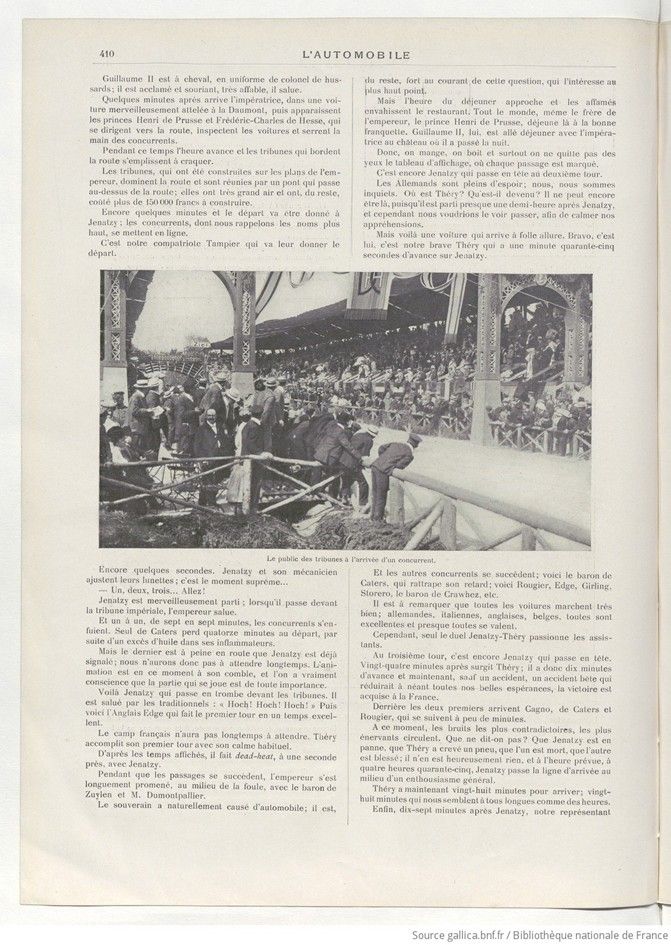
Here comes Jenatzy, whizzing past the grandstands. He is greeted with the traditional cries of “Hoch! Hoch! Hoch!” Then comes the Englishman Edge, completing the first lap in an excellent time.
The French side will not have to wait long. Théry completes his first lap with his usual calm.
According to the posted times, he is in a dead heat, within a second of Jenatzy.
As the cars keep passing by, the emperor takes a long stroll through the crowd with Baron de Zuylen and Mr. Dumontpallier.
The sovereign naturally talks about automobiles; he is, in fact, very well-versed in this subject, which interests him greatly.
But lunchtime is approaching, and the hungry crowd floods into the restaurant. Everyone, even the emperor’s brother, Prince Henry of Prussia, is having lunch there in a casual setting. Wilhelm II, for his part, has gone to have lunch with the empress at the castle where he spent the night. So, we eat, we drink, and above all, we keep our eyes glued to the scoreboard, where each lap is recorded
Once again, Jenatzy is in the lead in the second lap.
The Germans are full of hope; we, on the other hand, are worried. Where is Thery? What has become of him? He can’t be there yet, since he left almost half an hour after Jenatzy, and yet we would like to see him pass by, to calm our fears.
But here comes a car racing at breakneck speed. Bravo, it’s him—it’s our brave Théry, who is one minute and forty-five seconds ahead of Jenatzy.
And the other competitors follow one after another; here comes Baron de Caters, catching up; here come Rougier, Edge, Girling, Storero, Baron de Crawhez, and so on. It should be noted that all the cars are performing very well; German, Italian, English, Belgian—all are excellent and almost all are evenly matched. However, only the Jenatzy-Théry duel is thrilling the spectators.
On the third lap, it is Jenatzy again who takes the lead. Twenty-four minutes later, Théry appears; he is therefore ten minutes ahead, and now, barring an accident — a silly accident that would dash all our high hopes — victory is assured for France.
Behind the top two come Cagno, de Caters, and Rougier, who are following one another just a few minutes apart.
At this moment, the most contradictory and nerve-wracking rumors are circulating. What isn’t being said? That Jenatzy has broken down, that Théry has a flat tire, that one is dead, that the other is injured; fortunately, none of this is true, and at the scheduled time, at 4:45 p.m., Jenatzy crosses the finish line amid general enthusiasm. Théry now has twenty-eight minutes to finish; twenty-eight minutes that seem to all of us as long as hours.
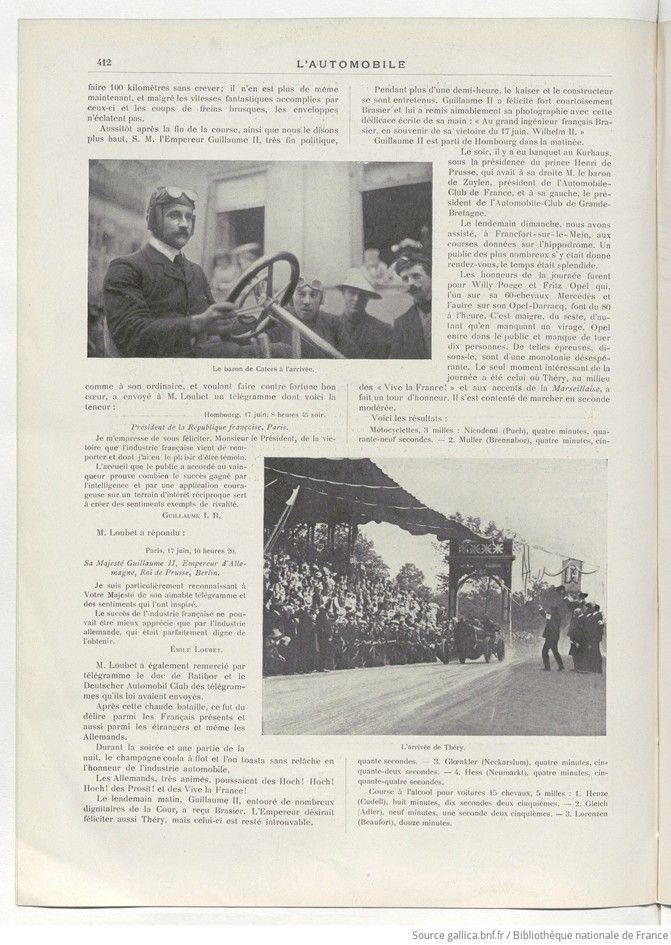
Finally, seventeen minutes after Jenatzy, our representative crosses the finish line; he has thus won the race by eleven minutes.
Théry stops, beaming, and a thousand hands reach out toward him. Brasier approaches and the two men throw their arms around each other; it is truly a beautiful sight.
Jenatzy, with tears in his eyes, comes over himself to congratulate his victorious opponent.
Behind Théry, in his Brasier, and Jenatzy, in his Mercedes, comes de Caters, also in a Mercedes, followed by Rougier, in a Turcat-Méry, who is beaten by only two minutes.
Then come Braun, Hautvast, Salleron, Lancia, Girling, Cagno, Werner, and Jarrott.
The number of finishers on this course of over 500 kilometers is twelve; the number of starters was eighteen.
The average is therefore excellent, especially since some competitors withdrew, not due to breakdowns, but because their cars no longer had a chance of securing the top spots.
Special congratulations are also in order here for the excellent Belgian brand Pipe, which finished sixth immediately behind the Brasier, Turcat-Méry, and Mercedes. The success is all the more impressive given that the Belgian brand was participating for the first time in an event of this magnitude.
Thery completed the entire course without a flat tire, as did Jenatzy, de Caters, Rougier, and Girling: that is, two Continentals, one Dunlop, and two Michelins.
Here is another point worth emphasizing. In the past, tires were the bane of racers, who could not cover 100 kilometers without a flat; this is no longer the case, and despite the fantastic speeds they achieve and sudden braking, the tires do not burst. Immediately after the race ended, as we mentioned above, His Majesty Emperor Wilhelm II, a shrewd politician as usual and wishing to make the best of a bad situation, sent Mr. Loubet a telegram with the following text:
Homburg, June 17, 8:45 p.m.
President of the French Republic, Paris.
I hasten to congratulate you, Mr. President, on the victory that French industry has just achieved and which I had the pleasure of witnessing.
The reception the public gave the winner proves how much success gained through intelligence and courageous application in a field of mutual interest serves to foster feelings free of rivalry.
WILHELM II I. R.
Mr. Loubet replied:
Paris, June 17, 10:20 p.m.
His Majesty William II, Emperor of Germany, King of Prussia, Berlin.
I am particularly grateful to Your Majesty for your kind telegram and the sentiments that inspired it.
The success of French industry could not have been better appreciated than by German industry, which was perfectly worthy of it.
EMILE LOUBET.
Mr. Loubet also sent a telegram thanking the Duke of Ratibor and the Deutscher Automobil Club for the telegrams they had sent him.
After this heated battle, there was wild jubilation among the French in attendance, as well as among the foreigners and even the Germans.
Throughout the evening and part of the night, champagne flowed freely, and toasts were raised ceaselessly in honor of the automotive industry.
The Germans, in high spirits, shouted “Hoch! Hoch! Hoch!” “Prosit!” and “Vive la France!”
The next morning, Wilhelm II, surrounded by numerous court dignitaries, received Brasier. The Emperor also wished to congratulate Thery, but the latter could not be found.
For over half an hour, the Kaiser and the engineer conversed. Wilhelm II congratulated Brasier most courteously and kindly presented him with his photograph, bearing this handwritten dedication: “To the great French engineer Brasier, in memory of his victory on June 17. Wilhelm II.”
Wilhelm II left Homburg in the morning.
In the evening, a banquet was held at the Kurhaus, presided over by Prince Henry of Prussia, who had at his right Baron de Zuylen, president of the Automobile Club of France, and at his left, the president of the Automobile Club of Great Britain.
The following day, Sunday, we attended the races held at the racetrack in Frankfurt am Main. A huge crowd had gathered there, and the weather was splendid.
The stars of the day were Willy Poege and Fritz Opel, who, one in his 60-horsepower Mercedes and the other in his Opel-Darracq, reached 80 miles per hour. That’s not much, mind you, especially since Opel missed a turn, drove into the crowd, and nearly killed ten people. Such events, let’s face it, are desperately monotonous. The only interesting moment of the day was when Théry, amid cries of “Vive la France!” and the strains of the Marseillaise, took a lap of honor. He contented himself with driving at a moderate speed.
Here are the results:
Motorcycles, 3 miles: Nicodemi (Puch), four minutes, forty-nine seconds. – 2. Muller (Brennabor), four minutes, fifty seconds. – 3. Gloenkler (Neckarslum), four minutes, fifty-two seconds. – 4. Hess (Neumarkt), four minutes, fifty-four seconds.
Alcohol-powered race for 15-horsepower cars, 5 miles: 1. Henze (Cudell), eight minutes, ten seconds, two-fifths. – 2. Gleich (Adler), nine minutes, one second, two-fifths. – 3. Lorenzen (Beaufort), twelve minutes.
Two-cylinder cars, 14 horsepower, 15 miles: 1. Fritz Opel (Darracq), eight minutes, ten seconds, four-fifths. – 2. Boehm (Benz), nine minutes, twenty-eight seconds, four-fifths. – 3. Kruck (Peugeot), nine minutes, fifty-five seconds.
Spirit-powered race, 10 miles: 1. Willy Poege (Mercedes), twelve minutes, twenty-nine seconds and one-fifth, wins the Emperor’s Prize. – 2. F. Opel (Darracq), twelve minutes, forty-seven seconds. – 3. Dranda (Darracq). – 4. Teves (Adler).
24-horsepower car race, 10 miles: 1. F. Opel (Darracq), eleven minutes, five seconds and one-fifth. – 2. Teves (Adler), eleven minutes, eleven seconds. – 3. Adam (Opel-Darracq), twelve minutes, – 4. Maurer (Maurer). – 5. Brauning (Brauning).
It’s a terrifying pileup of eight starters in a turn. Finally, everything goes smoothly, without a hitch.
40-horsepower cars, 10 miles: 1. F. Opel (Darracq), fifteen minutes, twenty-four seconds and four-fifths. -2. Martin (Daimler), fifteen minutes, twenty-eight seconds. – 3. Banda (Darracq), fifteen minutes, forty seconds. – 4. Oll (Westphal Dietrich), fifteen minutes, forty-one seconds. Peters Cup (holder, W. Poege): 1. Willy Poege (Mercedes), twelve minutes, twelve seconds (becomes the definitive holder of the Cup). – 2. F. Opel (Darracq), twelve minutes, seventeen seconds. – 3. Branda (Darracq), fifteen minutes. – 4. Beutler (Dietrich), fifteen minutes, thirty-five seconds.
And that’s it. After these wonderful festivities, our compatriots made their way back to the French border.
Some returned by train; others preferred to take the scenic route back to Paris, traveling along the beautiful banks of the Rhine that stretch from Mainz to Cologne.
As for Mr. Brasier and Mr. Thery, not yet satisfied with the number of kilometers covered, they returned to Paris on Tuesday in their race car.
In summary, we can be satisfied with the day of June 17; it is now up to us to retain this glorious trophy next year as well; in a few days, we will be able to admire the Cup at the A.C.F.
In 1905, the race will take place in France; we have everything we need to win again: our industrial prowess and the enormous confidence our recent victory has given us,
PAUL SENCIER.
Photos.
Page 404. The Cup winner, Thery, in his Richard-Brasier car. – The German Emperor in his box.
Page 405. The runner-up, Jenatzy, in his Mercedes car. – General view of the grandstands at Saalbourg.
Page 406. The weights that were used to weigh the Cup cars. – The cars waiting to be weighed.
Page 407. Jenatzy’s car at the weigh-in. – The gasoline fire that nearly destroyed Edge’s car the day before the race:
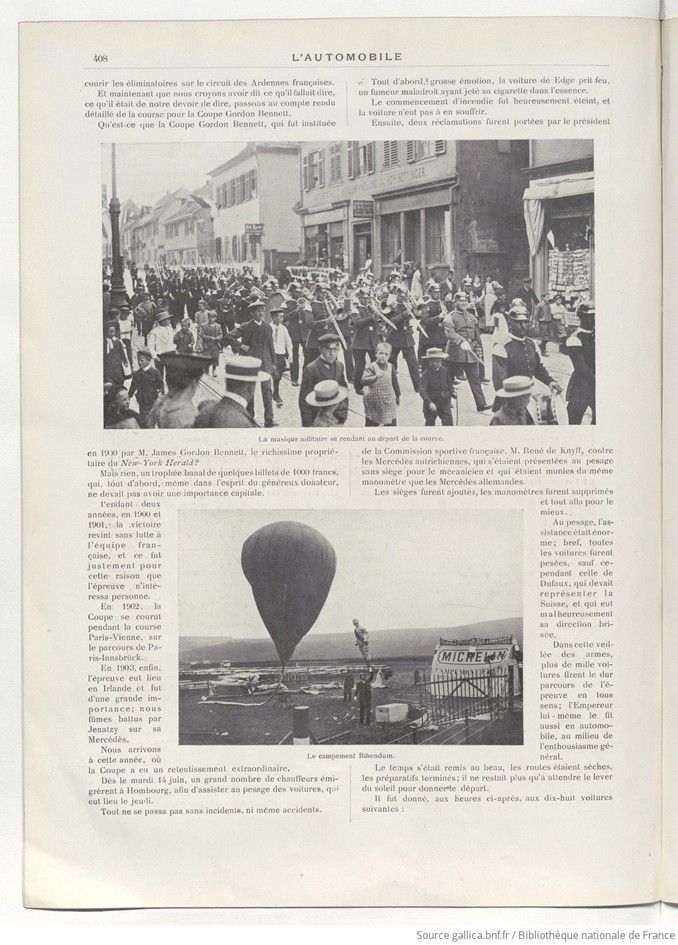
Page 408. The military band heading to the race start. – The Bibendum camp. (MICHELIN):
Page 409. Théry’s start.
Page 410. The crowd in the stands as a competitor crosses the finish line. – Théry’s start.
Page 411. Théry at full speed on the road. – The grandstand.
Page 412. Baron de Caters at the finish line. – Théry’s finish.
Page 413. Jenatzy taking a corner.