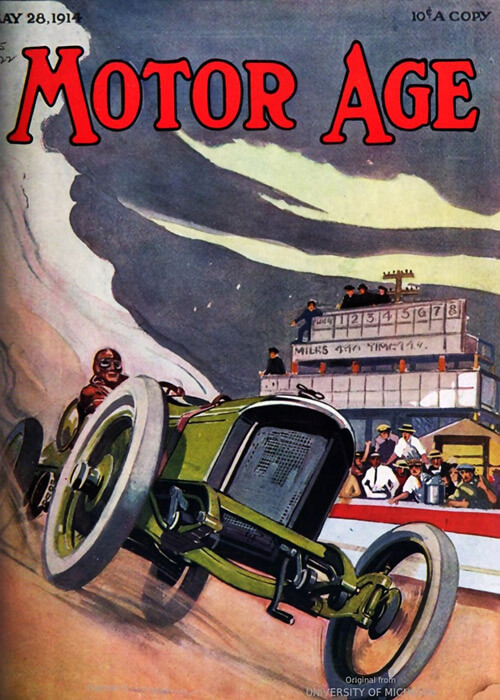
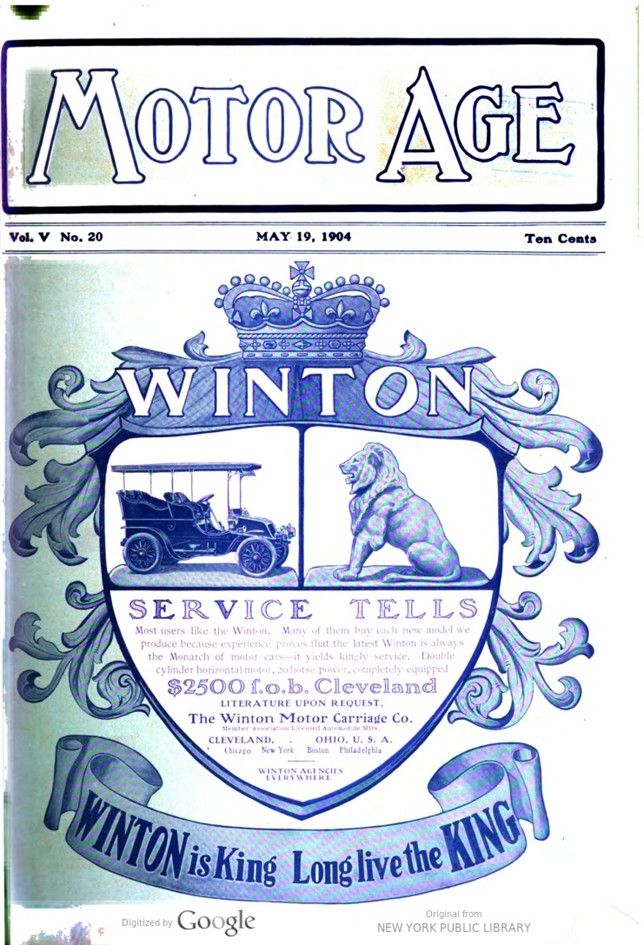
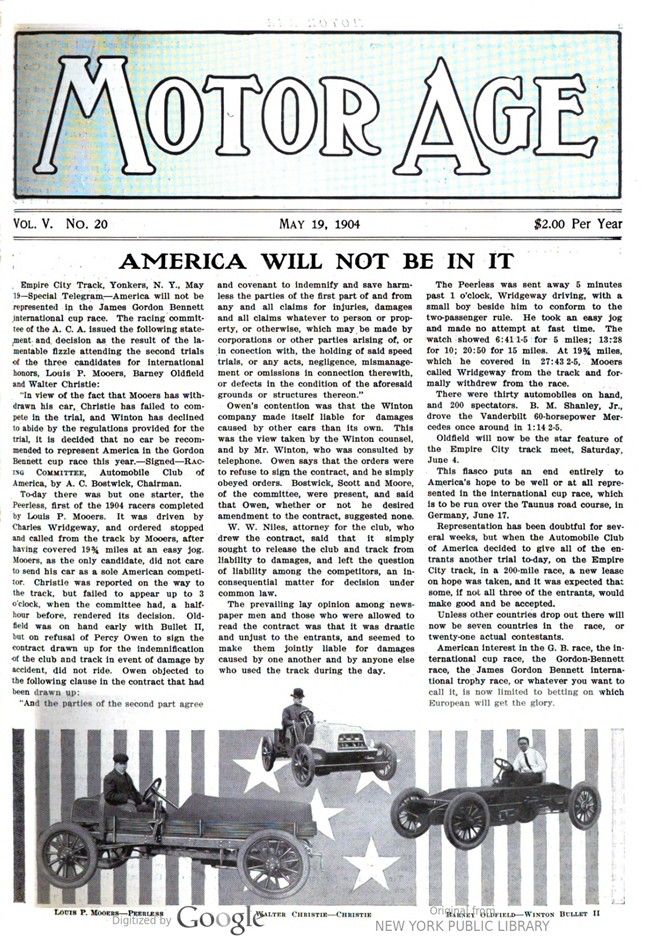
This May 19 1904 issue of „Motor Age“ highlights the result of the American elimination trials for the 1904 Gordon Bennet Cup Race.
It wasn’t really a succes, and the Automobile Club of America, the A.C.C. decided not to represent the US in the 1904 Gordon Bennet Cup race.
Text and photos with courtesy of hathitrust hathitrust.org, compiled by motorracingistory.com.
MOTOR AGE VOL. V. NO. 20. MAY 19, 1904.
AMERICA WILL NOT BE IN IT
Empire City Track, Yonkers, N. Y., May 19 – Special Telegram – America will not be represented in the James Gordon Bennett international cup race. The racing committee of the A. C. A. issued the following statement and decision as the result of the lamentable fizzle attending the second trials of the three candidates for international honors, Louis P. Mooers, Barney Oldfield and Walter Christie:
„In view of the fact that Mooers has withdrawn his car, Christie has failed to compete in the trial, and Winton has declined to abide by the regulations provided for the trial, it is decided that no car be recommended to represent America in the Gordon Bennett cup race this year. – Signed – RACING COMMITTEE, Automobile Club of America, by A. C. Bostwick, Chairman.
Toay there was but one starter, the Peerless, first of the 1904 racers completed by Louis P. Mooers. It was driven by Charles Wridgeway and ordered stopped and called from the track by Mooers, after having covered 1934 miles at an easy jog. Mooers, as the only candidate, did not care to send his car as a sole American competitor. Christie was reported on the way to the track, but failed to appear up to 3 o’clock, when the committee had, a half-hour before, rendered its decision. Old- field was on hand early with Bullet II, but on refusal of Percy Owen to sign the contract drawn up for the indemnification of the club and track in event of damage by accident, did not ride. Owen objected to the following clause in the contract that had been drawn up:
„And the parties of the second part agree and covenant to indemnify and save harmless the parties of the first part of and from any and all claims for injuries, damages and all claims whatever to person or property, or otherwise, which may be made by corporations or other parties arising of, or in connection with, the holding of said speed trials, or any acts, negligence, mismanagement or omissions in connection therewith, or defects in the condition of the aforesaid grounds or structures thereon.“
Owen’s contention was that the Winton company made itself liable for damages caused by other cars than its own. This was the view taken by the Winton counsel, and by Mr. Winton, who was consulted by telephone. Owen says that the orders were to refuse to sign the contract, and he simply obeyed orders. Bostwick, Scott and Moore, of the committee, were present, and said that Owen, whether or not he desired amendment to the contract, suggested none.
W. W. Niles, attorney for the club, who drew the contract, said that it simply sought to release the club and track from liability to damages, and left the question of liability among the competitors, an in- consequential matter for decision under common law.
The prevailing lay opinion among newspaper men and those who were allowed to read the contract was that it was drastic and unjust to the entrants and seemed to make them jointly liable for damages caused by one another and by anyone else who used the track during the day.
The Peerless was sent away 5 minutes past 1 o’clock, Wridgeway driving, with a small boy beside him to conform to the two-passenger rule. He took an easy jog and made no attempt at fast time. The watch showed 6:41 1-5 for 5 miles; 13:28 for 10; 20:50 for 15 miles. At 19¾ miles, which he covered in 27:43 2-5, Mooers called Wridgeway from the track and formally withdrew from the race.
There were thirty automobiles on hand, and 200 spectators. B. M. Shanley, Jr., drove the Vanderbilt 60-horsepower Mercedes once around in 1:14 2-5.
Oldfield will now be the star feature of the Empire City track meet Saturday June 4.
This fiasco puts an end entirely to America’s hope to be well or at all represented in the international cup race, which is to be run over the Taunus Road course, in Germany, June 17.
Representation has been doubtful for several weeks, but when the Automobile Club of America decided to give all of the entrants another trial to-day, on the Empire City track, in a 200-mile race, a new lease on hope was taken, and it was expected that some, if not all three of the entrants, would make good and be accepted. Unless other countries drop out there will now be seven countries in the race, or twenty-one actual contestants. American interest in the G. B. race, the international cup race, the Gordon-Bennett race, the James Gordon Bennett international trophy race, or whatever you want to call it, is now limited to betting on which European will get the glory.
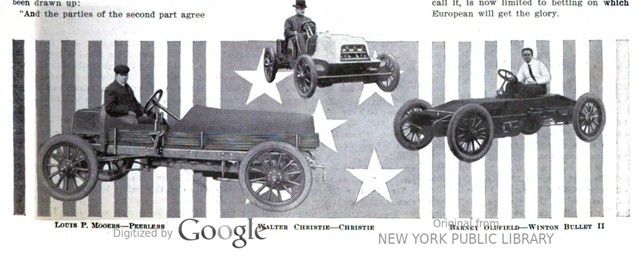
Photos.
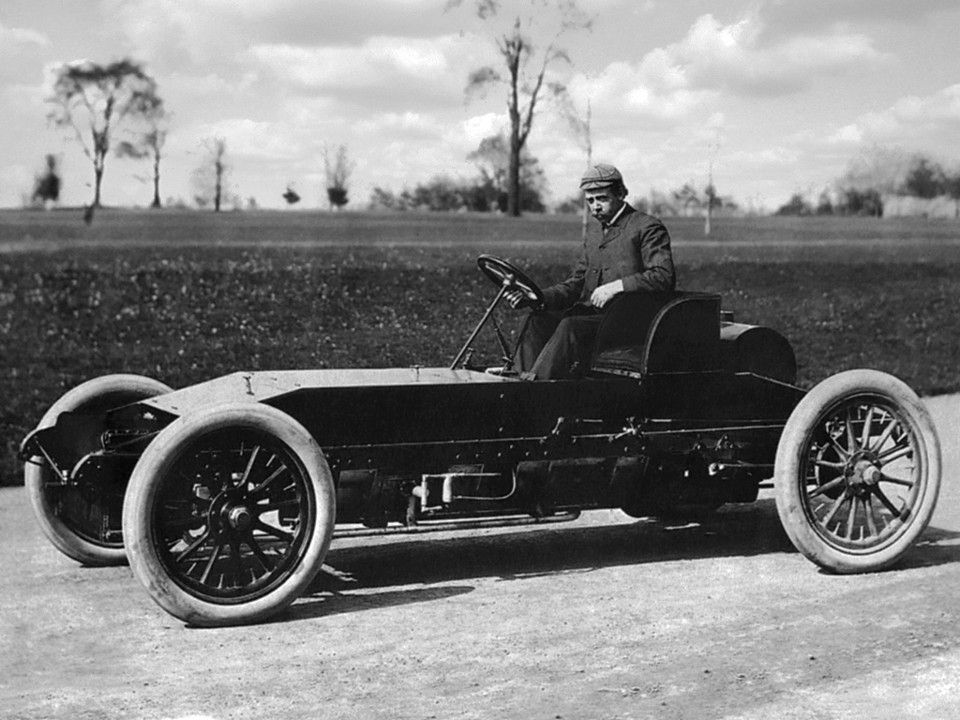
Page 1. LOUIS P. MOOERS-PEERLESS / WALTER CHRISTIE-CHRISTIE / BARNEY OLDFIELD-WINTON BULLET II
MOTOR AGE VOL. V. NO. 20. MAY 19, 1904.
TALK OF AMERICAN TRIALS
This Week’s Try-Out of International Cup Race Candidates Discussed on All Sides-Gossip of Track Aspirants – Looking at Virginia Beach Again – Louis Mooers Arrested
New York, May 15 – Pending the result of the 200-mile trial of the candidates for the American team in the international cup race at the Empire track next Thursday discussion as to whether or not the automobile club should cancel its entry has been halted. The hope is general and sincere that all or at least one of the cars will make good, that there may be no prolongation of a discussion both injurious and humiliating to the American sport and industry.
Now that the committee has yielded to the appeal of the entrants and the very general desire of the fraternity for another trial should a second failure be scored, it is more than likely that public opinion will be against the further heroic pursuit of a forlorn hope on the mere grounds of so-called sportsmanship and getting useful experience from defeat. It may be stated with assurance that the temper of the committee is against send- ing any car that fails to make good in this second trial which has been given it.
The committee men are somewhat nettled at the criticisms of the insufficiency of the tests they gave the candidates and hint at the development of defects beyond those alleged by their makers as the only causes for the failure of their cars to make good. The decision to grant a second trial, of course, smothered whatever report the committee could have made of the state of affairs as it found it from the first tests.
„It was not our fault,“ said one of the committee to a MOTOR AGE man, „that the cars stopped and could not even reach the hundred mile limit we set. The printed reports of what happened to the cars rest entirely, you must remember, on the statements of their makers and drivers, who desired another trial and would naturally wish to conceal facts that might result in their rejection or public pre- judice. It is to be hoped that the second trial will result in all of the cars making good. In any event their builders cannot say that every chance was not given them.“
The general impression is that the proposed test will be sufficient enough to justify the committee in sending to Homburg any car that can go the 200-mile run in creditable time. The course is now in use by 300 trotters and cannot be rolled into race meet condition. Its softness will give a fairly difficult test and the constant turns will reproduce the many curves of the German course. In the absence of any road available for racing it is surely the best course the committee can offer under existing conditions. It is not thought that the constant and gradual turning will be so very much more of a strenuous strain on tires and machines than the sharp curves of the Homburg course could present.
An error was made by MOTOR AGE in interpreting the telegraphic despatch on the conditions of the second trial. As in the real race gasoline and water must be taken on board the car outside the control and poured into the tanks inside the control. This rule is presumably to give a car that can run a long distance without having to stop for gasoline or water due advantage and credit in its aggregate running time.
The trials will not begin before 1 o’clock in the afternoon and possibly not before 2 o’clock, as they will have to follow the training spins of the trotters, whose owner has courteously consented that day to crowd them into the forenoon hours. President Butler’s courtesy in giving the club the use of the track for the trials at so great an inconvenience to its proper tenants is being commended and is another illustration of the strength of the fraternity the good roads crusade has created among the horsemen and automobilists of the metropolitan district.
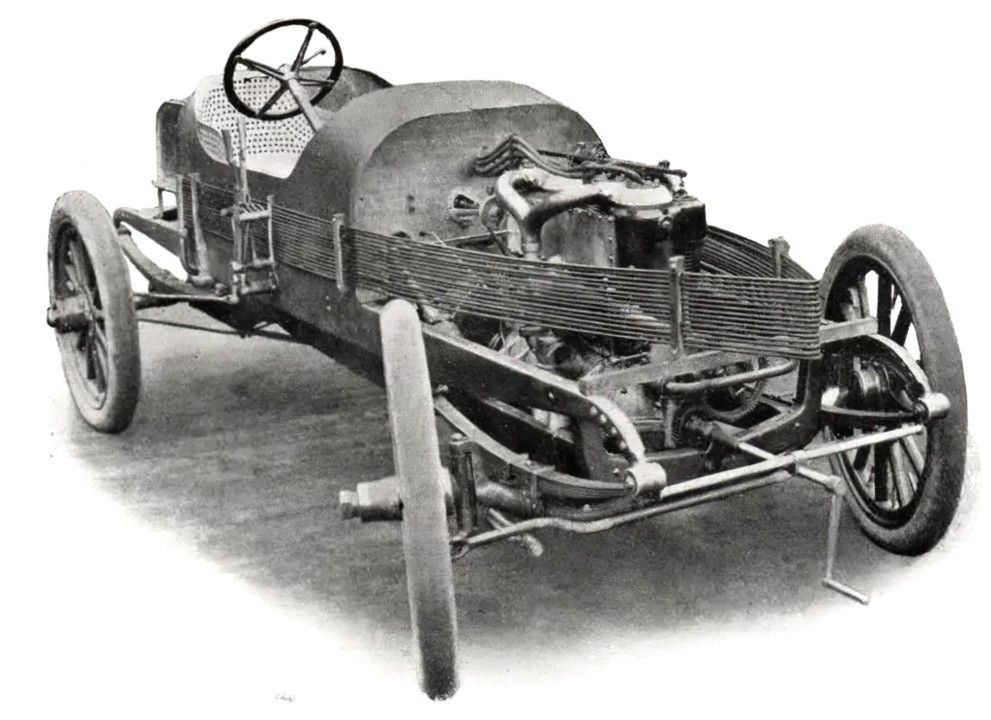
President Butler also favors open gates that day, believing that the trials can thus be made a boom to automobile racing and that the tests are a matter of general patriotic interest. He has, however, given the club the control of the track that day, reserving for the members of the New York Driving Club their right of access to the track at all times. Though no announcement of wide open gates will proba- bly be made, it is likely that the trials will be practically a public one.
It is said that Oldfield and the Bullet will be here tomorrow. Mr. Mooers says that the two Peerless cars will arrive on Thursday morning. Though no announcement has yet been made by Mr. Mooers it is believed that Charles G. Wridgway and Joe Tracy will drive the Peerless candidates. Secretary Reeves, of the Empire track, says that owing to its use by the trotters the cup cars and drivers will have no chance for practice on the track before the trials.
Several New York cars will be among the participants in the meet at Point Breeze, Philadelphia, on May 28, and at the Readville, Boston, races on Decoration day. At the former the Stevens-Duryea „Spider,“ which holds the world’s mile straightway record of 57 1-5 seconds in the voiturette class, has been entered by Woolston & Drew, of this city. At this meet Nathaniel Huggins will also start his 40-horsepower Decauville racer, a twin machine to the Henri Page car that scored a 15-mile track record last season. Hilliard, his chaffeur, will drive it. If possible the car will be shipped to Boston in time to run on the following Monday. The 60-horsepower Fiat, a counterpart of the international cup racers to be driven by the Italian team in the Homburg contest, which is expected to reach this port on Wednesday, will also be driven by Claude Fogelin in the free for all for the Boston Herald cup that day. E. D. Hollander will also drive a 24-horsepower Fiat in the 5-mile race for touring cars with all on, limited to that power.
Joe Tracy will surely make an attempt with the 1903 Peerless cup racer to lower the Commonwealth avenue record of 15 2-5 seconds scored by S. H. Bowden, Mercedes, and H. D. Hills, Richard, on April 19. The car had troube with its gears that day and was left in Boston. When new gears are fitted the Chronograph club has consented to time Tracy’s attempt.
Glen D. Stuart, former manager of Barney Oldfield, is having built at Buffalo two 70-horsepower racing cars, whose completion is expected within 2 weeks. They will be driven by John J. Lavin, a former pacemaker for Ed- die McDuffie, and Luty Callahan, a cycle racing veteran.
W. H. Pickens, the owner of the Ford 999, is negotiating with Eddie Bald to be its driver in exhibition and open races this season. But the former cycle champion is at present at the Electric Vehicle Co. factory studying the mechanism of the Columbia gasoline car with a view to acting as a salesman and demonstrator of it and also of piloting a racing car of that make should the company decide to build one.
Lee Straus, who brought about the prem ture inspection of Virginia beach as a race course when it was in no condition to do itself justice, has returned from another inspection of it and pronounces it now in ideal condition for racing. Accordingly he has applied to the racing board for a sanction for September 26.
„I went all over the beach,“ said Mr. Straus yesterday, and found for about 7 1/2 miles, from the Princess Anne hotel to the wreck, as fine a stretch for racing as I have ever seen. On this we will conduct races of from 1 to 5 miles, and every race will be in plain view of the beach walk.“
It is said that Harlan W. Whipple, president of the A. M. A., intends to take his new 80-horsepower racing car from Baltimore to Virginia beach to give it a trial.
Louis P. Mooers was arrested for speeding on Saturday and had to appear in court yesterday morning and pay a $5 fine. He was driving a Pierce motorette at the time.
CLEVELANDERS CONFIDENT
Cleveland, O., May 16 – Louis P. Mooers of the Peerless company has returned from New York and has rushed the work of pulling the two Peerless cars to pieces to repair the defects that caused the trouble at the first elimination trials last week. He stated that by polishing the pistons slightly, all danger of the recurrence of the former accident would be eliminated. Mooers expressed himself as greatly pleased with the courtesy shown by the race committee and he says that if either of his cars fail to show up satisfactorily, he will have nothing more to say. Both Peerless cars will be shipped to New York tomorrow evening. With Mr. Mooers will go W. H. Starring, who was with Mooers in Ireland last year, who it is expected will drive the second Peerless car in the elimination trial.
Winton Bullett II is already in New York, having been shipped from the factory Saturday evening. Charles Shanks says that the car is now in perfect condition, the parts that gave trouble before having been repaired and strengthened. Barney Oldfield leaves for New York today and he is taking with him an ab- normal amount of confidence in his ability, not only to make a showing in the second elimination trial, but in his chances for scoring in the big contest itself.