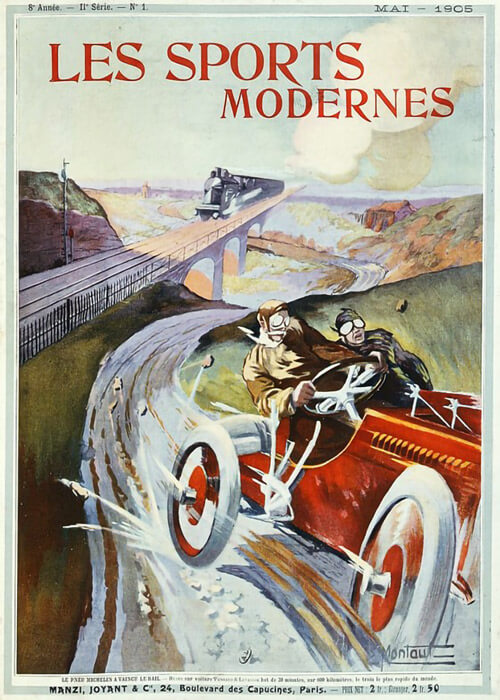
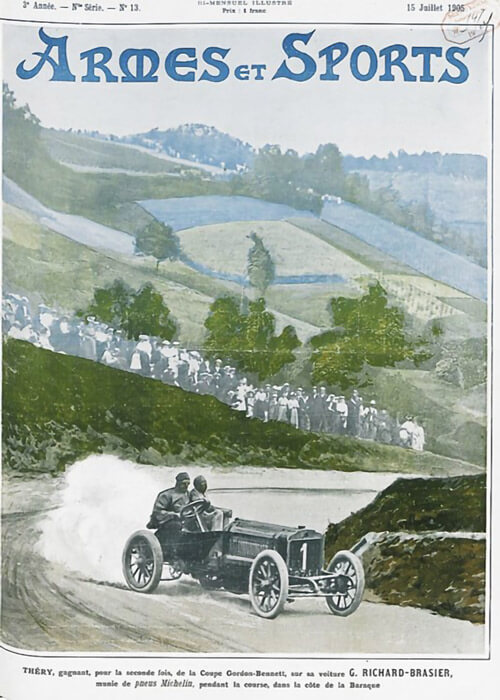
In this issue of “Motor Age” the 1904 Gordon Bennet Cup race is described, relatively meticuously and hence indeed-a-long-read. Specific sub-chapters are, next to the main title: The Winner’s Story, The Loser’s Story, The Car Troubles and Notes of the Contest. Especially the view of second-placed Jenatzy is interesting!
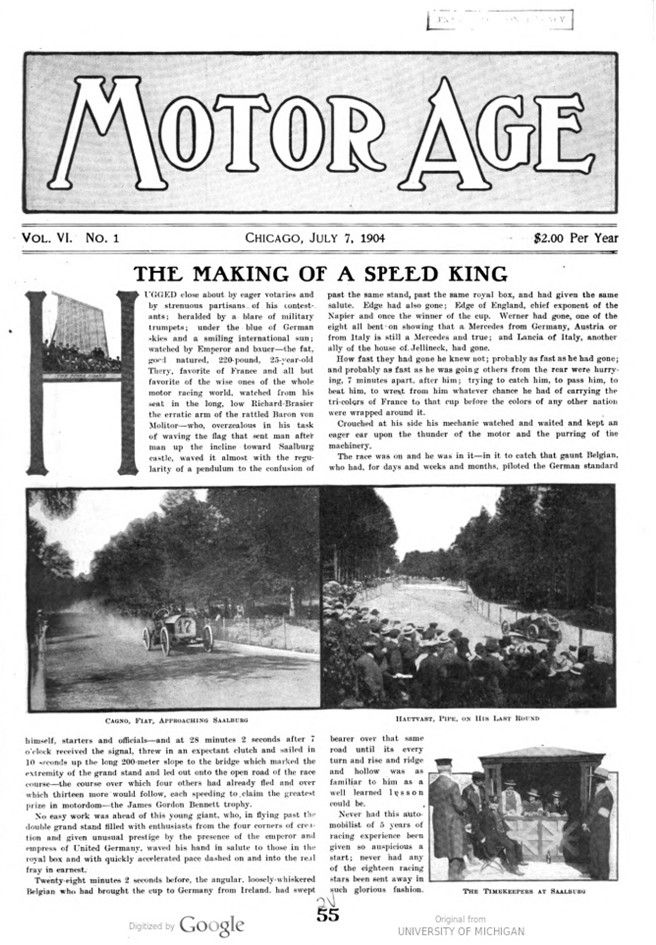
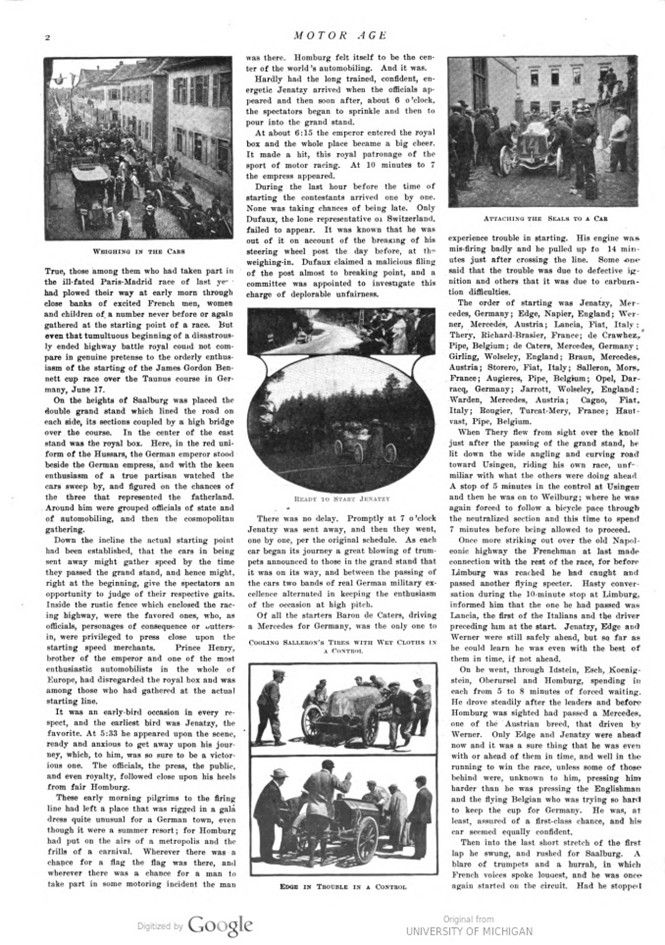
Text and photos with courtesy of hathitrust hathitrust.org, compiled by motorracingistory.com.
MOTOR AGE VOL. VI. NO. 1. JULY 7, 1904.
THE MAKING OF A SPEED KING
HUGGED close about by eager votaries and by strenuous partisans of his contestants; heralded by a blare of military trumpets; under the blue of German skies and a smiling international sun; watched by Emperor and bauer — the fat, good natured, 220-pound, 25-year-old Thery, favorite of France and all but favorite of the wise ones of the whole motor racing world, watched from his seat in the long, low Richard-Brasier the erratic arm of the rattled Baron von Molitor — who, overzealous in his task of waving the flag that sent man after man up the incline toward Saalburg castle, waved it almost with the regularity of a pendulum to the confusion of himself, starters and officials—and at 28 minutes 2 seconds after 7 o’clock received the signal, threw in an expectant clutch and sailed in 10 seconds up the long 200-meter slope to the bridge which marked the extremity of the grand stand and led out onto the open road of the race course — the course over which four others had already fled and over which thirteen more would follow, each speeding to claim the greatest prize in motordom — the James Gordon Bennett trophy.
No easy work was ahead of this young giant, who, in flying past the double grand stand filled with enthusiasts from the four corners of creation and given unusual prestige by the presence of the emperor and empress of United Germany, waved his hand in salute to those in the royal box and with quickly accelerated pace dashed on and into the real fray in earnest.
Twenty-eight minutes 2 seconds before, the angular, loosely whiskered Belgian who had brought the cup to Germany from Ireland, had swept past the same stand, past the same royal box, and had given the same salute. Edge had also gone; Edge of England, chief exponent of the Napier and once the winner of the cup. Werner had gone, one of the eight all bent on showing that a Mercedes from Germany, Austria or from Italy is still a Mercedes and true; and Lancia of Italy, another ally of the house of Jellineck, had gone.
How fast they had gone he knew not; probably as fast as he had gone; and probably as fast as he was going others from the rear were hurrying, 7 minutes apart, after him; trying to catch him, to pass him, to beat him, to wrest from him whatever chance he had of carrying the tri-colors of France to that cup before the colors of any other nation were wrapped around it. Crouched at his side his mechanic watched and waited and kept an eager ear upon the thunder of the motor and the purring of the machinery.
The race was on, and he was in it – in it to catch that gaunt Belgian, who had, for days and weeks and months, piloted the German standard bearer over that same road until its every turn and rise and ridge and hollow familiar to him as a well learned lesson could be.
Never had this automobilist of 5 years of racing experience been given so auspicious a start; never had any of the eighteen racing stars been sent away in such glorious fashion. True, those among them who had taken part in the ill-fated Paris-Madrid race of last year had plowed their way at early morn through close banks of excited French men, women and children of a number never before or again gathered at the starting point of a race. But even that tumultuous beginning of a disastrously ended highway battle royal could not compare in genuine pretense to the orderly enthusiasm of the starting of the James Gordon Bennett cup race over the Taunus course in Germany, June 17.
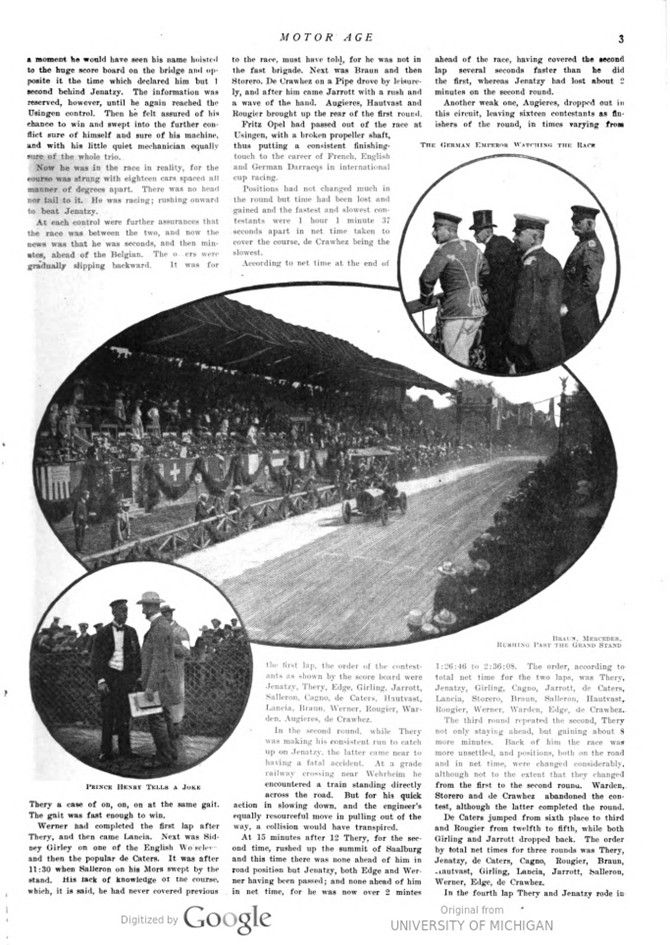
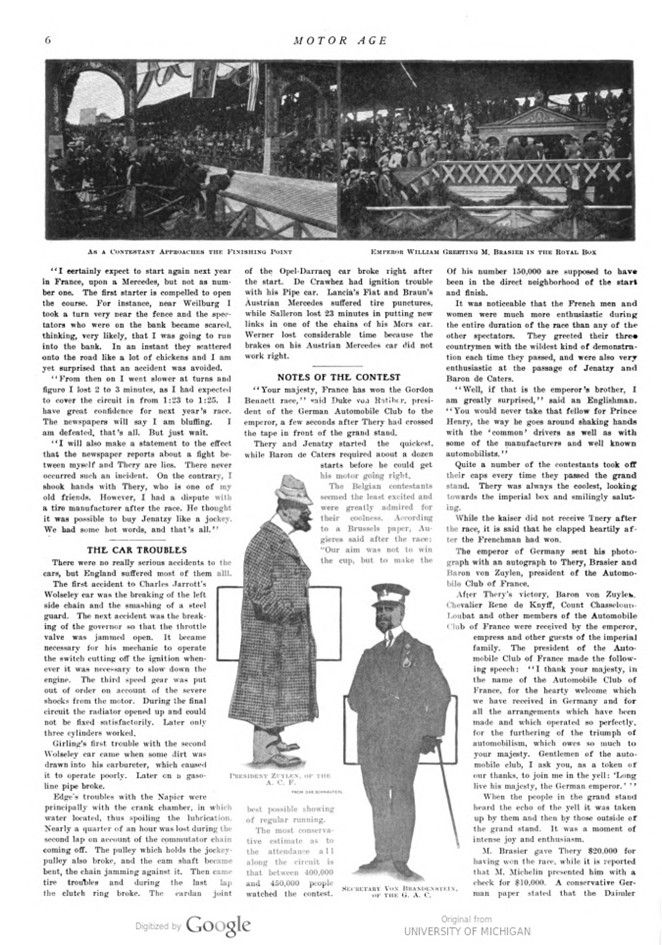
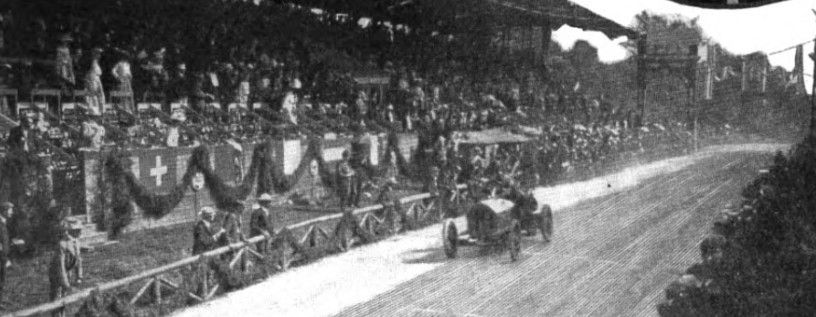
On the heights of Saalburg was placed the double grandstand which lined the road on each side, its sections coupled by a high bridge over the course. In the center of the east stand was the royal box. Here, in the red uniform of the Hussars, the German emperor stood beside the German empress, and with the keen enthusiasm of a true partisan watched the cars sweep by, and figured on the chances of the three that represented the fatherland. Around him were grouped officials of state and of automobiling, and then the cosmopolitan gathering. Down the incline the actual starting point had been established, that the cars in being sent away might gather speed by the time they passed the grand stand, and hence might, right at the beginning, give the spectators an opportunity to judge of their respective gaits. Inside the rustic fence which enclosed the racing highway, were the favored ones, who, as officials, personages of consequence or butters-in, were privileged to press close upon the starting speed merchants. Prince Henry, brother of the emperor and one of the most enthusiastic automobilists in the whole of Europe, had disregarded the royal box and was among those who had gathered at the actual starting line.
It was an early-bird occasion in every respect, and the earliest bird was Jenatzy, the favorite. At 5:33 he appeared upon the scene, ready and anxious to get away upon his journey, which, to him, was so sure to be a victorious one. The officials, the press, the public, and even royalty, followed close upon his heels from fair Homburg.
These early morning pilgrims to the firing line had left a place that was rigged in a gala dress quite unusual for a German town, even though it were a summer resort; for Homburg had put on the airs of a metropolis and the frills of a carnival. Wherever there was a chance for a flag the flag was there, and wherever there was a chance for a man to take part in some motoring incident the man was there. Homburg felt itself to be the center of the world’s automobiling. And it was.
Hardly had the long trained, confident, energetic Jenatzy arrived when the officials appeared and then soon after, about 6 o’clock, the spectators began to sprinkle and then to pour into the grandstand.
At about 6:15 the emperor entered the royal box and the whole place became a big cheer. It made a hit, this royal patronage of the sport of motor racing. At 10 minutes to 7 the empress appeared.
During the last hour before the time of starting the contestants arrived one by one. None was taking chances of being late. Only Dufaux, the lone representative oi Switzerland, failed to appear. It was known that he was out of it on account of the breaking of his steering wheel post the day before, at the weighing-in. Dufaux claimed a malicious filing of the post almost to breaking point, and a committee was appointed to investigate this charge of deplorable unfairness.
There was no delay. Promptly at 7 o’clock Jenatzy was sent away, and then they went, one by one, per the original schedule. As each car began its journey a great blowing of trumpets announced to those in the grandstand that it was on its way, and between the passing of the cars two bands of real German military excellence alternated in keeping the enthusiasm of the occasion at high pitch.
Of all the starters Baron de Caters, driving a Mercedes for Germany, was the only one to experience trouble in starting. His engine was misiring badly and he pulled up to 14 minutes just after crossing the line. Someone said that the trouble was due to defective ignition and others that it was due to carburation difficulties.
The order of starting was Jenatzy, Mercedes, Germany; Edge, Napier, England; Werner, Mercedes, Austria; Lancia, Fiat, Italy : Thery, Richard-Brasier, France; de Crawhez, Pipe, Belgium; de Caters, Mercedes, Germany; Girling, Wolseley, England; Braun, Mercedes, Austria; Storero, Fiat, Italy; Salleron, Mors, France; Augieres, Pipe, Belgium; Opel, Darracq, Germany; Jarrott, Wolseley, England; Warden, Mercedes, Austria; Cagno, Fiat, Italy; Rougier, Turcat-Mery, France; Hautvast, Pipe, Belgium.
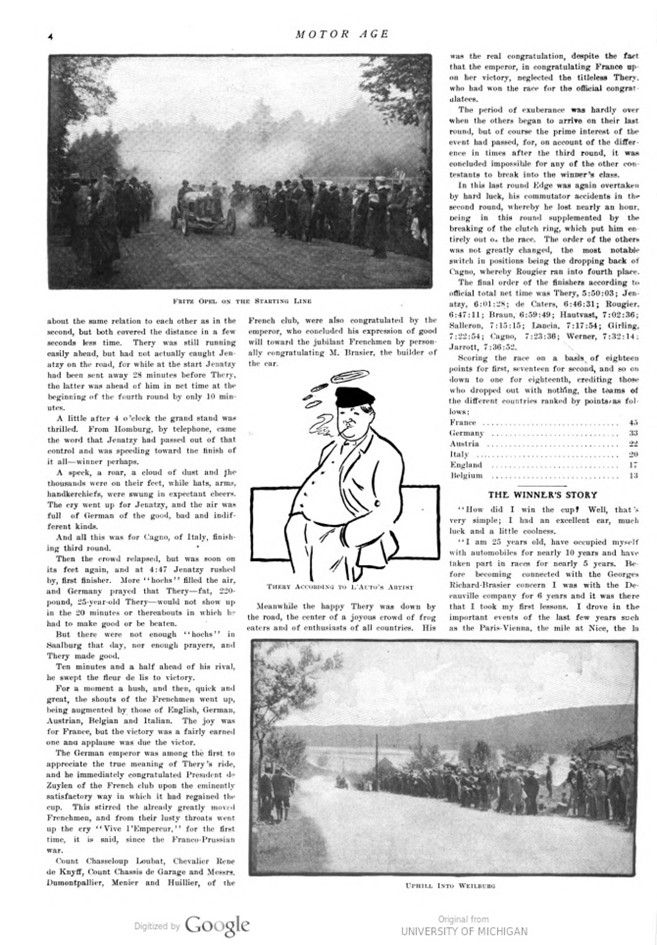
When Thery flew from sight over the knoll just after the passing of the grand stand, he lit down the wide angling and curving road toward Usingen, riding his own race, unfamiliar with what the others were doing ahead. A stop of 5 minutes in the control at Usingen and then he was on to Weilburg; where he was again forced to follow a bicycle pace through the neutralized section and this time to spend 7 minutes before being allowed to proceed.
Once more striking out over the old Napoleonic highway the Frenchman at last made connection with the rest of the race, for before Limburg was reached he had caught and passed another flying specter. Hasty conversation during the 10-minute stop at Limburg, informed him that the one he had passed was Lancia, the first of the Italians and the driver preceding him at the start. Jenatzy, Edge and Werner were still safely ahead, but so far as he could learn he was even with the best of them in time, if not ahead.
On he went, through Idstein, Esch, Koenigstein, Oberursel and Homburg, spending in each from 5 to 8 minutes of forced waiting. He drove steadily after the leaders and before Homburg was sighted had passed a Mercedes, one of the ‘Austrian breed, that driven by Werner. Only Edge and Jenatzy were ahead now, and it was a sure thing that he was even with or ahead of them in time, and well in the running to win the race, unless some of those behind were, unknown to him, pressing him harder than he was pressing the Englishman and the flying Belgian who was trying so hard to keep the cup for Germany. He was, at least, assured of a first-class chance, and his car seemed equally confident.
Then into the last short stretch of the first lap he swung and rushed for Saalburg. A blare of trumpets and a hurrah, in which French voices spoke loudest, and he was once again started on the circuit. Had he stopped a moment he would have seen his name hoisted to the huge score board on the bridge and opposite it the time which declared him but 1 second behind Jenatzy. The information was reserved, however, until he again reached the Usingen control. Then he felt assured of his chance to win and swept into the further conflict sure of himself and sure of his machine, and with his little quiet mechanician equally sure of the whole trio.
Now he was in the race in reality, for the course was strung with eighteen cars spaced all manner of degrees apart. There was no head nor tail to it. He was racing; rushing onward to beat Jenatzy.
At each control were further assurances that the race was between the two, and now the news was that he was seconds, and then minutes, ahead of the Belgian. The others were gradually slipping backward. It was for Thery a case of on, on, on at the same gait. The gait was fast enough to win.
Werner had completed the first lap after Thery and then came Lancia. Next was Sidney Girley on one of the English Wolseley and then the popular de Caters. It was after 11:30 when Salleron on his Mors swept by the stand. His lack of knowledge of the course, which, it is said, he had never covered previous to the race, must have told, for he was not in the fast brigade. Next was Braun and then Storero. De Crawhez on a Pipe drove by leisurely, and after him came Jarrott with a rush and a wave of the hand. Augieres, Hautvast and Rougier brought up the rear of the first round.
Fritz Opel had passed out of the race at Usingen, with a broken propeller shaft, thus putting a consistent finishing-touch to the career of French, English and German Darracqs in international cup racing.
Positions had not changed much in the round, but time had been lost and gained and the fastest and slowest contestants 1 hour 1 minute 37 seconds apart in net time taken to cover the course, de Crawhez being the slowest.
According to net time at the end of the first lap, the order of the contestants as shown by the score board were Jenatzy, Thery, Edge, Girling, Jarrott, Salleron, Cagno, de Caters, Hautvast, Lancia, Braun, Werner, Rougier, Warden, Augieres, de Crawhez.
In the second round, while Thery was making his consistent run to catch up on Jenatzy, the latter came near to having a fatal accident. At a grade railway crossing near Wehrheim he encountered a train standing directly across the road. But for his quick action in slowing down, and the engineer’s equally resourceful move in pulling out of the way, a collision would have transpired.
At 15 minutes after 12 Thery, for the second time, rushed up the summit of Saalburg and this time there was none ahead of him in road position but Jenatzy, both Edge and Werner having been passed; and none ahead of him in net time, for he was now over 2 minutes ahead of the race, having covered the second lap several seconds faster than he did the first, whereas Jenatzy had lost about 2 minutes on the second round.
Another weak one, Augieres, dropped out in this circuit, leaving sixteen contestants as finishers of the round, in times varying from 1:26:46 to 2:36:08. The order, according to total net time for the two laps, was Thery, Jenatzy, Girling, Cagno, Jarrott, de Caters, Lancia, Storero, Braun, Salleron, Hautvast, Rougier, Werner, Warden, Edge, de Crawhez.
The third round repeated the second, Thery not only staying ahead, but gaining about 8 more minutes. Back of him the race more unsettled, and positions, both on the road and in net time, were changed considerably, although not to the extent that they changed from the first to the second round. Warden, Storero and de Crawhez abandoned the contest, although the latter completed the round.
De Caters jumped from sixth place to third and Rougier from twelfth to fifth, while both Girling and Jarrott dropped back. The order by total net times for three rounds was Thery, Jenatzy, de Caters, Cagno, Rougier, Braun, Hautvast, Girling, Lancia, Jarrott, Salleron, Werner, Edge, de Crawhez.
In the fourth lap Thery and Jenatzy rode in about the same relation to each other as in the second, but both covered the distance in a few seconds less time. Thery was still running easily ahead but had not actually caught Jenatzy on the road, for while at the start Jenatzy had been sent away 28 minutes before Thery, the latter was ahead of him in net time at the beginning of the fourth round by only 10 minutes.
A little after 4 o’clock the grandstand was thrilled. From Homburg, by telephone came the word that Jenatzy had passed out of that control and was speeding toward the finish of it all-winner perhaps.
A speck, a roar, a cloud of dust and the thousands were on their feet, while hats, arms, handkerchiefs, were swung in expectant cheers. The cry went up for Jenatzy, and the air was full of German of the good, bad and indifferent kinds.
And all this was for Cagno, of Italy, finishing third round.
Then the crowd relapsed, but was soon its feet again, and at 4:47 Jenatzy rushed by, first finisher. More “hochs” filled the air, and Germany prayed that Thery-fat, 220-pound, 25-year-old Thery – would not show up in the 20 minutes or thereabouts in which he had to make good or be beaten.
But there were not enough “hochs” in Saalburg that day, nor enough prayers, and Thery made good.
Ten minutes and a half ahead of his rival, he swept the “fleur de lis” to victory. For a moment a hush, and then, quick and great, the shouts of the Frenchmen went up, being augmented by those of English, German, Austrian, Belgian and Italian. The joy was for France, but the victory was a fairly earned one and applause was due the victor.
The German emperor was among the first to appreciate the true meaning of Thery’s ride, and he immediately congratulated President de Zuylen of the French club upon the eminently satisfactory way in which it had regained the cup. This stirred the already greatly moved Frenchmen, and from their lusty throats went up the cry “Vive l’Empereur,” for the first time, it is said, since the Franco-Prussian war.
Count Chasseloup Loubat, Chevalier Rene de Knyff, Count Chassis de Garage and Messrs. Dumontpallier, Menier and Huillier, of the French club, were also congratulated by the emperor, who concluded his expression of good will toward the jubilant Frenchmen by personally congratulating M. Brasier, the builder of the car.
Meanwhile the happy Thery was down by the road, the center of a joyous crowd of frog eaters and of enthusiasts of all countries. His was the real congratulation, despite the fact that the emperor, in congratulating France upon her victory, neglected the titleless Thery, who had won the race for the official congratulates.
The period of exuberance was hardly over when the others began to arrive on their last round, but of course the prime interest of the event had passed, for, on account of the difference in times after the third round, it was concluded impossible for any of the other contestants to break into the winner’s class.
In this last round Edge was again overtaken by hard luck, his commutator accidents in the second round, whereby he lost nearly an hour, being in this round supplemented by the breaking of the clutch ring, which put him entirely out of the race. The order of the others was not greatly changed, the most notable switch in positions being the dropping back of Cagno, whereby Rougier ran into fourth place.
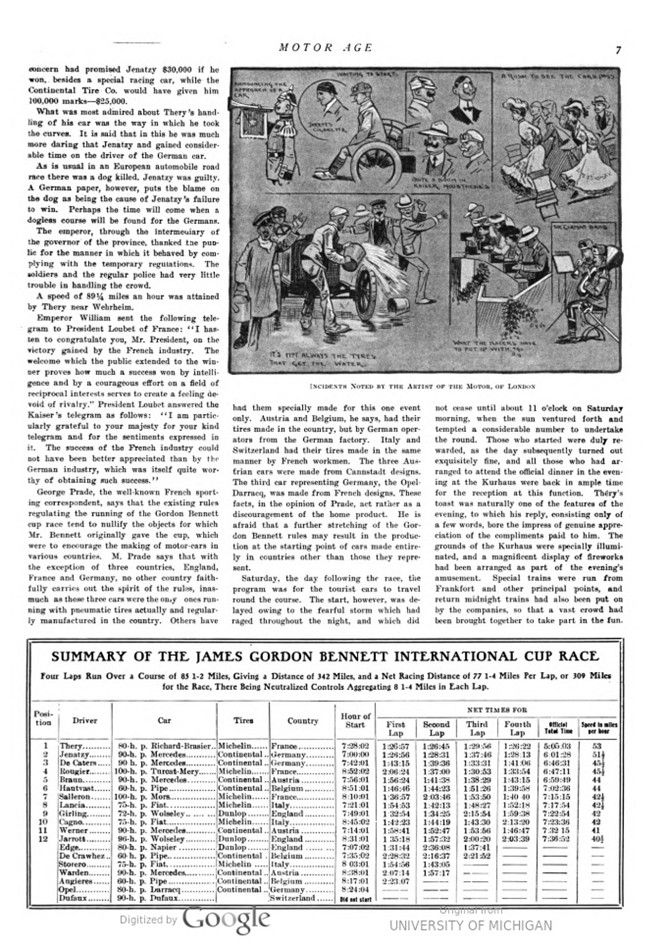
The final order of the finishers according to official total net time was Thery, 5:50:03; Jenatzy, 6:01:28; de Caters, 6:46:31; Rougier, 6:47:11; Braun, 6:59:49; Hautvast, 7:02:36; Salleron, 7:15:15; Lancia, 7:17:54; Girling, 7:22:54; Cagno, 7:23:36; Werner, 7:32:14; Jarrott, 7:36:52.
Scoring the race a basis of eighteen points for first, seventeen for second, and so on down to one for eighteenth, crediting those who dropped out with nothing, the teams of the different countries ranked by points as follows:
France 45
Germany 33
Austria 22
Italy 20
England 17
Belgium 13.
THE WINNER’S STORY
“How did I win the cup! Well, that’s very simple; I had an excellent car, much luck and a little coolness.
“I am 25 years old, have occupied myself with automobiles for nearly 10 years and have taken part in races for nearly 5 years. Before becoming connected with the Georges Richard-Brasier concern I was with the Decauville company for 6 years and it was there that I took my first lessons. I drove in the important events of the last few years such as the Paris-Vienna, the mile at Nice, the la Turbie contest, the Paris-Madrid, and others in Decauvilles. Sometimes I finished well but often had bad luck; my day had not yet come.
“It is only since the first of last November that I have been driving Richard-Brasier cars and thus had 6 months prior to the eliminating race in which to learn my machine. Havily already had a long practice in driving automobiles, however, these 6 months were enough to enable me to become acquainted with by car. That is essential for a driver; if he wants to get there he must know perfectly the mechanism of his car. This quality is even more important than the ability to drive.
“A fortnight before the race, I went to Germany with Mr. Brasier, who built the car. I went over the course only four times, not many times to learn all the difficulties of the circuit, which was very dangerous for a careless and imprudent driver-nearly 100 turns per lap, and what turns! Some in the middle of a down grade and some at right angles. But then, this could not greatly annoy an old timer who has seen worse in the Paris- Vienna and the Arlberg races. In one word, the near approach of the race did not effect me so that I lost my appetite nor did I become thinner. Just as long before the race, I weigh 220 pounds.
“At 7:28 in the morning, 28 minutes after the start of Jenatzy, M. Tampier, the time- keeper, had me started and I went away without thinking about anybody except to salute Emperor William. I thought only of one thing and that was to go faster than my competitors, and especially faster than Jenatzy, who, I fully recognize, gave me a hard run. At the end of the first lap, I was already satisfied, as I had made a dead heat with Jenatzy for the time of the lap. Owing to the elasticity of my motor I was able to gain 2 minutes during the second circuit and 10 minutes during the third. From that time on I had no more fear, and, excepting a possible accident, I considered the race as mine and became more prudent the nearer I came to the goal.
“The rest is known. I finished without an accident. When I reached the finishing line, I was acclaimed winner, carried off the course in triumph, and, according to what they say, the emperor took off his cap, which is not within the protocol. I must say that I felt very proud about this act of the German ruler.
“And there you are. I have not said very much and yet I have nothing more to tell. One more word, however. Do you know what was my strongest impression during the race? It was that of an intense thirst.”
THE LOSER’S STORY
“Both Thery and I covered the route without stop, accident or tire puncture, and that means that both cars are good. The fact that the third car came in 45 minutes behind was an expected fact and before the race the opinion was that the fight would be between Thery’s car and mine.
“The advantage gained by the Frenchman is due especially to my logs in time for taking on fuel, and it happened this way — it is impossible to fill up the tank of the Mercedes car while it is going. It is necessary to relieve the air pressure to put in the gasoline and this required a stop of 2 minutes before each control.
“I gained a second over Thery in the first lap. But during the next circuit I lost much more time. My supply station was in Limburg and I had to slow up before the control was reached. The employes of the Mercedes company, who prepared the flasks containing the gasoline, thought it would be a good scheme to make a hole in the cover of each flask to let in air. My mechanic did not know this and some gasoline was spilled on the car. Being afraid that the car might take fire, the mechanic threw the flask away. Having started I passed the control. I could not go back and I took the chance of going on without a sure supply of gasoline. Between Usingen and Weilburg I ran short and lost 20 minutes in finding a supply.
“During the last lap, at the Limburg control I was told that Thery had only 2 minutes the advantage of me. I was going to take on some gasoline but thought it over and figured that I would lose 5 minutes by doing so. So, I took only one flask with me, although I had to run 80 kilometers. Bad luck once more confronted me between Esch and Koenigstein, where I had to again stop for gasoline. I lost 5 minutes here, so that I lost, all told, 30 minutes owing to lack of gasoline.
216 page 6
“I certainly expect to start again next year in France, upon a Mercedes, but not as number one. The first starter is compelled to open the course. For instance, near Weilburg, I took a turn very near the fence and the spectators who were on the bank became scared, thinking, very likely, that I was going to run into the bank. In an instant they scattered onto the road like a lot of chickens, and I am yet surprised that an accident was avoided.
“From then on I went slower at turns and figure I lost 2 to 3 minutes, as I had expected to cover the circuit in from 1:23 to 1:25. I have great confidence for next year’s race. The newspapers will say I am bluffing. I am defeated, that’s all. But just wait.
“I will also make a statement to the effect that the newspaper reports about a fight between myself and Thery are lies. There never occurred such an incident. On the contrary, I shook hands with Thery, who is one of my old friends. However, I had a dispute with a tire manufacturer after the race. He thought it was possible to buy Jenatzy like a jockey. We had some hot words, and that’s all.”
THE CAR TROUBLES
There were no really serious accidents to the cars, but England suffered most of them all.
The first accident to Charles Jarrott’s Wolseley car was the breaking of the left side chain and the smashing of a steel guard. The next accident was the breaking of the governor so that the throttle valve was jammed open. It became necessary for his mechanic to operate the switch cutting off the ignition whenever it was necessary to slow down the engine. The third speed gear was put out of order on account of the severe shocks from the motor. During the final circuit the radiator opened up and could not be fixed satisfactorily. Later only three cylinders worked.
Girling’s first trouble with the second Wolseley car came when some dirt was drawn into his carbureter, which caused it to operate poorly. Later on a gasoline pipe broke.
Edge’s troubles with the Napier were principally with the crank chamber, in which water located, thus spoiling the lubrication. Nearly a quarter of an hour was lost during the second lap on account of the commutator chain coming off. The pulley which holds the jockey-pulley also broke, and the cam shaft became bent, the chain jamming against it. Then came tire troubles and during the last lap the clutch ring broke. The cardan joint of the Opel-Darracq car broke right after the start. De Crawhez had ignition trouble with his Pipe car. Lancia’s Fiat and Braun’s Austrian Mercedes suffered tire punctures, while Salleron lost 23 minutes in putting new links in one of the chains of his Mors car. Werner lost considerable time because the brakes on his Austrian Mercedes car did not work right.
NOTES OF THE CONTEST
“Your majesty, France has won the Gordon Bennett race,” said Duke von Ratibor, president of the German Automobile Club to the emperor, a few seconds after Thery had crossed the tape in front of the grand stand.
Thery and Jenatzy started the quickest, while Baron de Caters required about a dozen starts before he could get his motor going right.
The Belgian contestants seemed the least excited and were greatly admired for their coolness. According to a Brussels paper, Augieres said after the race: “Our aim was not to win the cup, but to make the best possible showing of regular running.
The most conservative estimate as to the attendance all along the circuit is that between 400,000 and 450,000 people watched the contest. Of his number 150,000 are supposed to have been in the direct neighborhood of the start and finish.
It was noticeable that the French men and women were much more enthusiastic during the entire duration of the race than any of the other spectators. They greeted their three countrymen with the wildest kind of demonstration each time they passed, and were also very enthusiastic at the passage of Jenatzy and Baron de Caters.
“Well, if that is the emperor’s brother, I am greatly surprised,” said an Englishman. “You would never take that fellow for Prince Henry, the way he goes around shaking hands with the ‘common’ drivers as well as with some of the manufacturers and well known automobilists.”
Quite a number of the contestants took off their caps every time they passed the grand stand. Thery was always the coolest, looking towards the imperial box and smilingly saluting.
While the kaiser did not receive Théry after the race, it is said that he clapped heartily after the Frenchman had won.
The emperor of Germany sent his photograph with an autograph to Thery, Brasier and Baron von Zuylen, president of the Automobile Club of France.
After Thery’s victory, Baron von Zuylen, Chevalier Rene de Knyff, Count Chasseloup-Loubat and other members of the Automobile Club of France were received by the emperor, empress and other guests of the imperial family. The president of the Auto-mobile Club of France made the following speech: “I thank your majesty, in the name of the Automobile Club of France, for the hearty welcome which we have received in Germany and for all the arrangements which have been made and which operated so perfectly. for the furthering of the triumph of automobilism, which owes so much to your majesty. Gentlemen of the automobile club, I ask you, as a token of our thanks, to join me in the yell: ‘Long live his majesty, the German emperor.”
When the people in the grand stand heard the echo of the yell it was taken up by them and then by those outside of the grand stand. It was a moment of intense joy and enthusiasm.
M. Brasier gave Thery $20.000 for having won the race, while it is reported that M. Michelin presented him with a check for $10,000. A conservative German paper stated that the Daimler concern had promised Jenatzy $30,000 if he won, besides a special racing car, while the Continental Tire Co. would have given him 100,000 marks – $25,000.
What was most admired about Thery’s handling of his car was the way in which he took the curves. It is said that in this he was much more daring that Jenatzy and gained considerable time on the driver of the German car.
As is usual in an European automobile road race there was a dog killed. Jenatzy was guilty. A German paper, however, puts the blame on the dog as being the cause of Jenatzy’s failure to win. Perhaps the time will come when a dogless course will be found for the Germans. The emperor, through the intermediary of the governor of the province, thanked the pub- lie for the manner in which it behaved by com- plying with the temporary regulations. The soldiers and the regular police had very little trouble in handling the crowd.
A speed of 89¼ miles an hour was attained by Thery near Wehrheim.
Emperor William sent the following telegram to President Loubet of France: “I hasten to congratulate you, Mr. President, on the victory gained by the French industry. The welcome which the public extended to the win- per proves how much a success won by intelligence and by a courageous effort on a field of reciprocal interests serves to create a feeling devoid of rivalry.” President Loubet answered the Kaiser’s telegram as follows: “I am particularly grateful to your majesty for your kind telegram and for the sentiments expressed in it. The success of the French industry could not have been better appreciated than by the German industry, which was itself quite worthy of obtaining such success.”
George Prade, the well-known French sporting correspondent, says that the existing rules regulating the running of the Gordon Bennett Cup race tend to nullify the objects for which Mr. Bennett originally gave the cup, which were to encourage the making of motorcars in various countries. M. Prade says that with the exception of three countries, England, France and Germany, no other country faithfully carries out the spirit of the rules, inasmuch as these three cars were the only ones running with pneumatic tires actually and regularly manufactured in the country. Others have had them specially made for this one event only. Austria and Belgium, he says, had their tires made in the country, but by German operators from the German factory. Italy and Switzerland had their tires made in the same manner by French workmen. The three Austrian cars were made from Cannstadt designs. The third car representing Germany, the Opel-Darracq, was made from French designs. These facts, in the opinion of Prade, act rather as a discouragement of the home product. He is afraid that a further stretching of the Gordon Bennett rules may result in the production at the starting point of cars made entirely in countries other than those they represent.
Saturday, the day following the race, the program was for the tourist cars to travel round the course. The start, however, was delayed owing to the fearful storm which had raged throughout the night, and which did not cease until about 11 o’clock on Saturday morning, when the sun ventured forth and tempted a considerable number to undertake the round. Those who started were duly rewarded, as the day subsequently turned out exquisitely fine, and all those who had arranged to attend the official dinner in the evening at the Kurhaus were back in ample time for the reception at this function. Théry’s toast was naturally one of the features of the evening, to which his reply, consisting only of a few words, bore the impress of genuine appre-iation of the compliments paid to him. The grounds of the Kurhaus were specially illuminated, and a magnificent display of fireworks had been arranged as part of the evening’s amusement. Special trains were run from Frankfort and other principal points, and return midnight trains had also been put on by the companies, so that a vast crowd had been brought together to take part in the fun.
Photos.
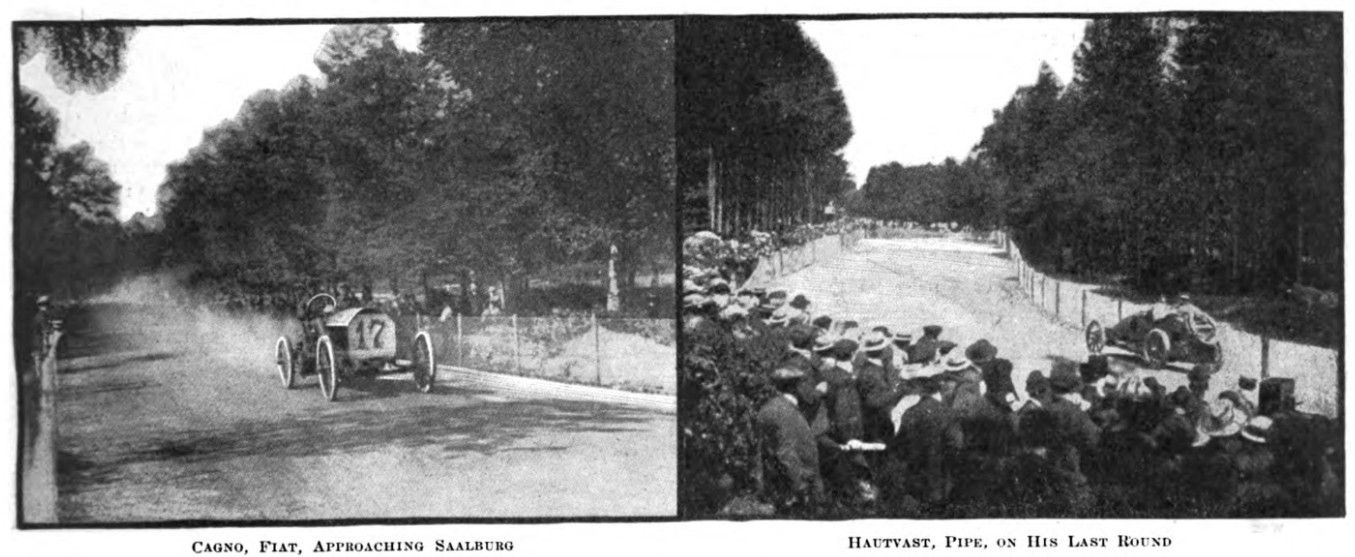
Page 1. CAGNO, FIAT, APPROACHING SAALBURG – HAUTVAST, PIPE, ON HIS LAST ROUND – THE TIMEKEEPERS AT SAALBURG
Page 2. WEIGHING IN THE CARS – ATTACHING THE SEALS TO A CAR – READY TO START JENATZY – COOLING SALLERON’S TIRES WITH WET CLOTHS IN A CONTROL – EDGE IN TROUBLE IN A CONTROL
Page 3. THE GERMAN EMPEROR WATCHING THE RACE – BRAUN, MERCEDES, RUSHING PAST THE GRANDSTAND – PRINCE HENRY TELLS A JOKE
Page 4. FRITZ OPEL ON THE STARTING LINE – THERY ACCORDING TO L’AUTO‘S ARTIST – UPHILL INTO WEILBURG
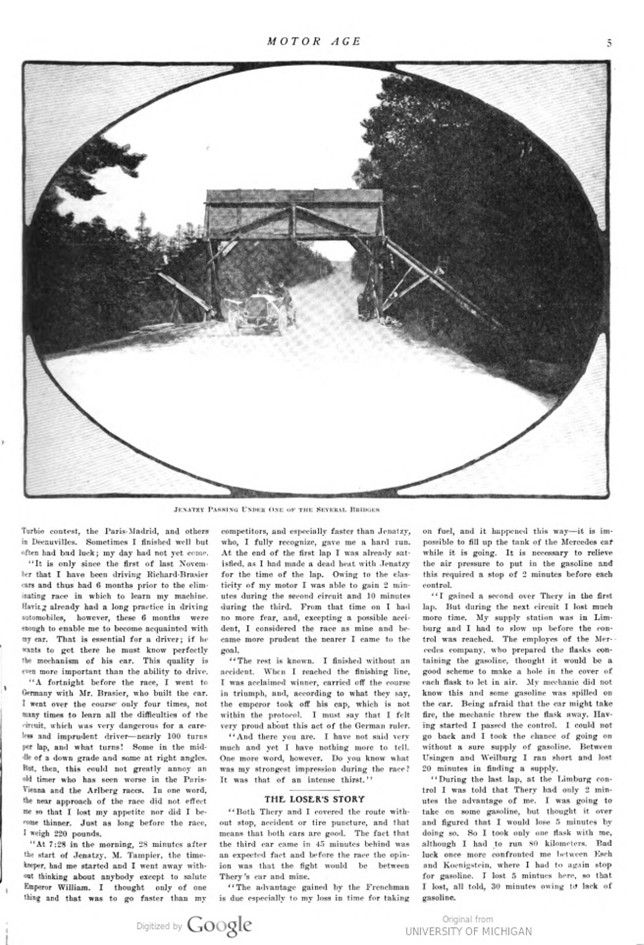
Page 5. JENATZY PASSING UNDER ONE OF THE SEVERAL BRIDGES
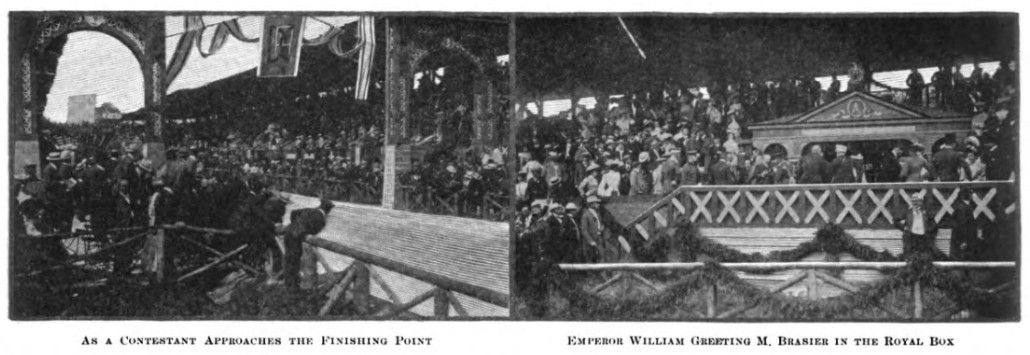
Page 6. AS A CONTESTANT APPROACHES THE FINISHING POINT – EMPEROR WILLIAM GREETING M. BRASIER IN THE ROYAL BOX. – PRESIDENT ZUYLEN, OF THE A. C. F. – SECRETARY VON BRANDENSTEIN, OF THE G. A. C. (FROM DAS SCHNAUFERL)
Page 7. INCIDENTS NOTED BY THE ARTIST OF THE MOTOR, OF LONDON: ANNOUNCING THE APPROACH OF A CAR – JARROTS CIGARETTE – WATING TO START – QUITE A BOOM IN KAISERS MOUSTACHES – A RUSH TO SEE THE CARD PASS – IT’S NOT ALWAYS THE TYRES THAT GET THE WATER – WHAT THE RACERS HAVE TO PUT UP WITH – THE GERMAN BAND
SUMMARY OF THE JAMES GORDON BENNETT INTERNATIONAL CUP RACE
Four Laps Run Over a Course of 85 1-2 Miles, Giving a Distance of 342 Miles, and a Net Racing Distance of 77 1-4 Miles Per Lap, or 309 Miles for the Race, There Being Neutralized Controls Aggregating 8 1-4 Miles in Each Lap.