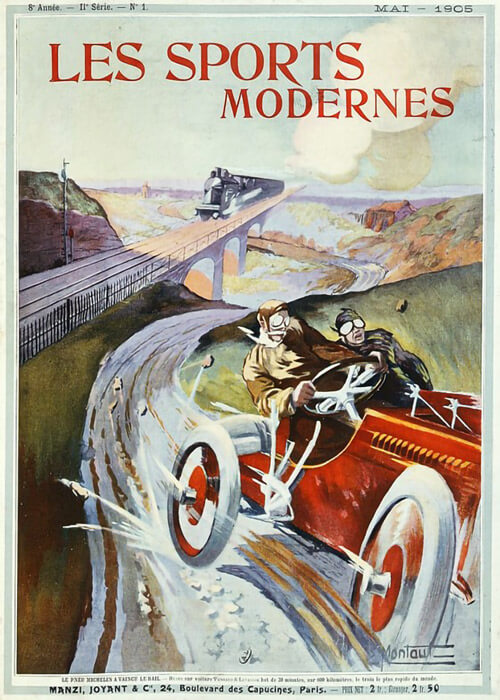
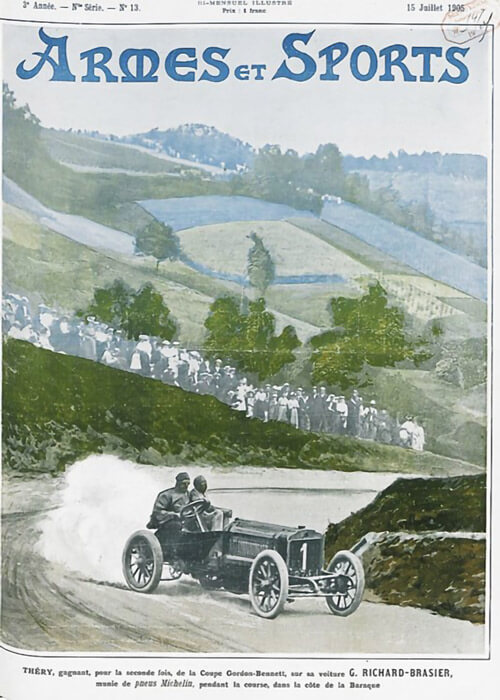
The New York Herald had their European Edition, which appeared in Paris. And of course it was more than normal to publish on all the Gordon Bennet events. Just prior to and just after the 1904 Cup Race, several daily articles were devoted to that very event. Relatively few photographs, but combined with a lot of text. Especially interesting is all that what happens in-and-around the race. A fine read, all articles; gives You an impression of those days.
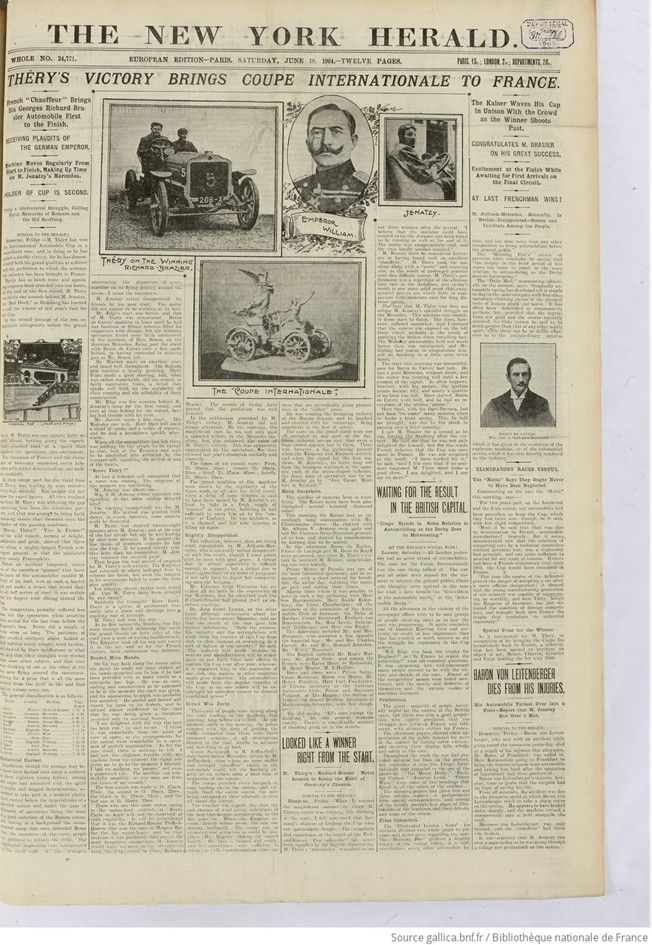
Text and photos with authorisation of Bibliothèque National de France, gallica.bnf.fr.; compiled by motorracingistory.com,
THE NEW YORK HERALD, European Edition, PARIS, SATURDAY, JUNE 18, 1904.
THERY’S VICTORY BRINGS COUPE INTERNATIONALE TO FRANCE.
French “Chauffeur” Brings His Georges Richard-Brasier Automobile First to the Finish.
RECEIVING plaudits of THE GERMAN EMPEROR.
Machine Moves Regularly From Start to Finish, Making Up Time on M. Jenatzy’s Mercedes.
HOLDER OF CUP IS SECOND.
Truly a Gladiatorial Struggle, Calling forth Memories of Romans and the Old Saalburg.
The Kaiser Waves His Cap in Unison With the Crowd as the Winner Shoots Past.
CONGRATULATES M. BRASIER ON HIS GREAT SUCCESS.
Excitement at the Finish While Awaiting for First Arrivals on the Final Circuit.
AT LAST FRENCHMAN WINS!
M. Jellinek-Mercedes, Naturally, Is Rather Disappointed — Scenes and Incidents Among the People.
—–
[SPECIAL TO THE HERALD.]
Homburg, Friday. — M. Thery has won the International Automobile Cup in a munificent race, and in doing so he has gained a double victory, for he has demonstrated both his grand qualities as a driver and the perfection to which the automobile industry has been brought in France.
Rarely has so much tense and agonizing suspense been crowded into ten hours.
At the end of the first round, M. Thery was thirty-one seconds behind M. Jenatzy, the “Red Devil,” as Homburg has learned to call the winner of last year’s race for the Cup.
At the second passage of the two redoubtable antagonists before the grandstand, M. Théry was one minute forty seconds ahead, tearing along the superb, closely guarded road at a speed that thrashed the spectators into excitement. The champion of France and the champion of Germany contested every kilometre with bitter determination and reckless audacity.
As they swept past for the third time M. Thery was leading by nine minutes thirty-five seconds. The people did not know the exact figures. All they realized was that M. Thery was widening the gap separating him from his relentless pursuer, and that was enough to bring forth deafening cheers that drowned even the thunder of the passing machines.
“Bravo, Thery!” “Vive la France!” and the wild tumult, formed of delight, confidence and pride, showed that there was either a mighty-lunged French contingent present, or that the spectators were mainly Francophiles.
Unless an accident happened, unless cue of the countless “pannes” that beset the path of the automobilist robbed M. Théry of his lead, won at such a fearful risk and under a strain that would shatter all but nerves of steel, it was certain that his fingers were closing around the Cup.
The competitors probably suffered less than did the spectators while awaiting their arrival for the last time before the Emperor’s box. Never did a couple of hours seem so long. The partisans of both strolled restlessly about, looked at their watches every minute, tried to chat, and showed by their indifference to what was said that their thoughts were riveted upon some other subject, and that they were thinking of one or the other of the two men flying around the racecourse, striving for a prize that is all the more coveted from the peril to life and limb ‘hat its winner must run.
The general classification is as follows:
Driver. Country. Machine. Time H.M.S.
1. Thery France Richard-Brasier 5 50 8
2. Jenatzy Germany Mercedes 6 1 28
3. De Caters Germany Mercedes 6 46 31
4. Rougier France Turcat-Mery 6 48 11
5. Braun Austria Mercedes 6 59 6
6. Hautvast Belgium Pipe 7 2 36
7. Sallercn France Mors 7 15 3
8. Lancia Italy Fiat 7 17 54
9. Girling England Wolseley 7 22 54
10. Cagno Italy Fiat 7 23 36
11. Werner Austria Mercedes 7 32 14
12. Jarrott England Wolseley 7 36 32
Gladiatorial Contest.
Lugubrious though the presage may be, it must have flashed into many a memory these eighteen young fellows, strong and eager and animated with the spirit of rivalry and dogged determination, assembled to take part in a modern gladiatorial contest before the imperial ruler of a powerful nation and under the gaze of thousands of spectators lining the seats of a good imitation of the Roman circus, and, having as a background the reconstructed camp that once defended Rome from the ancestors of the very people now gathered to witness the strife. The gladiatorial impression was accentuated by the shrill calls of the trumpets announcing the departure of every machine on its flying journey around the arena — I mean the racecourse.
M. Jenatzy rather disappointed his friends by his poor start. The motor did not appear to be working at its best.
Mr. Edge’s start was better, and that of M. Tilery was sensational. Baron tie Caters’ inability to leave until he had lost fourteen or fifteen minutes filled his supporters with dismay, but the ordinary spectators found some little excitement in the spectacle of Herr Braun, on the Austrian Mercedes, flying past the stand with Baron de Caters only a few yards behind, he having succeeded in starting just as Mr. Braun left.
Mr. Warden made an excellent start and raced well throughout. The Italians also received a hearty greeting. Their Fiats made a good showing, and what was rather remarkable, did the rounds in fairly equivalent times, a detail that speaks well both for the regularity of their running and the reliability of their construction.
Mr. Edge was five minutes behind M. Jenatzy’s time for the first round, and over an hour behind for the second, having had trouble with his tires.
Mr. Jarrott made a fine start. His Wolseley ran well. Herr Opel left amid a cloud of smoke and a volley of reports, and he had a breakdown quickly afterwards.
When all the competitors had left there was nothing for the people to do except to chat, look at the Emperor and wait to be electrified into attention by the trumpet-calls signaling the arrival of one of the racers.
“Bravo Thery!”
At last, a trumpet call announced that a racer was coining. The suspense at this moment was maddening.
M. Jenatzy was about due.
Was it M. Jenatzy whose approach was signaled, or had some mishap delayed him?
The warning trumpet-call was for M. Jenatzy. His arrival was greeted with cheers, in which, however, some anxiety could be discerned.
M. Thery had started twenty-eight minutes after M. Jenatzy, and at the end of the last circuit but one he was leading by over nine minutes. If he passed the line inside of nineteen minutes he had won the Cup. If he passed twenty minutes later than his competitor, M. Jenatzv retained the coveted prize.
Then began the real period of anguish for M Tilery’s well-wishers. The Emperor had returned at about half-past four to witness the finish, but even the interest in his movements failed to make the time pass quickly.
Ten minutes, eleven, twelve were ticked off. Can M. Thery have been delayed by any cause?
Suddenly the trumpets blare forth. There is a quiver of excitement that swells into a shout and develops into a crashing roar of triumph.
M. Thery had won the cup.
As he flew across the finishing line like some strange bomb skimming the earth the grandstands on both sides of the road were a mass of waving handkerchiefs. The Emperor took off his cap and waved it in the air, and as for the French visitors, their enthusiasm was delirious.
Needed More Hands.
On his way back along the course after the finish he could not have shaken all the hands stretched out to him if he had been provided with as many hands as a centipede has legs. He was as cool, smiling and unconcerned as he appeared to be at the moment the start was given, and his appearance tonight was probably less assumed. He smiled and bowed and waved his hand to his friends, and he seemed almost indifferent to the fact that he was being given a reception accorded only to national heroes.
“I am delighted with the way the race has been run,” lie said to me. “I think it was remarkable from the point of view of sport, as the arrangements for the course were remarkable as a specimen of perfect organization. As for the race itself, there is nothing to tell. I had not the slightest trouble with my machine from the moment the signal was given to me to go to the moment I finished. I had no mishaps, no ‘pannes,’ not even a punctured tire. The machine ran wonderfully smoothly, as you may see from the times of my rounds.”
The first circuit was made in 1h. 27min. 27sec., the second in 1h. 26min. 22sec., the third in 1h. 29min. 51sec., and the last one in 1h. 26min. 23sec.
Those who saw this same motor racing in the motor-boat contests at Monte Carlo in April will not be surprised at such regularity. It will be remembered that it was the Richard-Brasier Trefle-a-Quatre that won the race in Monaco Bay for the big motorboats, and on that occasion, it was predicted that one of the most, dangerous competitors M. Jenatzy would have to meet in his struggle to keep the Cup would be the Richard-Brasier. The events of today have proved that the prediction was well founded.
In the enthusiasm provoked by M. Thery’s victory, M. Jenatzy did not escape attention. On the contrary, the magnificent race he ran not only paid a splendid tribute to the Mercedes machine, but also enhanced the value of M. Théry’s victory. This was apparently appreciated by the spectators, for they cheered last year’s champion cordially and sincerely.
The times of his rounds were: First, 1h. 26min. 56sec.; second, 1h. 28min. 33sec.; third. 1h. 37miri. 46sec.; fourth, 1h. 28min. 13sec.
The grand qualities of the machine were shown by the regularity of the times made on all save the third round, when a delay of some minutes is said to have been caused by M. Jenatzy’s refusal to take in a fresh supply of “essence” at one point, believing he had sufficient to carry him on to the “controle” at Limburg. He was mistaken, so it is claimed, and lost nine minutes in filling up again.
Slightly Disappointed.
This reflection, however, does not bring much consolation to M. Jellinek-Mercedes, who is naturally rather disappointed with the result, though I must admit that he loses with good grace. A defeat due to actual superiority is difficult enough to support, but a defeat due to short-sightedness or an error of judgment is not only hard to digest but exasperating into the bargain.
Mr. Clarence Gray Dinsmore has retained all his faith in the superiority of the Mercedes, but he admitted that the Richard-Brasier had proved itself an excellent machine.
Dr. John Grant Lyman, on the other hand, although enthusiastic about his thirty-five horse-power Mercedes, told me that the result of the race gave him sincere satisfaction. “Both the automobile industry and the automobilists will profit from the transfer of this Cup from club to club, instead of remaining as a sort, of fixture in one country.” he said. “The industry will profit because inventors and manufacturers will be stimulated to put forth their best efforts to capture the Cup year after year, whereas, if it remained long in the possession of one club, the makers in other countries might grow dispirited. The automobilists will profit from the regular transfer of the Cup, as no one maker will be encouraged by unbroken success to demand exorbitant prices.”
Crowd Was Early.
Thousands of people were strung along the road leading to the Saalburg this morning, long before six o’clock. At one moment, early in the morning, the police charged with the duty of guiding the traffic estimated that there were three thousand vehicles of all descriptions blocked in the road, unable to advance and unwilling, to go back.
Count Sierstorpff, in M. Auffm-Ordt’s sixty horse-power Mercedes, driven by M. Auffm-Ordt, than whom no more skillful and intrepid “chauffeur” exists in the automobile world, left the Saalburg exactly at six o’clock upon a final tour of inspection of the course.
The troops guarded every footpath or road leading on to the course, and virtually lined the entire course, the men being stationed at close intervals in twos all round the circuit.
The weather was superb, the clear sky and absence of wind giving indications of the heat, that became overpowering as the day wore on. When the Emperor arrived, shortly before seven, the sun was shining brilliantly. The scene was as animated and attractive as could he imagined, His Majesty looking in superb health. His face is tanned and ruddy, and his appearance was sufficient to stamp as idle sensationalism the rumors that are periodically given prominence in the “yellow” press.
He was wearing the becoming uniform of the Hussar Guards, and he laughed and chatted with his “entourage,” being manifestly in the best of spirits.
The seats on the grandstand were not all occupied at any part of the day. These tribunes are so vast that even a huge crowd appears lost in them. There was, however, a big, gathering present when the Emperor and Empress arrived, and when the signal for the first machine, M. Jenatzy’s, to leave rang out from the trumpets stationed at the opposite ends of the arena-shaped tribunes, the dense mass of spectators rose to see M. Jenatzy go by. “Avé, Caesar, Morituri te Salutant!”
Many Snapshots.
The number of cameras here is terrifying. The Kaiser must have been photographed several hundred thousand times.
This morning the Kaiser had an exceedingly long conversation with Mr. Charlemagne Tower. He chatted with Mr. Allison V. Armour very gaily and had Mr. Clarence Gray-Dinsmore presented to him, and showed his consideration by bidding him to be seated.
In the afternoon Baron de Zuylen, Prince do Lucinge and M. Rene de Knyff were presented, and after M. Thery’s victory lie received M. Brasier, congratulating him very warmly.
Prince Henry of Prussia was one of the most interested spectators, and he remained, with a short interval for breakfast, the entire day, watching the racers go past and noting their times.
Among those whom it was possible to note in such a big gathering were Herr von Hammerstein, Herr Budde Eulenburg, the Court Chamberlain, all the members of the committee of the Automobile Club of Germany, the Duke of Ratibor, Count Sierstorpff, Freiherr von Brandenstein, Dr. Max Levin, Geheimrath Goldberger and Herr von Engler.
The Americans included Mr. and Mrs. Dinsmore, who occupied a box opposite the Imperial logo; Mr. and Mrs. Charles Carroll, Mr. and Mrs, Howard Johnston, Mr. “Willio” Roosevelt.
The English included Mr. Roger Wallace, Mr. Julian Orde; and among the French were Baron Henri de Rothschild, M. Henri Menier, M. L’Huillier.
Here and there were: Prince Solms, Count Kolowrat, Baron von Meyer, Mr. Henry Peartree, Herr Carl Fassbinder, of Vienna, secretary of the Austrian Automobile Club ; Baron and Baroness Pallandt, of The Hague; the Sultan of Johore, the Grand Duchess Anastasia of Mecklenburg-Schwerin, with her daughter.
The old saying, “All’s over except the shouting,” fits the present occasion exactly. There’s a considerable amount of shouting going on in the streets.
LOOKED LIKE A WINNER RIGHT FROM THE START.
M. Thery’s Richard-Brasier Motor Seemed to Sound the Knell Germany’s Chances.
[SPECIAL TO THE HERALD]
Homburg, Friday. — When I noticed the magnificent manner in which M. Théry’s motor was running this morning at the start, I felt convinced that Germany’s chances of keeping the Cup were not particularly bright. The regularity and smoothness of the march of the Richard-Brasier “Cup Contester” has never been equaled in the history of motoring. M. Therv’s “mecanicien’’ remarked to me not three minutes after the arrival; “I believe that the machine could have covered twice the distance and been found to’ be running as well at the end of it. The motor was comparatively cool, and the tires hardly seemed touched.”
M. Brasier must be considered fortunate in having found such an excellent “chauffeur.” M. Thery took his machine along with a “nerve” and unerring aim, as the result of prolonged practice over this difficult course. M. Thery’s performance was a repetition of the eliminatory race in the Ardennes, and today’s result is one more solid proof that exaggerated powers are worth little in comparison with moderate ones for long distance racing.
The race that M. Thery won does not eclipse M. Jenatzy’s splendid struggle on the Mercedes. This machine ran smoothly from start to finish. The tires, however, suffered somewhat, and I noticed that the canvas was exposed on the left front wheel, probably as the result of applying the brakes when travelling fast. The Woiseley automobiles held out much better than was anticipated, and Mr. Girling had reason to congratulate himself on finishing in a little over seven hours.
The start this morning was uneventful, save for Baron de Caters’ bad luck. He had a good Mercedes, without doubt, and the motor was running well until a few seconds of the signal. As often happens, however, with big motors, the ignition points became oily, and nearly a quarter of an hour was lost. Once started, Baron de Caters went well, and he had no recurrence of the serious “panne.”
Herr Opel, with the Opel-Darracq, had not been “on route” many minutes when he broke a front spring. This, he told me tonight, was due to the shock in passing over a level crossing.
I saw M. Brasier for a second as he was leaving the Saalburg after the victory. He told me that he was not only delighted for himself, but for the whole French industry that the Cup was once more in France. He was not surprised at the result. “I have worked for it,” he said, “and I felt sure that if no accident happened M. Thery must make a good show. I am delighted, and I can say no more.”
WAITING FOR THE RESULT IN THE BRITISH CAPITAL.
“Coupe Stands in Some Relation to Automobiling as the Derby Does to Horseracing.”
[BY THE HERALD’S SPECIAL WIRE.]
London, Saturday. — All London yesterday had an acute attack of automobilitis.
The race for the Coupe Internationale was the one thing talked of. The war and all other news ceased for the moment to interest the general public, whose sole thoughts were centered in the race for what is here termed the “blue-ribbon of the automobile world,” or the “Automobile Derby.”
All the afternoon in the vicinity of the newspaper offices were to be seen groups of people awaiting news as to how the race was progressing. It quite reminded one of General Election time and certainly no event of less importance than that has created so much interest as did the struggle for supremacy in the Cup contest.
“Will Edge win hack the trophy for England?” or “Is France to regain the holdership ?” were oft-repeated questions. It was surprising how well-conversant many people seemed to be with the history and details of the race. Almost all the competitors’ names were heard mentioned, and the merits and demerits of themselves and the various makes of machines discussed.
Predictions.
The great majority of people naturally hoped for the success of the British team, hut there was also a good proportion who rightly predicted that the struggle was between France and Germany, with ultimate victory lor France.
The afternoon papers showed their appreciation of the public demand for news of the contest by issuing extra editions and devoting their display bills wholly and solely to the race.
Throughout the week the war had provided material for lines on the posters, but yesterday it was the Coupe Internationale that appealed to the eye of the passer-by. “The Motor Derby,’ Exciting Contest,” “Jenatzy Leads. “France Wins,” were some of the headings that flared in all the colors of the rainbow.
The morning papers had given two and three column reports of preliminaries from special correspondents, and several of the weekly journals had pages of illustrations of the machines and their drivers, and maps of the course.
Press Comments.
The “Illustrated London News” for instance devoted two whole pages to pictures and letter-press regarding the race. The “Morning Post” printed a lengthy review of the “event which, it is said, overshadows every other automobile fixture, and has done more than any other competition to bring automobilism before the general public.”
The “Morning Post’s” review of previous races concludes by saying that “the trophy in the brief period of five years has come to stand in the same relation to automobiling as the Derby does to horseracing.”
The “Daily Mail,” commenting editorially on the contest, says: “Gradually automobile racing has developed till it stands to-day in the same category with first-class mountain climbing as one of the sternest tests of human pluck and nerve. It has often been denounced as unnecessarily perilous, hut, provided that the regulations are good, and the course carefully selected, its risks cannot be said to be much greater than that of any other manly sport, while there can be no doubt whatever as to the extraordinary impetus which it has given to the evolution of the explosion machine, or of the substantial service which it has thus directly rendered to the industry.
ELIMINATORY RACES USEFUL.
The “Matin” Says They Ought Never to Have Been Neglected.
Commenting on the race the “Matin” this morning, says: —
“For two years past, on the Innsbruck and the Irish course, our automobiles had been powerless to keep the Cup, which they had twice won—though, be it said, with but slight competition.
“Must it be said that that was due to deterioration in French automobile manufacture? Scarcely. But it seems demonstrated now that the selection of competing cars by a technical committee without a previous test, was a deplorably bad principle, and one quite sufficient to account for our want of success. If there had been a French eliminatory trial since 1902, the Cup would have remained in France.
“This time the course of the Ardennes proved the danger of accepting a car after a mere official designation: it showed that the young manufacturing generation of our country was capable of representing us worthily, and now Thery, before the Emperor of Germany, has just defeated the coalition of foreign competitors, and brought back into France the trophy that symbolizes its industrial supremacy.”
Special Prize for the Winner.
As a testimonial for M. Thery, in recognition of his bringing the Coupe Internationale back to France, a subscription has been opened to purchase an object of art, Messrs. Charron, Girardot and Voigt heading the list with 500fr.
Baron Von Leitenberger Dies from his Injuries.
His Automobile Turned Over into a Field — Report that M. Jenatzy Ran Over a Man.
[SPECIAL TO THE HERALD]
Homburg, Friday. — Baron von Leitenberger, who met with an accident while going round the racecourse yesterday, died as a result of his injuries this afternoon.
Dr. Rehn, of Frankfort, was called in, Herr Katzenstein going to Frankfort to bring the famous surgeon in an automobile and taking him hack after the operation of laparotomy had been performed.
Baron von Leitenberger’s injuries, however, were so grave that the surgeon had no hope of saving his life.
From all accounts, the accident was due to the excessive speed at which Baron von Leitenberger tried to take a sharp curve on the course. He appears to have braked down sharply, and the machine turned a summersault into a field alongside the road.
Baroness von Leitenberger was only bruised, and the “chauffeur” had three ribs broken.
It was reported that M. Jenatzy ran over a man to-day as he was going through a village not neutralized on the course.
Photos
IMPERIAL BAR – (Start and Finish).
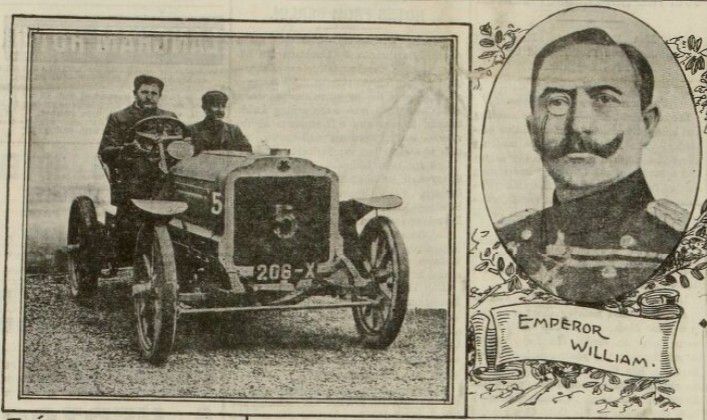
Théry on the Winning Richard – Brasier.
Emperor William.
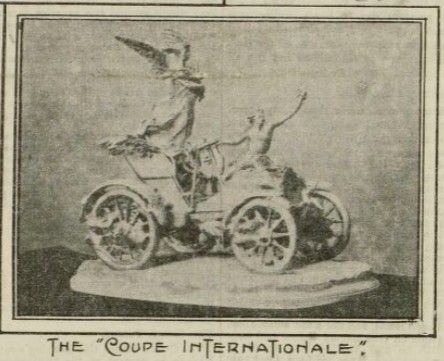
The “Coupe Internationale”.
JENATZY.
BARON DE CATERS. – (Who came in third on a Mercedes).