This is the first of a series of four articles in the French magazine La Vie automobile. In this first one, the route for the French elimination trials is described very meticuously. Lying in the north-east of France, the commision responsible to find the route for that elimination, undertook considerable efforts to find one that would resemble the 1904 Gordon Bennet Race in the German Taunus mountains. Finally they did! And so, preparations for the 1904 Gordon Bennet Cup got on their way.
With kind permission of Le Conservatoire numérique des Arts et Métiers (Cnum) – https://cnum.cnam.fr
Text and photos compiled by motorracingistory.com, translation by DeepL.com.
La Vie Automobile Vol. 4. — N° 137. – Saturday May 28, 1904.
The Elimination trials (1)
Next Friday, May 20, the qualifying round will be held to select the three French champions for the Gordon Bennett Cup, which will take place in June.
This event was decided, as we recall, by a vote of the Automobile Club de France Sports Commission, in order to allow all manufacturers to compete for a selection that truly represents the best of our automotive industry.
A vote by the Chamber of Deputies authorized the ministry to sanction the event.
A few days ago, the government, in the person of the Minister of the Interior, felt it necessary to make a change to the original route of the event, which we published two months ago.
This change had to be accepted immediately by the A.C.F. Sports Commission, otherwise the organizers’ authorization would be withdrawn. The organizers bowed to this decision. So it is this new route that we will be discussing today.
As we already announced in our last issue, the new route passes through Vouziers, Le Chesne, Les Crêtes de Neuvizy, and Rethel. This raises an initial question: when you look at a map of northeastern France, you are surprised by the choice of such a mediocre route, when there are so many beautiful roads in the same region that would have been so easy to use for the race!
We are not the first to express our surprise at this choice; others before us have already murmured their discontent. These complaints were met with the response that every effort had been made to find a route in France that was similar in difficulty to the famous German Taunus Circuit. If that was really the aim, then it has been achieved, because the new qualifying route is sufficiently dangerous so that numerous accidents are to be feared. We sincerely hope that our fears are unfounded and do not come true; we hope that the results will prove us wrong.
The impression that emerges after driving the circuit several times is that the roads are too narrow, that there are too many bad bends, and that the surface leaves much to be desired in many places along the route.
In some places, the road is no more than 3 meters wide; at the best points of the course, it is barely more than 6 meters wide, to which must be added, it is true, the shoulders, from which the grass is currently being removed but which will offer very little resistance to vehicles traveling at 110 or 120 kilometers per hour!
Efforts are also being made to reduce the danger of dangerous bends by widening them at the apex, but will this newly resurfaced road surface withstand the force of 120 to 130 vehicles? As the course is completed six times and there are 29 competitors, we can expect a minimum of between these two numbers of passes.
What cannot be improved, however, are the right-angle turns at Vouziers and Crêtes de Neuvizy, and the even more dangerous ones at Biernes and Bourcq. As for the small railway line that we encounter after Le Chesne and which runs alongside the road for 3 kilometers after crossing it at the bottom of a 1,500-meter descent with a 5% gradient, we do not think it can be removed! It is certainly very dangerous.
Having made these observations, we must acknowledge that the local authorities are doing everything they can to improve the route, with the powerful support of the Department of Bridges and Roads. Almost everywhere along the route, teams of road workers can be seen pulling up the grass on the sides of the road to widen it, or filling in potholes with gravel and sand, leveling the ground, or removing speed bumps. But, once again, will all these commendable efforts be enough, or would it have been better to choose another route, using the major national roads that abound in this region?
Security will be provided by 5,000 troops; military cyclists from Lunéville will serve as guides in Rethel, Vouziers, and Le Chesne, and finally, all the gendarmerie brigades in the department will join in!
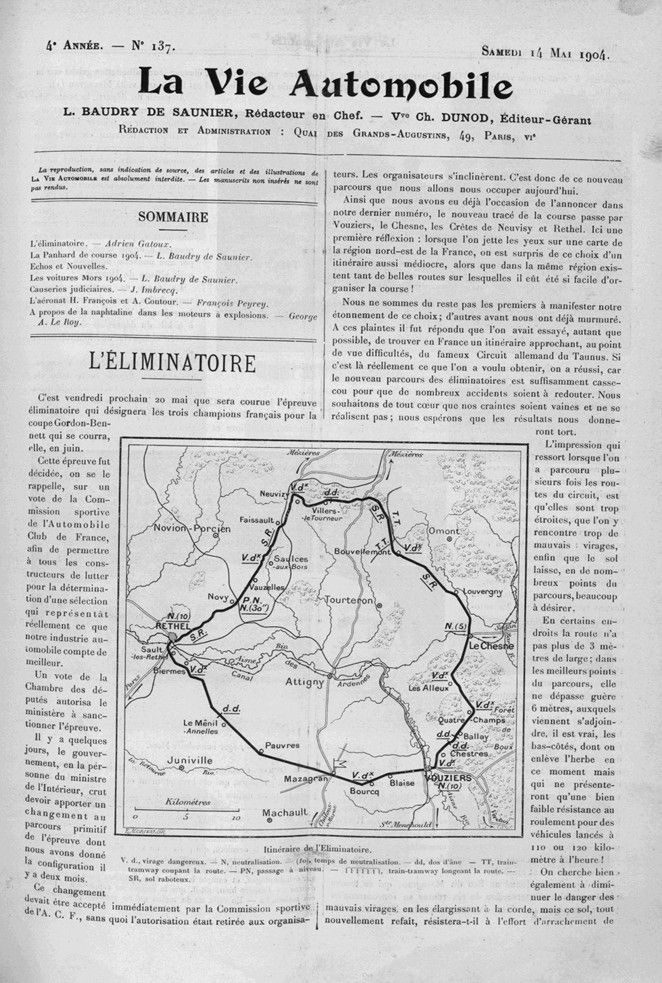
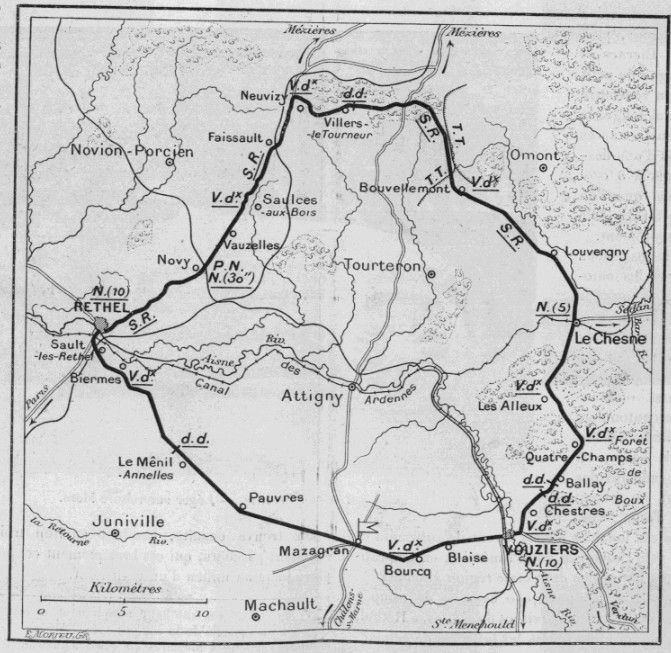
Let us now examine the route, for which we provide a carefully annotated map.
The start will be at Mazagran, which is located at the intersection of six roads meeting in the middle of a vast plain in the countryside. Three houses, one of which is under construction, rise up like gray silhouettes against the monotony of the plain. This is the starting point: Mazagran (1). (1) Mazagran is simply a stopping place, not a village. Its name recalls an episode in the conquest of Algeria. The road from the Châlons camp to Mézières is dotted with six small stopping places, of which Mazagran is the last, all bearing Algerian names: La Mosquée, etc. In Mazagran, a local is currently building a house. He is going to build a terrace on the roof, platforms on scaffolding, and plans to rent it all out at a high price for the day of the race: “I hope,” he says, “that the race will pay for my house!” — Here is at least one person who will no longer curse automobiles!
From the start, the road runs straight along a slightly steep slope, soon rising and then sloping down again in a series of small roller coaster-like bumps, quite similar to the undulations of the Quarante-Sous road. This straight line continues for 3.5 kilometers. Then, at the top of a ridge, the road veers sharply to the left, descends rapidly for 500 meters, then turns again at almost a right angle to arrive via another descent in the small village of Bourcq.
The road then continues straight ahead and downhill to Vouziers, which is 9 kilometers from the start and takes 10 minutes to cross.
Eight hundred meters from Vouziers, we leave the main highway to turn left at a right angle and take the Chesne road. Two kilometers of straight road, then a slight right turn; the road, which has been bumpy since Vouziers, improves and becomes excellent.
Then, for about three kilometers, there is an excellent stretch of road, which is suddenly cut off by a speed bump placed right in the middle of a small bridge.
Five hundred meters further on, the same thing happens again. This brings you to Bellay, where you cross the tracks of a small narrow-gauge railway.
The road then continues, in excellent condition, to the village of Quatre-Champs, which has four successive bends.
From Quatre-Champs, the road continues to be very good and climbs for a fairly long distance to reach a place called La Maison Rouge and then Le Chesne.
There is a 5-minute neutralization period when passing through Le Chesne, so we will not be concerned about the road at this point.
After leaving Le Chesne, the road climbs slightly and veers to the left; it then presents a series of long, slightly undulating straights for five kilometers. From this point, the road surface is poor for about a kilometer. It then improves, only to become terrible again in the village of Chagny.
We then reach Bouvellemont, which is very difficult to cross and requires a 30-second stop.
Shortly after Bouvellemont, there is a long, fairly fast descent of 5 to 6%. This descent is straight and could be taken at full speed — if it weren’t for the two tracks of a small Decauville railway currently under construction at the bottom. These two rails are a real hazard.
The road then climbs rapidly and is bordered for 2.5 kilometers by the narrow-gauge railway line, which takes up a third of the road, reducing it to three meters, which is very narrow. From this point, there is a beautiful series of straight lines for five kilometers, with successive left-hand bends, then more straight lines until Villers.
La Crête is marked by a sharp left-hand bend, somewhat reminiscent of the Longlier bend on the Belgian Ardennes circuit.
From this point on, the road becomes excellent and very wide until Rethel.
The only thing to note is the Novy-Chevrières level crossing, which has a 30-second delay.
This section of road from the Crêtes de Neuvigny to Rethel is certainly the most beautiful part of the route.
Rethel is reached via a long descent. The town of Rethel, which is about 1,500 meters long, is neutralized; the duration of this fifth and final neutralization is 10 minutes.
Immediately after Rethel, there are two small train-tramway tracks.
Then, after a two-kilometer straight stretch, there is a first left-hand bend that ends in a fast descent, approximately 600 to 700 meters long; at the bottom of the descent, there is a very sharp turn where the small village of Biernes begins. This point is very, very dangerous.
From Biermes, you then reach Pauvres, then Mazagran.
As you can see, the entire circuit, which competitors will have to race six times, is definitely not a track!
The competitors will start at two-minute intervals; this would mean, if all the riders were present, 58 minutes, which is enough time for the first rider to have completed one lap before the 29th rider starts. This is not a concern, as the neutralizations will hold up the riders long enough so that the first rider will not be able to return less than an hour and twenty minutes after his start.
The first neutralization is ten minutes long and involves crossing Vouziers; the second is five minutes long and takes place at Chesne; the third, which was imposed at the last minute and which we fully approve of, will be thirty seconds: it is located at the exit of Bouvellemont, at the bottom of a long descent, at a point where the road is crossed by a small railway line going to Baalon. The fourth neutralization, also lasting thirty seconds, is assigned to the Novy-Chevrières level crossing, and the last, lasting ten minutes, to the crossing of Rethel.
Timekeepers will be stationed at the entrance and exit of each neutralization.
The timekeeper at the entrance to a neutralization will give the lead cyclist the competitor’s card; the cyclist will ride ahead of the runner and give the card to the timekeeper at the exit control who, once the neutralization time has expired, will give the runner the start signal.
A whole squad of timekeepers will therefore be needed to carry out such an event; one will be needed at the start, two in Vouziers, two in Le Chesne, one in Bouvellemont, one in Novy-Chevrières and two in Rethel, making a total of nine.
Checking the sheets will necessarily take quite a long time, and the result will not be known immediately, as errors may occur in the neutralizations.
Finally, as the riders will have to cover the course six times, taking an average of 1 hour 20 minutes per lap, which is certainly a minimum, this gives a total of eight hours for the entire course.
As for the start time, it has not yet been set; however, it is assumed that the A.C.F. Sports Commission will decide on 5 a.m.
The roads will be completely closed to traffic from 4 a.m. and will not reopen until 4 p.m.
By giving the first start at 5 a.m., we can be sure that the terrain will be completely cleared, and the first competitor will be able to finish around 1 p.m.; and the winner, even if he started last, would certainly also have completed the course before 2 p.m.
The people of the Ardennes are eagerly awaiting the big event, and to be fair, we must say that, apart from the great curiosity aroused by the race, these good people’s hopes of making a decent profit add to their curiosity. A considerable crowd of visitors is expected, and the curious onlookers who will gather around the circuit will certainly number several hundred thousand.
At present, all the hotel rooms in Rethel, Vouziers, Attigny, and Le Chesne are already booked; apart from these, almost all those available in private homes have been rented.
Many curious onlookers would therefore be well advised to bring blankets and food in their cars if they do not want to suffer from the cold and go hungry during the night and day of May 20.
To watch the race, there will be a choice of locations along the 88-kilometer course; in any case, thrill seekers can position themselves near the bends at Biernes, Bourcq, Vouziers, and Crêtes de Neuvizy. Speed enthusiasts can choose from the long straights from Rethel to Vouziers. As for those who want to examine the competitors at their leisure, they can simply stay in the neutralized zones.
To get to the circuit, in addition to the two special trains provided by L’Auto, the Compagnie de l’Est is organizing a special train to Rethel.
The price of tickets for this train, which is very popular, will be 15 francs for a return trip in second class and 10 francs in third class. In addition, passengers will be able to take their bicycles with them, which will be transported for an additional fee of 1 franc.
Let’s end by hoping that there will be no accidents and that good weather will favor the event!
Adrien Gatoux.
Photos.
305. Route of the Elimination trials.
V. d., dangerous bend. — N, neutralization. — (to), neutralization time. — dd, speed bump – TT, train-tramway crossing the road. – PN, level crossing. – I-I-I-I train-tramway running alongside the road. — SR, rough ground.
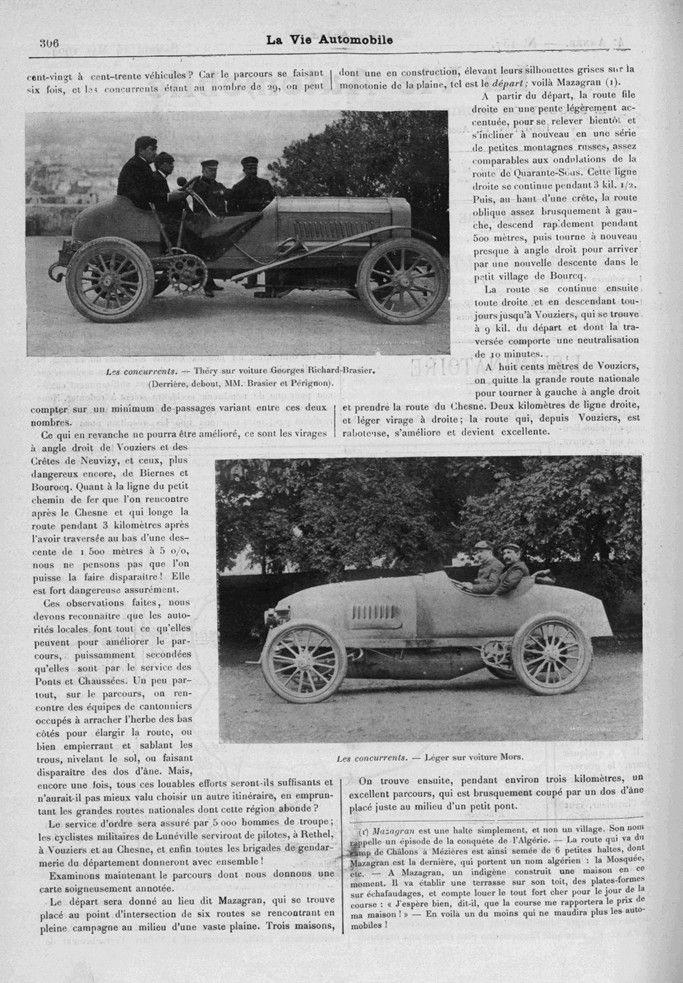
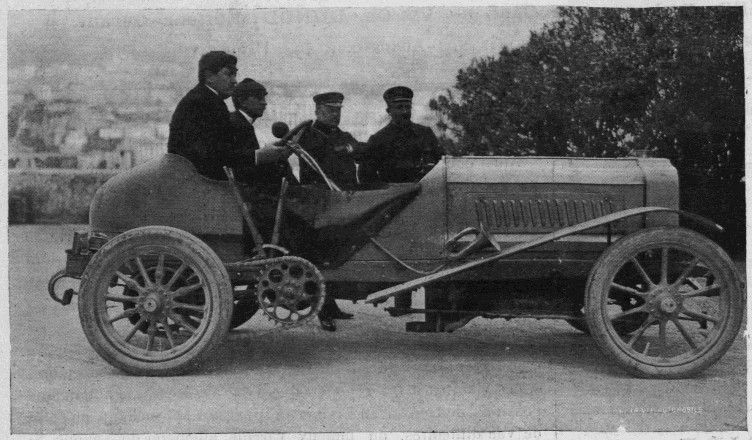
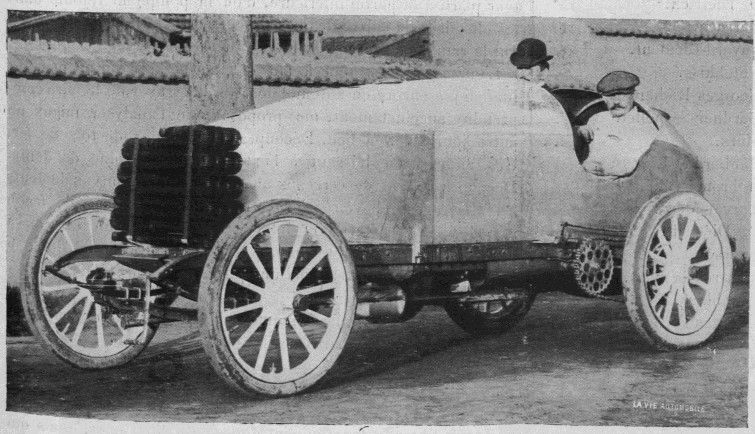
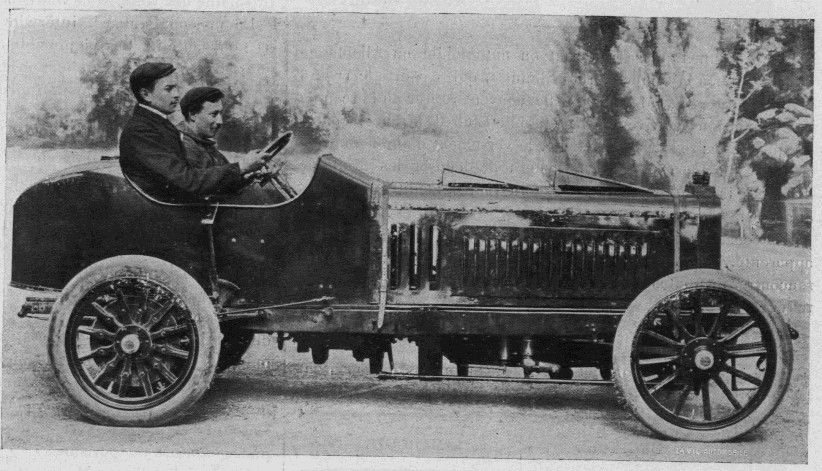
306. The competitors. — Théry in Georges Richard-Brasier’s car. (Behind, standing, Messrs. Brasier and Pérignon). — Léger in Mors’ car.
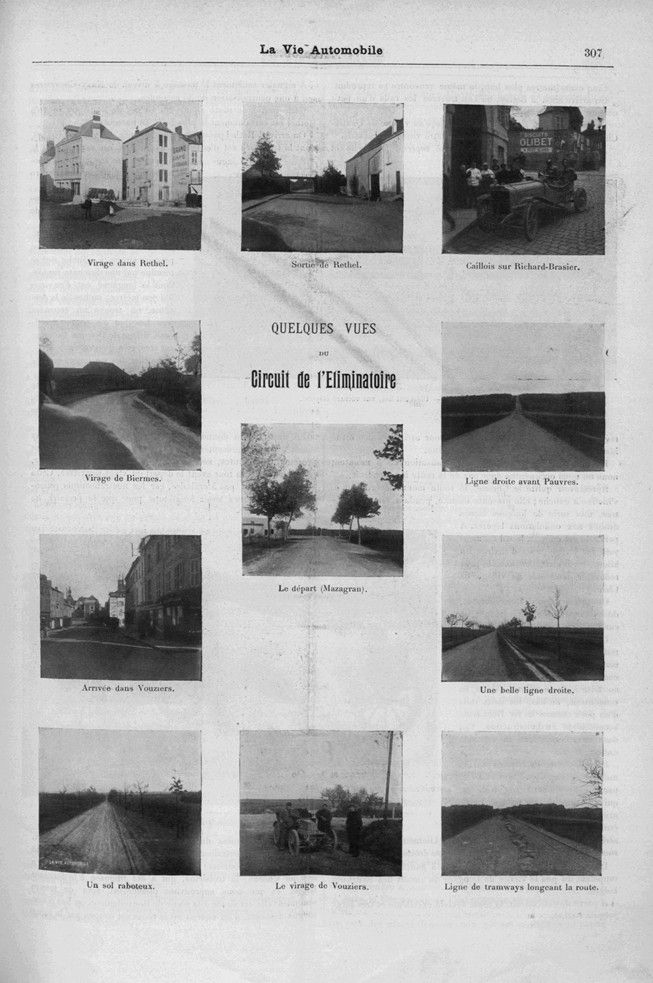
307. Some views of the Eliminatory Circuit
Bend in Rethel. – Exit from Rethel. – Caillois in Richard-Brasier. – The bend in Vouziers. – Straight ahead before Pauvres – Arrival in Vouziers. – A beautiful straight stretch. – Rough ground. – The bend in Vouziers. – Tram line running alongside the road.
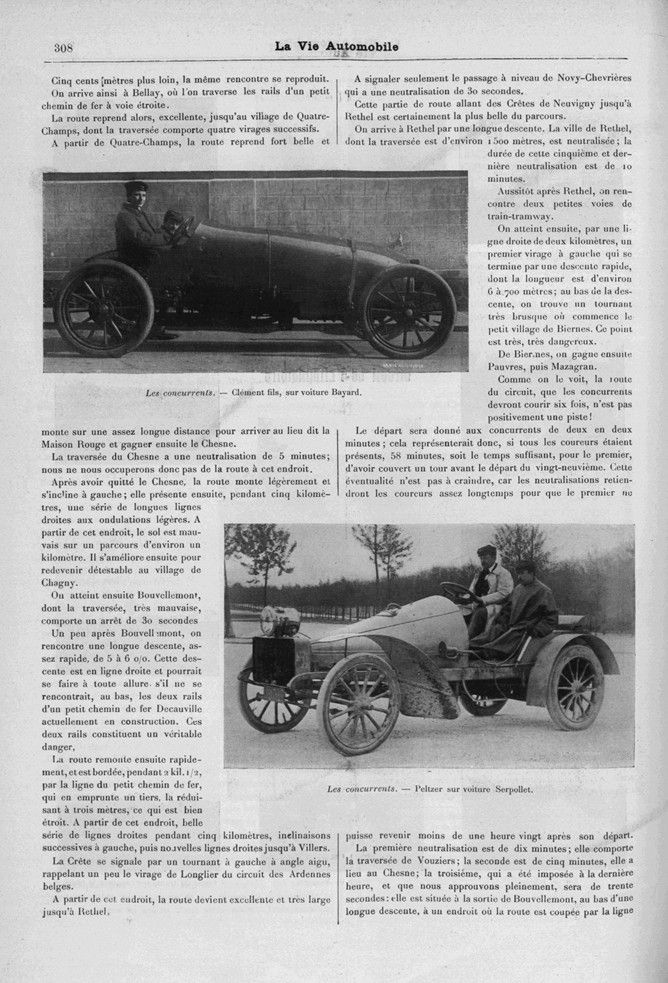
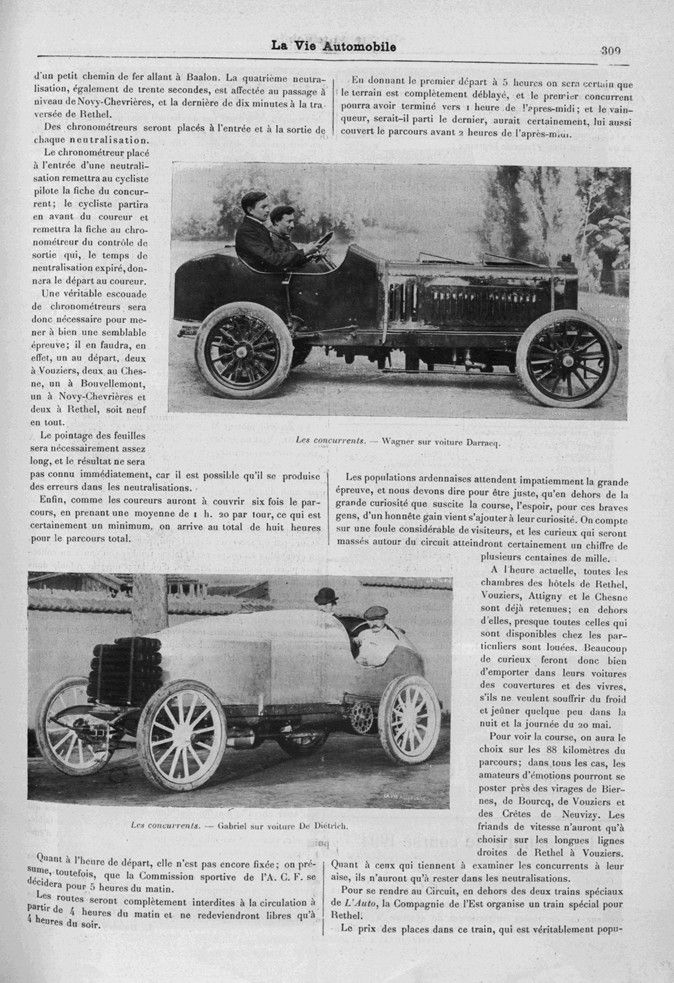
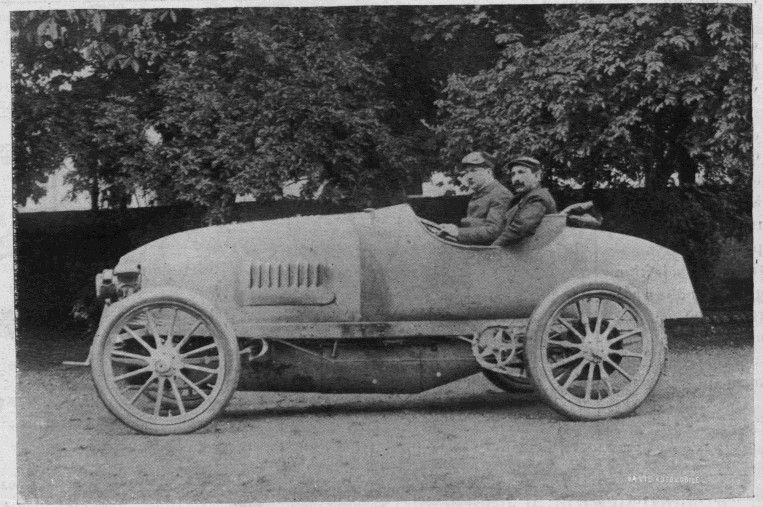
308 – 309. Competitors. — Clément sons, in a Bayard car. — Peltzer in a Serpollet car. — Wagner in a Darracq car. — Gabriel in a De Dietrich car.
***
People traveling by car to Germany to attend the Gordon Bennett Cup, which will take place on June 17 in Homburg, are advised that they can obtain a badge from the Automobile Club de France Sports Commission office, in exchange for a signed questionnaire and a payment of 2 francs. which will exempt them from paying customs duties at the border and provide them with all police and other facilities.
The badges must be affixed to the car in a clearly visible manner. Those who do not have these badges will encounter all sorts of difficulties when crossing the border.
* * *
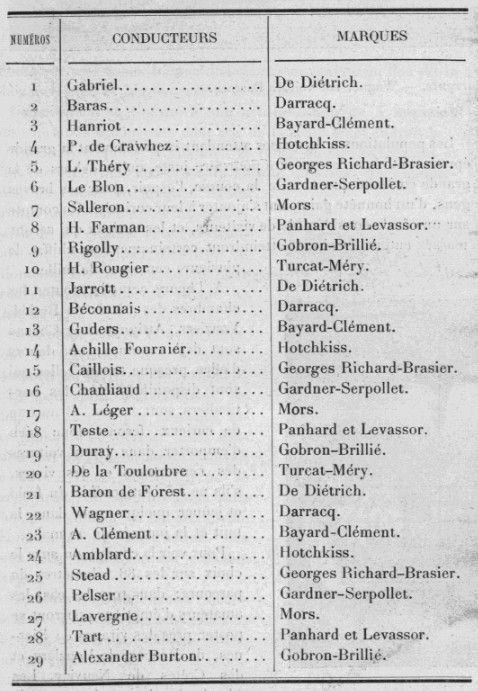
Here are the names of the drivers and the numbers that the cars will bear:
NUMBERS DRIVERS BRANDS
1 Gabriel De Diétrich.
2 Baras Darracq.
3 Hanriot Bayard-Clément.
4 P. de Crawhez Hotchkiss.
5 L. Théry Georges Richard-Brasier.
6 Le Blon Gardner-Serpollet.
7 Salleron Mors.
8 H. Farman Panhard et Levassor.
9 Rigolly Gobron-Brillié,
10 H. Rougier Turcat-Méry.
11 Jarrott De Diétrich.
12 Béconnais Darracq.
13 Guders Bayard-Clément.
14 Achille Fournier Hotchkiss.
15 Caillois. Georges Richard-Brasier.
16 Chanliaud Gardner-Serpollet.
17 A. Léger Mors.
18 Teste Panhard et Levassor.
19 Duray Gobron-Brillié.
20 De la Touloubre Turcat-Méry.
21 Baron de Forest De Diétrich.
22 Wagner Darracq.
23 A. Clément Bayard-Clément.
24 Amblard Hotchkiss.
25 Stead Georges Richard-Brasier.
26 Pelser Gardner-Serpollet.
27 Lavergne Mors.
28 Tart Panhard et Levassor.
29 Alexander Burton Gobron-Brillié.