Text and jpegs by courtesy of hathitrust.org www.hathitrust.org, compiled by motorracinghistory.com
Motor Age, Vol. XXI (21), No.25, June 20, 1912
Wheels Given Impact Pendulum Test
COVENTRY, Eng., June 7 – It is a little over 4 years since it was suggested that the impact pendulum was the fairest methods of testing the relative virtues of different kinds of road wheels for vehicles. The static test, that is, a steady pull attached to the wheels, had previously been used, but it did not meet with the demands of the cities. The general impression at that date was, that the wire wheel while it would stand a steady strain would col- lapse with a shock. To meet this new demand the Rudge-Whitworth Co. of this city has installed the necessary apparatus for a pendulum test and found it an admirable and rapid means of testing improvements in wire wheels.
When the American Society of Automobile Engineers visited the Rudge-Whitworth factories in November 1911, the wire wheel and English oak artillery wheel were tested, and some of the American visitors expressed the opinion that oak was an unsuitable timber for this purpose, and that hickory would give a better result.
It therefore was thought necessary to obtain the best possible examples of hickory wheels, one set from the United States and the other from France. There was every reason to believe that at least the American hickory wheels were the best of their kind as they were specially ordered, and the purpose explained to the maker. At the same time two sheet steel artillery wheels were tested and two Rudge-Whitworth detachable triple-spoked wheels. The wheels to be tested were held on a rigid steel bar bolted to a concrete bed and a pendulum, the bob of which weighed 480 pounds, was pulled back a series of varying distances and allowed to swing and strike the wheel, in the same direction as the wheel strikes the curb. Owing to the difference in weight of the different wheels a direct comparison is impossible, but a fair com- parison can be made by multiplying the weight of the wheel by the amount of the deflection, since it is obvious that the minimum deflection and the minimum weight are equally desirable, or putting it the other way, the increase in weight of the wheel would naturally mean a de- crease in the deflection, it being remembered that the lower the figure the greater the merit of the wheel.
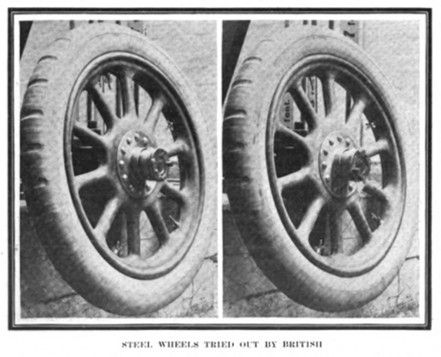
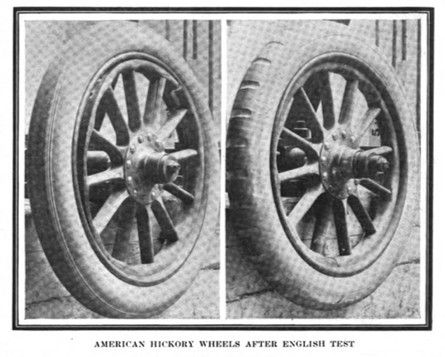
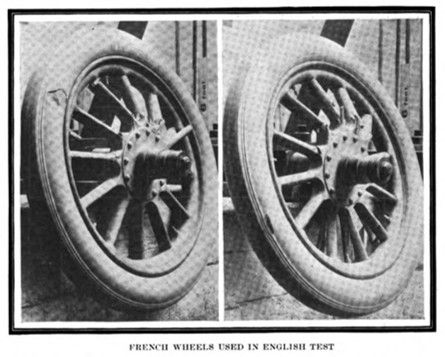
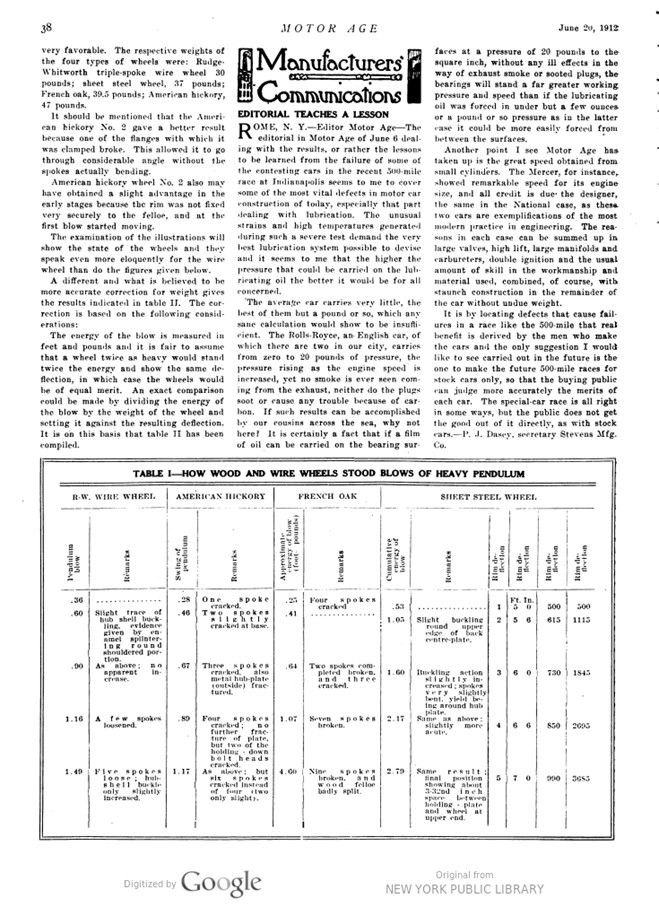
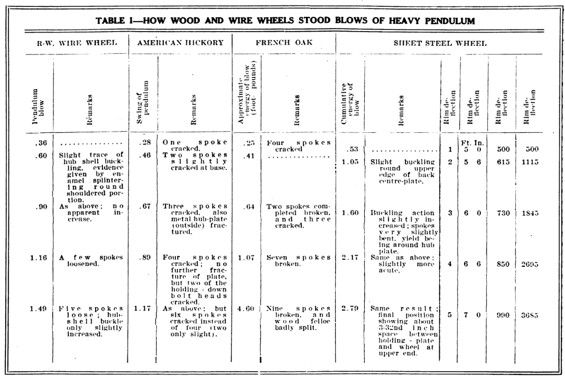
In the test of the four wheels the French wheel came out worst. The results of the tests are given herewith. The pendulum swing varied from 5 feet in the first blow to 7 feet in the fifth. Table I shows that the sheet metal wheel had a rim deflection after the first blow of .53 inches; after the second of 1.05 inch; and after the fifth of 2.79 inches. With the French oak four spokes cracked on the first blow, two more on the third, seven on the fourth and nine on the fifth. The American hickory wheel stood up better. One cracked on the first pendulum stroke, two on the second, three on the third, four on the fourth and six on the fifth.
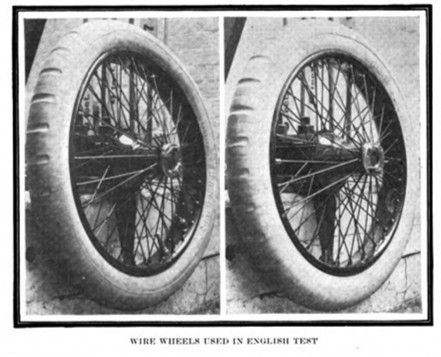
The Rudge-Whitworth triple-spoke wire wheel was tested. No evil result followed the first pendulum stroke. After the second there was slight trace of the hub shell buckling, after the fourth blow a few 5 spokes loosened, and after the fifth blow five spokes were loose and the hub shell buckle slightly increased. The rim deflections for each of the four wheels are given in table I.
The tabulation was compiled by taking the best results secured by each type of wheel, there being two of each tested. The results of the sheet steel wheels were very favorable. The respective weights of the four types of wheels were: Rudge-Whitworth triple-spoke wire wheel 30 pounds; sheet steel wheel, 37 pounds; French oak, 39.5 pounds; American hickory, 47 pounds.
It should be mentioned that the American hickory No. 2 gave a better result because one of the flanges with which it was clamped broke. This allowed it to go through considerable angle without the spokes actually bending.
American hickory wheel No. 2 also may have obtained a slight advantage in the early stages because the rim was not fixed very securely to the felloe, and at the first blow started moving.
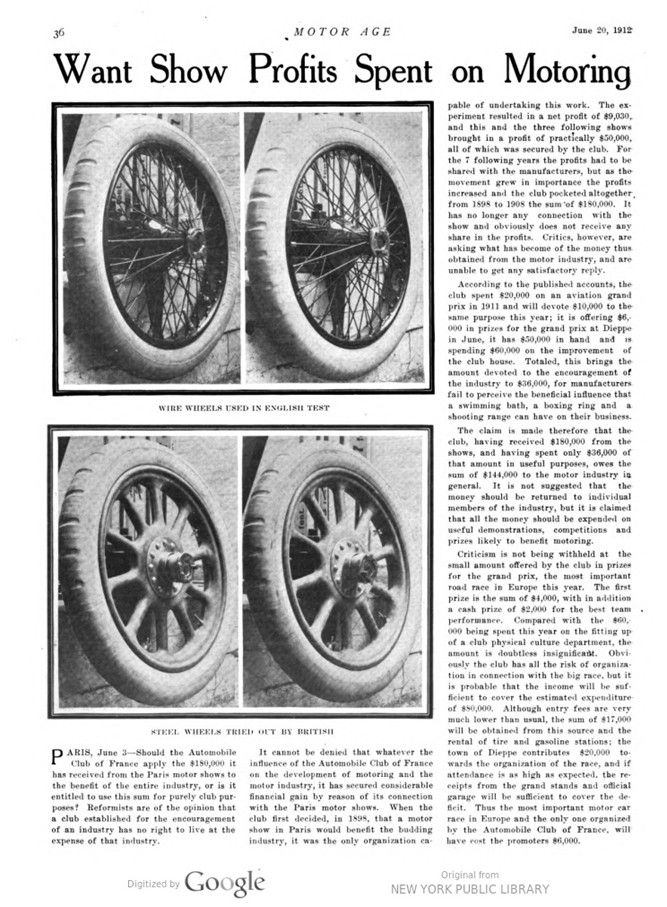
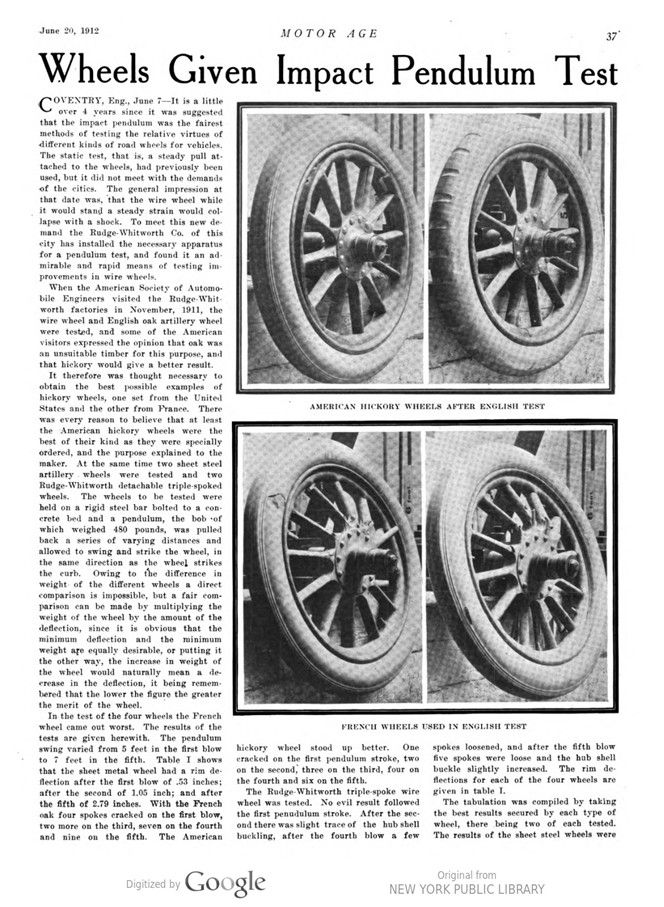
The examination of the illustrations will show the state of the wheels and they speak even more eloquently for the wire wheel than do the figures given below.
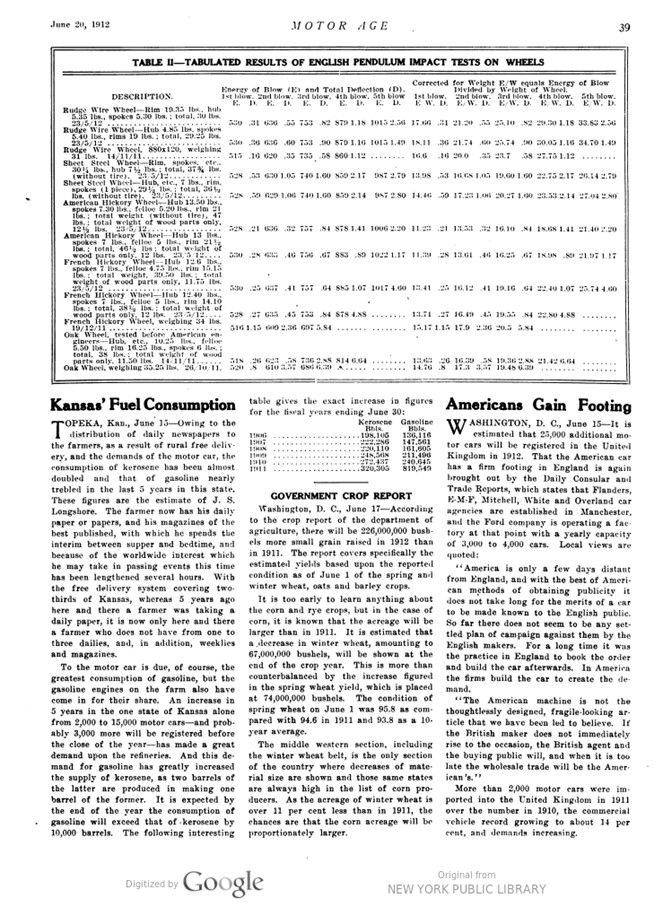
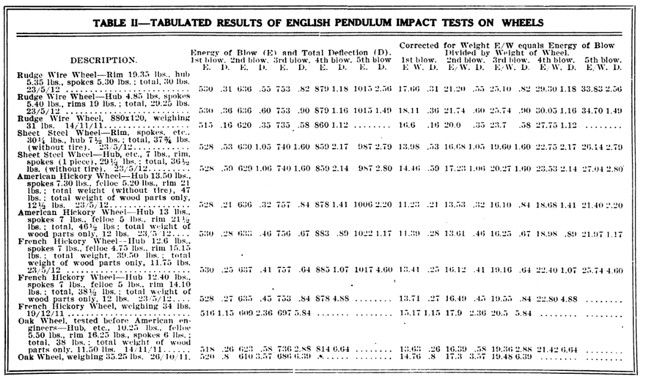
A different and what is believed to be more accurate correction for weight gives the results indicated in table II. The correction is based on the following considerations:
The energy of the blow is measured in feet and pounds and it is fair to assume that a wheel twice as heavy would stand twice the energy and show the same deflection, in which case the wheels would be of equal merit. An exact comparison could be made by dividing the energy of the blow by the weight of the wheel and setting it against the resulting deflection. It is on this basis that table II has been compiled.
Photo captions.
Page 36.
WIRE WHEELS USED IN ENGLISH TEST – STEEL WHEELS TRIED OUT BY BRITISH
Page 37.
AMERICAN HICKORY WHEELS AFTER ENGLISH TEST – FRENCH WHEELS USED IN ENGLISH TEST
TABLE I – HOW WOOD AND WIRE WHEELS STOOD BLOWS OF HEAVY PENDULUM
TABLE II – TABULATED RESULTS OF ENGLISH PENDULUM IMPACT TESTS ON WHEELS
Note: Elsewhere in this chapter separately, a graphical evaluation and comparison will be given on the results of the different pendulum test that have been performed by the different institutions during this timeframe. GrocerJack.