Text and jpegs by courtesy of hathitrust.org www.hathitrust.org, compiled by motorracinghistory.com
MOTOR AGE Vol. XXI, No. 22 Chicago, May 30, 1912
Hoosiers Thrilled by Speedway Trials – Mechanical Features of the Racing Cars
Preparations for 500 Mile Race on Big Track Interests Fans at Indianapolis Railbirds Watch Practice – Accidents Few but Spectacular – Incidents of the Training Camps
What Drivers Have Done to Get Top Speed Out of Their Mounts – Some Using Wire Wheels – Bodies Designed to Minimize Wind Resistance – Differentials Locked
INDIANAPOLIS, Ind., May 26 – Now that all but one of the steel mounts entered for the 500-mile grind on the speedway Memorial day are on the track for their preliminary workouts, the critics have a chance to see what the cars can do and how they are made. That the Indianapolis public, at least, is not uninterested is attested by the fact that each succeeding day sees the main grandstands more nearly packed with spectators, who have paid the 25 cents admission fee demanded at the gate for the tryouts.
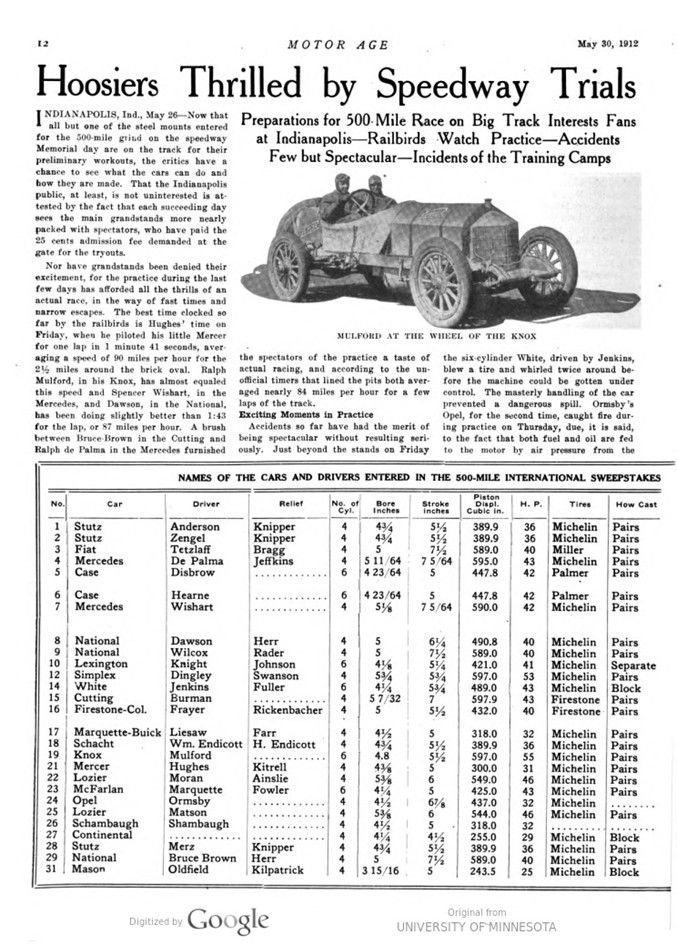
Nor have grandstands been denied their excitement, for the practice during the last few days has afforded all the thrills of an actual race, in the way of fast times and narrow escapes. The best time clocked so far by the railbirds is Hughes‘ time on Friday, when he piloted his little Mercer for one lap in 1 minute 41 seconds, averaging a speed of 90 miles per hour for the 2½ miles around the brick oval. Ralph Mulford, in his Knox, has almost equaled this speed and Spencer Wishart, in the Mercedes, and Dawson, in the National, has been doing slightly better than 1:43 for the lap, or 87 miles per hour. A brush between Bruce-Brown in the Cutting and Ralph de Palma in the Mercedes furnished the spectators of the practice a taste of actual racing, and according to the unofficial timers that lined the pits both averaged nearly 84 miles per hour for a few laps of the track.
Exciting Moments in Practice
Accidents so far have had the merit of being spectacular without resulting seriously. Just beyond the stands on Friday the six-cylinder White, driven by Jenkins, blew a tire and whirled twice around before the machine could be gotten under control. The masterly handling of the car prevented a dangerous spill. Ormsby’s Opel, for the second time, caught fire during practice on Thursday, due, it is said, to the fact that both fuel and oil are fed to the motor by air pressure from the same source, requiring that the pressure on the gasoline be excessive to be sufficient for the oil. Whatever the cause, the flames spurted up over the footboard so that the clutch and brake pedals could not be used to stop the car and both driver and mechanic had to jump, allowing the car to smash into the fence. Neither driver nor mechanic was injured, and the damage sustained by the car is not sufficient to prevent its appearance on the day of the race. The identity of the „mysterious unknown‘ which has for the past two weeks been shrouded in secrecy has at last come to light. This is entered as the Shambaugh by Charles Shambaugh of La Fayette, Ind., and, it is whispered, consists of a Buick motor on a hybrid running gear. It has not appeared for practice as yet.
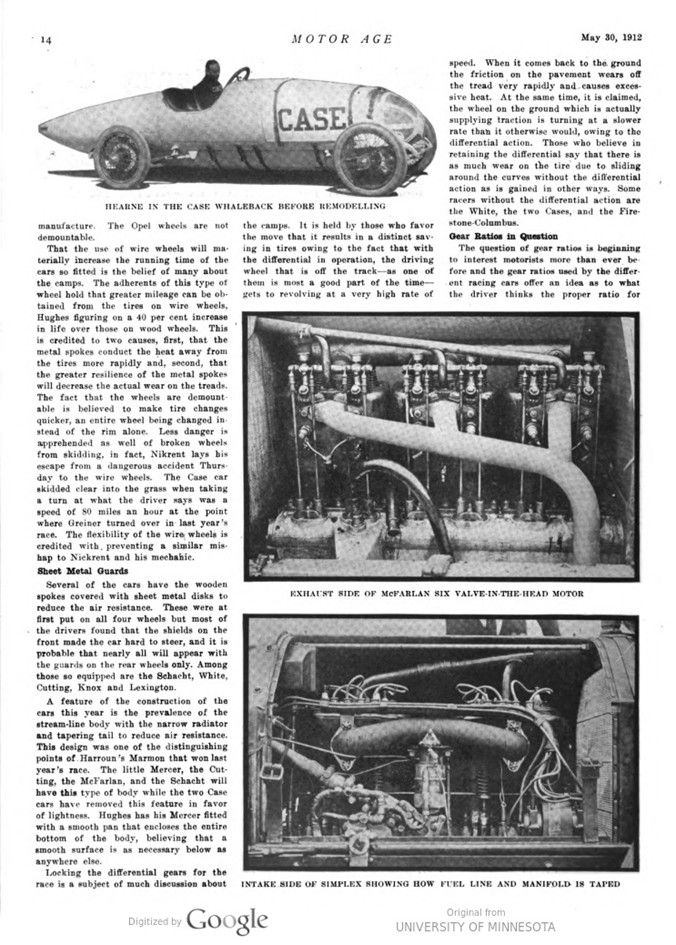
The withdrawal of Herrick today on account of wifely objections puts Eddie Hearne in as pilot of one of the Case cars, while Disbrow, the head of the Case team, will drive the other entry. Both of the Case whalebacks, whose mammoth rearward extensions have made them the most sensational looking machines seen on a track, have been shorn of all extra appendages in the effort to reduce weight so that when they next appear the cars will rival the Mercedes for squat appearance. Something over 1,000 pounds in excess weight has been eliminated from each car, but they lose the effect of the streamline body of the original design
Wire Wheels an Issue
One of the most important questions to be decided by the race on Thursday is the effect of wire wheels. These wheels will have their first real test in America on that day, and the way they and the tires on them stand up in the 500-mile grind will, it is believed, greatly affect their use in this country. The opportunities for a comparison of wire and wood spokes that will be offered are excellent, for the wire wheels will be used on both light and heavy cars in the race. Among those cars which are fitted with the wire wheels are the Hughes Mercer, the two Case cars, the Firestone-Columbus and the Opel. The first three are employing the English Rudge-Whitworth demountables and the Firestone-Columbus carries McCue wire demountable wheels of American manufacture. The Opel wheels are not demountable.
That the use of wire wheels will materially increase the running time of the cars so fitted is the belief of many about the camps. The adherents of this type of wheel hold that greater mileage can be obtained from the tires on wire wheels, Hughes figuring on a 40 per cent increase in life over those on wood wheels. This is credited to two causes, first, that the metal spokes conduct the heat away from the tires more rapidly and, second, that the greater resilience of the metal spokes will decrease the actual wear on the treads. The fact that the wheels are demountable is believed to make tire changes quicker, an entire wheel being changed instead of the rim alone. Less danger is apprehended as well of broken wheels from skidding, in fact, Nikrent lays his escape from a dangerous accident Thurs- day to the wire wheels. The Case car skidded clear into the grass when taking a turn at what the driver says was a speed of 80 miles an hour at the point where Greiner turned over in last year’s race. The flexibility of the wire wheels is credited with, preventing a similar mishap to Nickrent and his mechanic.
Sheet Metal Guards
Several of the cars have the wooden spokes covered with sheet metal disks to reduce the air resistance. These were at first put on all four wheels but most of the drivers found that the shields on the front made the car hard to steer, and it is probable that nearly all will appear with the guards on the rear wheels only. Among those so equipped are the Schacht, White, Cutting, Knox and Lexington.
A feature of the construction of the cars this year is the prevalence of the stream-line body with the narrow radiator and tapering tail to reduce air resistance. This design was one of the distinguishing points of Harroun’s Marmon that won last year’s race. The little Mercer, the Cutting, the McFarlan, and the Schacht will have this type of body while the two Case cars have removed this feature in favor of lightness. Hughes has his Mercer fitted with a smooth pan that encloses the entire bottom of the body, believing that a smooth surface is as necessary below as anywhere else.
Locking the differential gears for the race is a subject of much discussion about the camps. It is held by those who favor the move that it results in a distinct saving in tires owing to the fact that with the differential in operation, the driving wheel that is off the track – as one of them is most a good part of the time – gets to revolving at a very high rate of speed. When it comes back to the ground the friction on the pavement wears off the tread very rapidly and causes excessive heat. At the same time, it is claimed, the wheel on the ground which is actually supplying traction is turning at a slower rate than it otherwise would, owing to the differential action. Those who believe in retaining the differential say that there is as much wear on the tire due to sliding around the curves without the differential action as is gained in other ways. Some racers without the differential action are the White, the two Cases, and the Firestone-Columbus.
Gear Ratios in Question
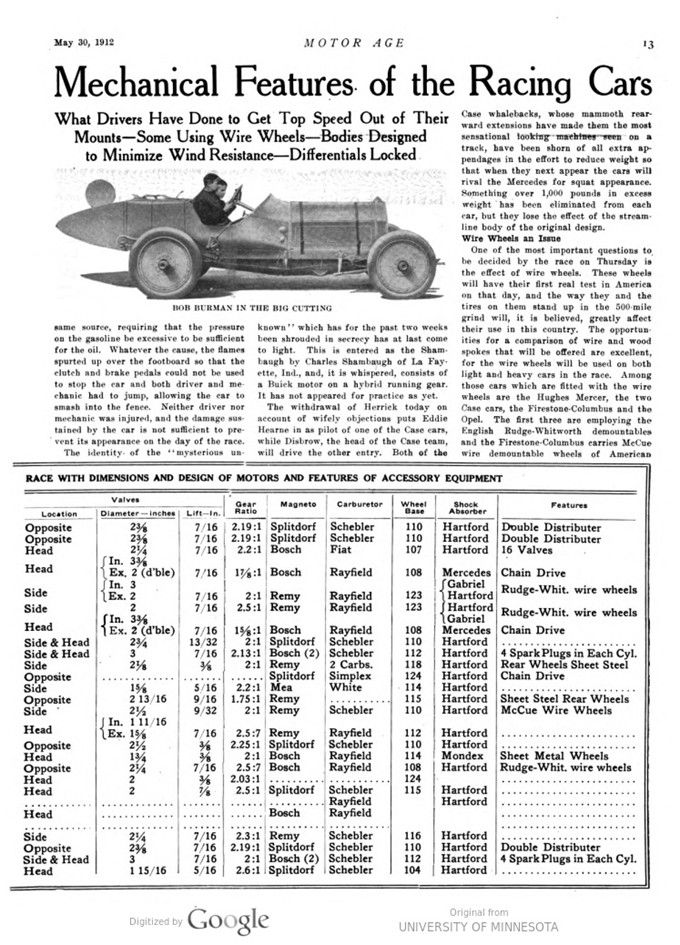
The question of gear ratios is beginning to interest motorists more than ever be- fore and the gear ratios used by the different racing cars offer an idea as to what the driver thinks the proper ratio for speed work should be. A consultation of the gear ratios in the table will show that the average is between 2 and 2.2 to 1. The smallest gear ratio is that used by Wishart on the No. 7 Mercedes. This is 1-5/8 to 1. The largest gear ratio given is on the Marquette Buick No. 17. This is 2½ to 1.
Special Ignition
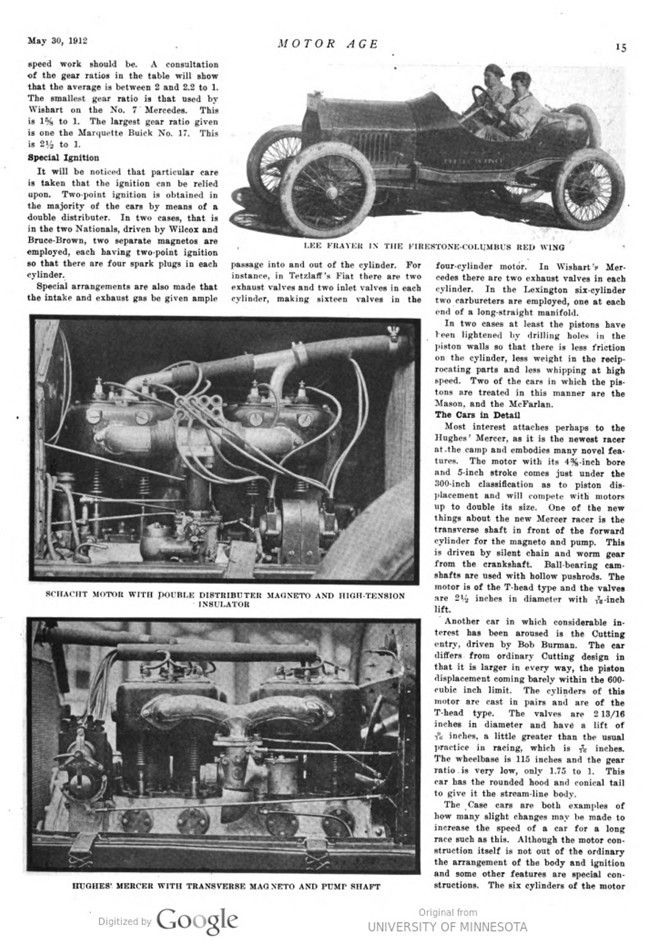
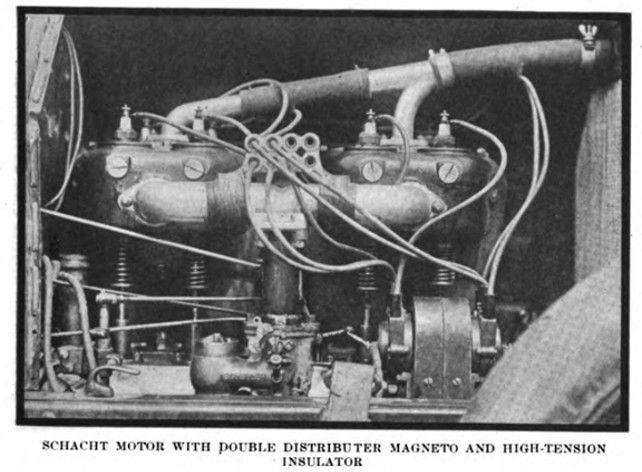
It will be noticed that particular care is taken that the ignition can be relied upon. Two-point ignition is obtained in the majority of the cars by means of a double distributor. In two cases, that is in the two Nationals, driven by Wilcox and Bruce-Brown, two separate magnetos are employed, each having two-point ignition so that there are four spark plugs in each cylinder.
Special arrangements are also made that the intake and exhaust gas be given ample passage into and out of the cylinder. For instance, in Tetzlaff’s Fiat there are two exhaust valves and two inlet valves in each cylinder, making sixteen valves in the four-cylinder motor. In Wishart’s Mercedes there are two exhaust valves in each cylinder. In the Lexington six-cylinder two carbureters are employed, one at each end of a long-straight manifold.
In two cases at least the pistons have been lightened by drilling holes in the piston walls so that there is less friction on the cylinder, less weight in the reciprocating parts and less whipping at high speed. Two of the cars in which the pistons are treated in this manner are the Mason, and the McFarlan.
The Cars in Detail
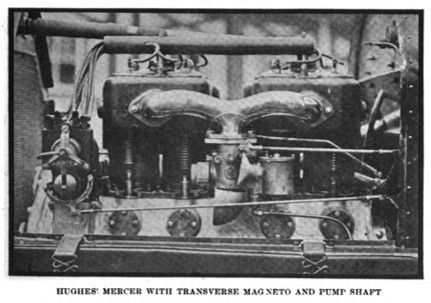
Most interest attaches perhaps to the Hughes‘ Mercer, as it is the newest racer at the camp and embodies many novel features. The motor with its 4 3/8-inch bore and 5-inch stroke comes just under the 300-inch classification as to piston dis- placement and will compete with motors up to double its size. One of the new things about the new Mercer racer is the transverse shaft in front of the forward cylinder for the magneto and pump. This is driven by silent chain and worm gear from the crankshaft. Ball-bearing cam- shafts are used with hollow pushrods. The motor is of the T-head type and the valves are 2½ inches in diameter with 7/16-inch lift.
Another car in which considerable interest has been aroused is the Cutting entry, driven by Bob Burman. The car differs from ordinary Cutting design in that it is larger in every way, the piston displacement coming barely within the 600-cubic inch limit. The cylinders of this motor are cast in pairs and are of the T-head type. The valves are 2 13/16 inches in diameter and have a lift of 9/16 inches, a little greater than the usual practice in racing, which is inches. The wheelbase is 115 inches and the gear ratio is very low, only 1.75 to 1. This car has the rounded hood and conical tail to give it the stream-line body. The Case cars are both examples of how many slight changes may be made to increase the speed of a car for a long race such as this. Although the motor construction itself is not out of the ordinary the arrangement of the body and ignition and some other features are special constructions. The six cylinders of the motor are cast in pairs and have a bore of 4 23/64 inches by 5 inches stroke. The valves are on one side and have a lift of 7/16-inch, the intake valves are 3 inches in diameter and the exhaust 2 inches in diameter. The wheelbase is 123 inches and the gear ratio, while not definitely decided, will be probably 2 to 1 on Disbrow’s car, and 2½ to 1 on the Hearne car.
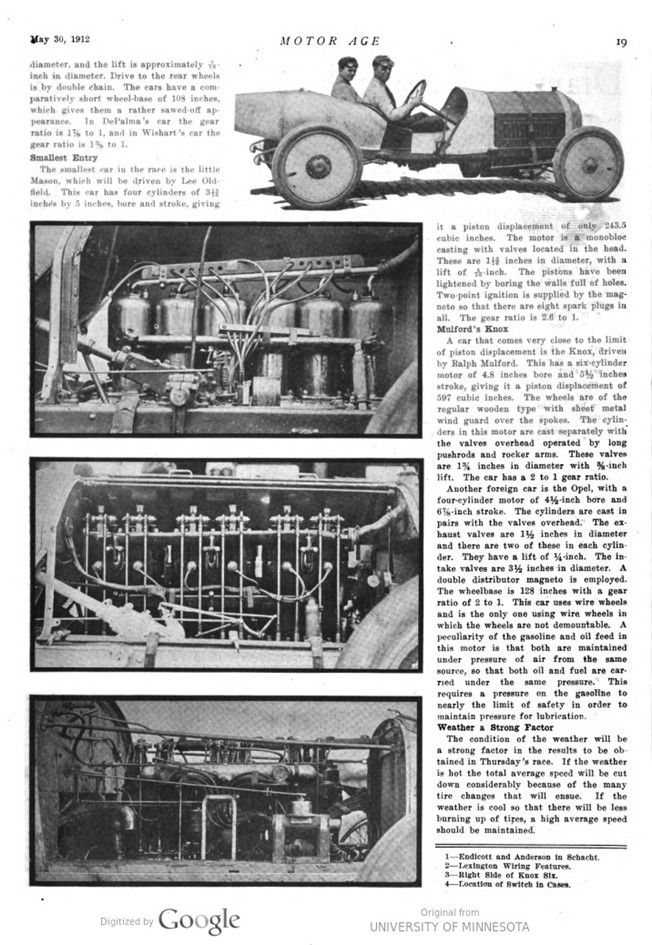
The extraordinary body design, which was tried out in preliminary practice and discontinued, has been described already. Some of the other notable features are the use of the Rudge-Whitworth demountable wire wheels with Palmer cord tires; the screen of conical-shape in front of the radiator; and the mounting of the dash switch and coil for the double distributer magneto on the frame of the car alongside the magneto, the switch being operated from the dash by means of a rod. The object of placing the coil and switch in this position is to reduce the length of the wiring and so reduce the chances of short-circuits and leakage of current. In place of the speedometer used in the Case there is installed on these cars Hopkin’s electric tachometers, by which the speed of revolution of the engine is shown rather than the actual speed of the car.
Three Stutzes Alike
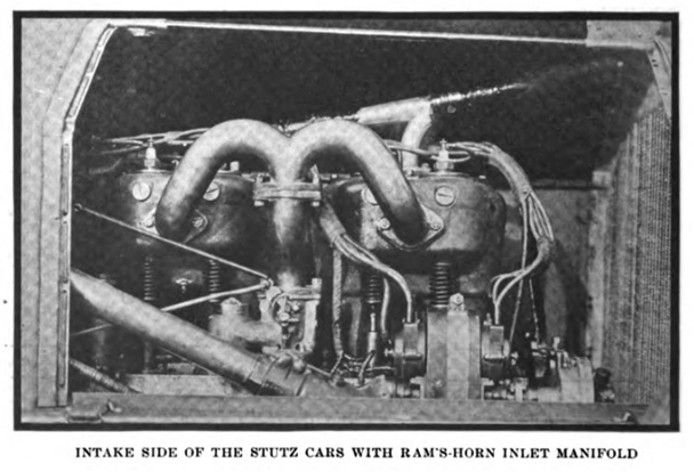
The three Stutz cars are alike in practically every respect. The four cylinders are 44 inches in diameter, with a 5½-inch stroke, making their displacement 389.9 cubic inches. The cylinders are cast in pairs and are of the T-type. The inlet valves are driven from a camshaft on one side of the motor which gives the valves a lift of inches. The exhaust cams are on the opposite side and have a lift of 2-inch. All valves are 2% inches in diameter and a double distributer magneto is used. The wheelbase is 110 inches and a gear ratio of 2 to 1 is employed in the rear axle.
Of the three National cars the mounts of Wilcox and Bruce-Brown are alike. The motors have four cylinders 5 by 7.5 inches, with a displacement of 589 cubic inches. These motors have as great a stroke-bore ratio as any cars in the race, 1.5 to 1. The cylinders are cast in pairs and the intake valves are located in the head and the exhaust valves on the side. Both are 3 inches in diameter and have a lift of 7/16-inch. The feature of both these cars is the ignition in which two magnetos are employed, each of which supply a distinct two-point system, so that there are four spark plugs in each cylinder. The other National, driven by Dawson, is practically the same except that the stroke is 64 inches, and the valves are 24 inches in size with 13/32-inch lift. The type of motor is T-head. There is a 2 to 1 gear ratio in the rear system.
The Continental is one of the three motors in which the cylinders are cast in one block. The motor is the next to the smallest entered in the race, its four cylinders having only 4 1/4-inch bore and 41/2-inch stroke, giving it a displacement of much less than half that of many of the entries. In this motor the valves are located on one side and are 2¼ inches in diameter, with 7/16-inch lift. The wheelbase of the car is 115 inches and the gear ratio is 2 to 1.
Red Bird Has Wire Wheels
Lee Frayer’s car, the Firestone-Columbus, is unique in one respect and that is the use of American wire wheels. Aside from this it is the same car that appeared on this track last year. It has a 5-inch bore with a 5½-inch stroke, with the cylinders cast in pairs and the valves on one side with the intake valve directly over the exhaust. The diameter of the valves is 2½ inches and the cams arranged to lift 9/32-inch. Two to 1 gear ratio is used and the differential is locked.
The Schacht is one of the smaller cars, having a displacement of less than 390 inches, the same as the three Stutz cars. Its four cylinders are cast in pairs with valves on opposite sides. Both intake and exhaust valves are 2½ inches in diameter and lift 3/8-inch off their seat. A comparatively short wheelbase of 110 inches is employed and the wooden spokes of the wheels are covered with sheet metal disks to minimize wind resistance.
Two of the Big Ones
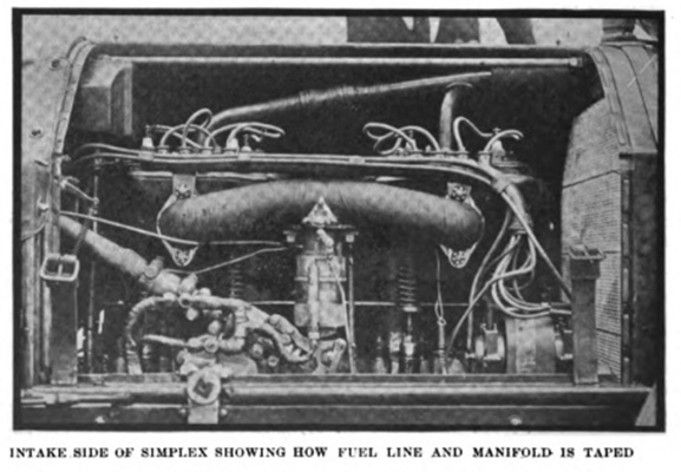
Bert Dingley’s Simplex is familiar to those who have watched previous races. The chief feature of the car is the use of double chain drive as final drive. Its four cylinders are 5-3/4 inches square, giving it a displacement of just under the 600 cubic inches limit. The cylinders are cast in pairs and are of the T type.
Another of the big cars is the Fiat, which is to be piloted by Tetzlaff, the road race record holder. The motor has four cylinders of 5 inches bore and 7½ inches stroke, giving a piston displacement of 589 cubic inches. This car, like the Simplex, uses double-chain drive with a gear ratio of approximately 2¼ to 1. Each cylinder has four valves, there being two sets of exhaust valves and two sets of inlet valves, making sixteen valves in all. Each valve is 2¼ inches in diameter with a lift of approximately-7/16inch.
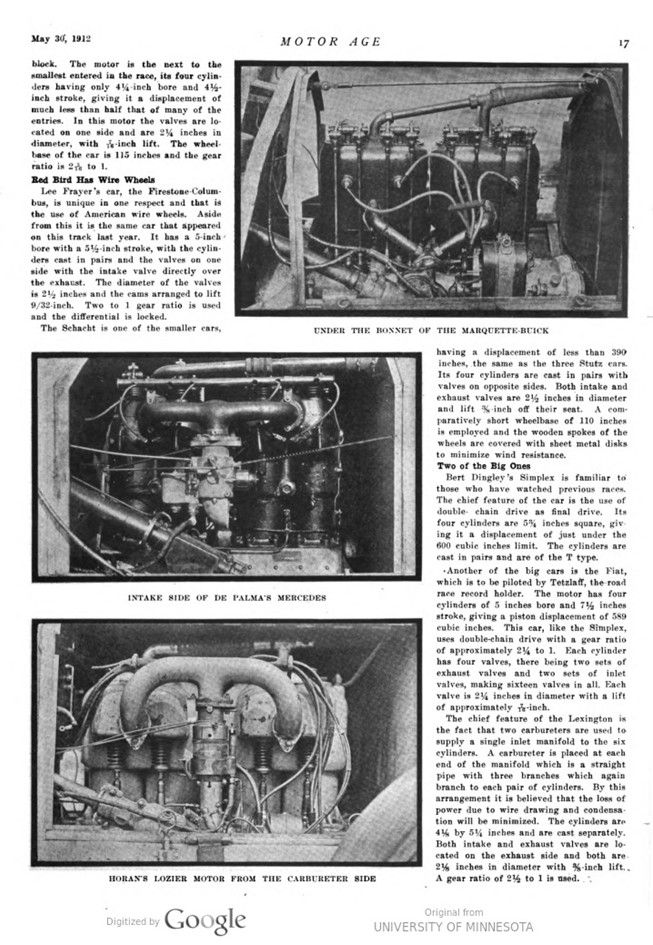
The chief feature of the Lexington is the fact that two carbureters are used to supply a single inlet manifold to the six cylinders. A carbureter is placed at each end of the manifold which is a straight pipe with three branches which again branch to each pair of cylinders. By this arrangement it is believed that the loss of power due to wire drawing and condensation will be minimized. The cylinders are 4 1/8 by 5¼ inches and are cast separately. Both intake and exhaust valves are located on the exhaust side and both are. 2½ inches in diameter with 3/8-inch lift. A gear ratio of 2½ to 1 is used.
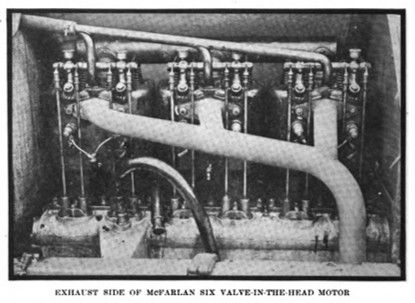
Another six-cylinder car is the McFarlan. This motor is 4¼ by 5 inches in size and is practically the same piston displacement as the Lexington. The cylinders in this motor are cast in pairs with both valves located in the head of the cylinders, and both are 2 inches in size with 7/8-inch lift. A gear ratio of 2½ to 1 is used in the rear axle system.
White’s First Appearance
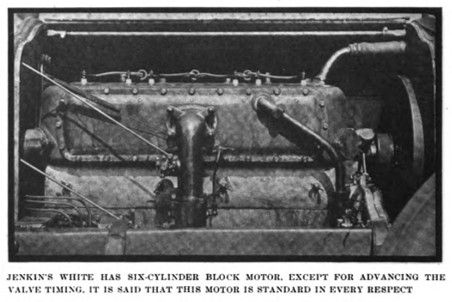
A car making its first appearance upon the Indianapolis track is the White six driven by Jenkins. So far as can be ascertained from an examination of the car the only changes from the standard White six motor is in the valve timing, which has been arranged for higher speed. In the running gear the changes include locking differential, putting sheet metal guards over the spokes of the rear wheels, and putting a wooden filler of triangular section in front of the I-beam front axle to reduce wind resistance. The motor seems to be standard in most respects. All six cylinders are made in a single casting with the intake and exhaust manifold an integral part of the casting. The dimensions of the cylinders are 4¼ by 5¾. The valves are located on the same side of the motor and are 1 5/8 inches in diameter with 5/16-inch lift. The gear ratio is 2.2 to 1. A peculiarity that will be noticed is that the driver is on the left side of the car.
A car that will be recognized as an oldtimer on the track is the Marquette-Buick which will be driven by Liesaw. This car is one of the original Marquette-Buicks with a four-cylinder motor, 4½ by 5 inches in size. The cylinders are cast in pairs with both valves in the head, the intake valve being 1 11/16 inches in diameter and the exhaust valve 1 5/8 inches in diameter. The usual lift of 7/16-inch is given the cam contour and the conservative ratio of 2½ to 1 employed for the race.
The two Loziers are practically the same, and a description of one will do for both. The car has a four-cylinder motor of 5 3/8 bore and 6 inches stroke, giving it a piston displacement of 544 cubic inches. The cylinders are cast in pairs with the valves located overhead. They are 2 inches in diameter and 3/8-inch lift. Two-point ignition is employed. The gear ratio is slightly greater than 2 to 1; the wheelbase is 124 inches.
Two old-timers that will show on the track again this year are the Mercedes cars, one driven by Ralph de Palma, and the other by Wishart. These cars were among the first really long-stroke motors. Wishart’s car is 5 11/64 inches in bore with a stroke of 7 5/54 inches, giving it a bore-stroke ratio of 1.4 to 1. DePalma’s car is slightly greater bore, 5.186 inches, except for the gear ratio the cars are in every respect the same. The four cylinders are cast in pairs with the valves in the head, the inlet valves are 3 3/8 inches in diameter. Double exhaust valves are used in each cylinder and these are 2 inches in diameter, and the lift is approximately inch in diameter. Drive to the rear wheels is by double chain. The cars have a comparatively short wheelbase of 108 inches, which gives them a rather sawed-off appearance. In DePalma’s car the gear ratio is 1 7/8 to 1, and in Wishart’s car the gear ratio is 1 3/8 to 1.
Smallest Entry
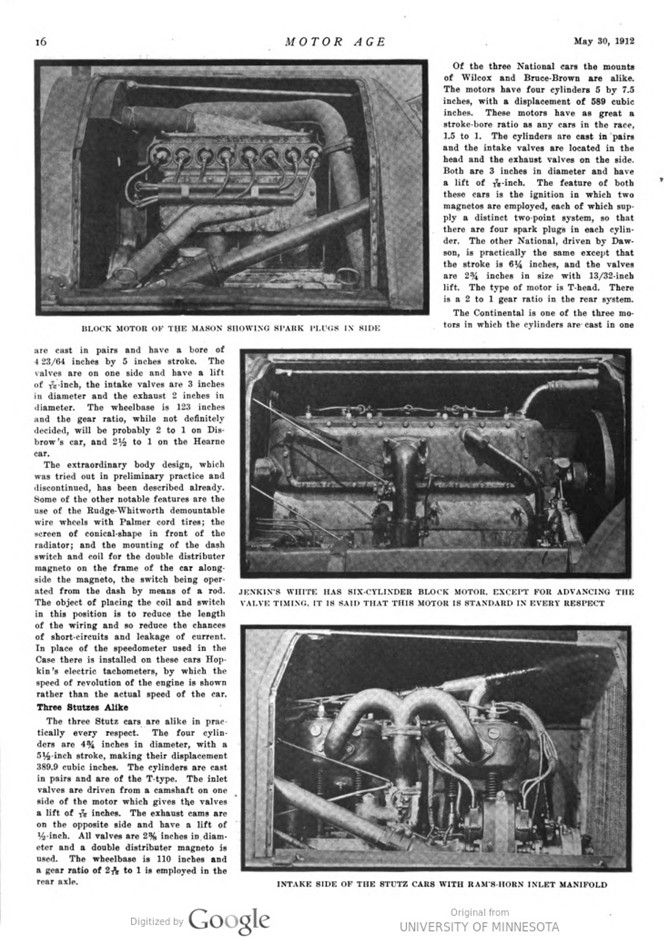
The smallest car in the race is the little Mason, which will be driven by Lee Oldfield. This car has four cylinders of 3 15/16 inches by 5 inches, bore and stroke, giving it a piston displacement of only 243.5 cubic inches. The motor is a monobloc casting with valves located in the head. These are 11 inches in diameter, with a lift of 5/16-inch. The pistons have been lightened by boring the walls full of holes. Two-point ignition is supplied by the magneto so that there are eight spark plugs in all. The gear ratio is 2.6 to 1.
Mulford’s Knox
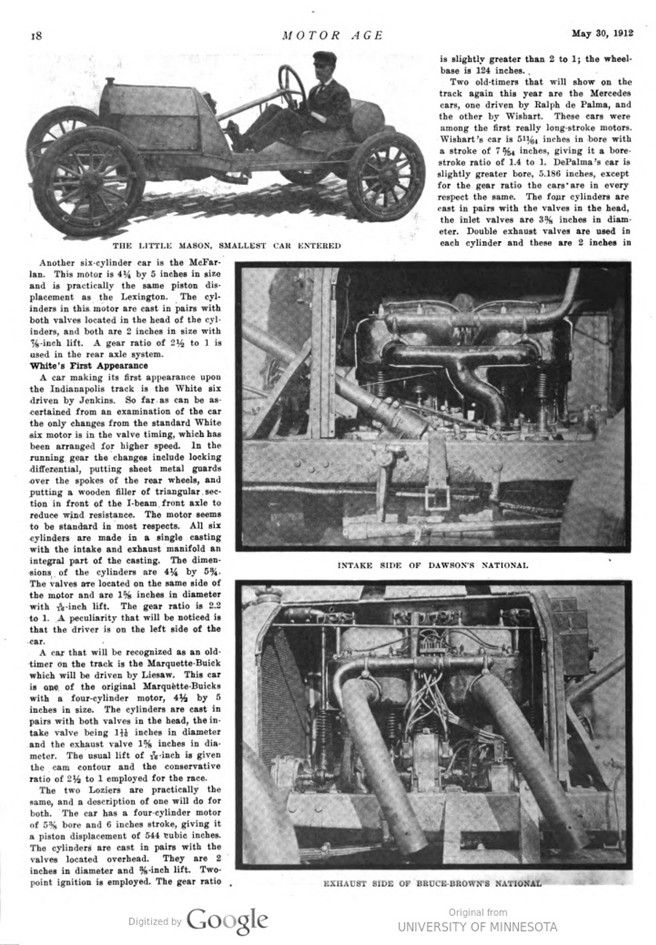
A car that comes very close to the limit of piston displacement is the Knox, driven by Ralph Mulford. This has a six-cylinder motor of 4.8 inches bore and 5½ inches stroke, giving it a piston displacement of 597 cubic inches. The wheels are of the regular wooden type with sheet metal wind guard over the spokes. The cylinders in this motor are cast separately with the valves overhead operated by long pushrods and rocker arms. These valves are 1¾ inches in diameter with 3/8-inch lift. The car has a 2 to 1 gear ratio.
Another foreign car is the Opel, with a four-cylinder motor of 4½ inch bore and 6 7/8-inch stroke. The cylinders are cast in pairs with the valves overhead. The exhaust valves are 1½ inches in diameter and there are two of these in each cylinder. They have a lift of 1/4-inch. The intake valves are 3½ inches in diameter. A double distributor magneto is employed. The wheelbase is 128 inches with a gear ratio of 2 to 1. This car uses wire wheels and is the only one using wire, wheels in which the wheels are not demountable. A peculiarity of the gasoline and oil feed in this motor is that both are maintained under pressure of air from the same source, so that both oil and fuel are carried under the same pressure. This requires a pressure on the gasoline to nearly the limit of safety in order to maintain pressure for lubrication.
Weather a Strong Factor
The condition of the weather will be a strong factor in the results to be obtained in Thursday’s race. If the weather is hot the total average speed will be cut down considerably because of the many tire changes that will ensue. If the weather is cool so that there will be less burning up of tires, a high average speed should be maintained.

Photo captions.
Page 12.
MULFORD AT THE WHEEL OF THE KNOX
NAMES OF THE CARS AND DRIVERS ENTERED IN THE 500-MILE INTERNATIONAL SWEEPSTAKES RACE WITH DIMENSIONS AND DESIGN OF MOTORS AND FEATURES OF ACCESSORY EQUIPMENT
Page 14.
CASE HEARNE IN THE CASE WHALEBACK BEFORE REMODELLING
EXHAUST SIDE OF MCFARLAN SIX VALVE-IN-THE-HEAD MOTOR
INTAKE SIDE OF SIMPLEX SHOWING HOW FUEL LINE AND MANIFOLD IS TAPED
Page 15.
LEE FRAYER IN THE FIRESTONE-COLUMBUS RED WING
SCHACHT MOTOR WITH DOUBLE DISTRIBUTER MAGNETO AND HIGH-TENSION INSULATOR
HUGHES MERCER WITH TRANSVERSE MAG NETO AND PUMP SHAFT
Page 16.
BLOCK MOTOR OF THE MASON SHOWING SPARK PLUGS IN SIDE
JENKIN’S WHITE HAS SIX-CYLINDER BLOCK MOTOR, EXCEPT FOR ADVANCING THE VALVE TIMING, IT IS SAID THAT THIS MOTOR IS STANDARD IN EVERY RESPECT
INTAKE SIDE OF THE STUTZ CARS WITH RAM’S-HORN INLET MANIFOLD
Page 17.
UNDER THE BONNET OF THE MARQUETTE-BUICK
INTAKE SIDE OF DE PALMA’S MERCEDES
HORAN’S LOZIER MOTOR FROM THE CARBURETER SIDE
Page 18.
THE LITTLE MASON, SMALLEST CAR ENTERED
INTAKE SIDE OF DAWSON’S NATIONAL
EXHAUST SIDE OF BRUCE-BROWN’S NATIONAL
Page 19.
1-Endicott and Anderson in Schacht.
2-Lexington Wiring Features.
3-Right Side of Knox Six.
4-Location of Switch in Cases