The well known french auto journalist Charles Faroux here writes a remarkable piece, in which technological developments of race engines and racecars are highlighted and compared between US and European developments. Here, one comes aware of how technological developments have taken place in the last twenty years.
Text and fotos with permission of Bibliothèque nationale de France- gallica.bnf.fr https://www.bnf.fr/fr Translation by DeepL.com, compiled by motorracinghistory.com
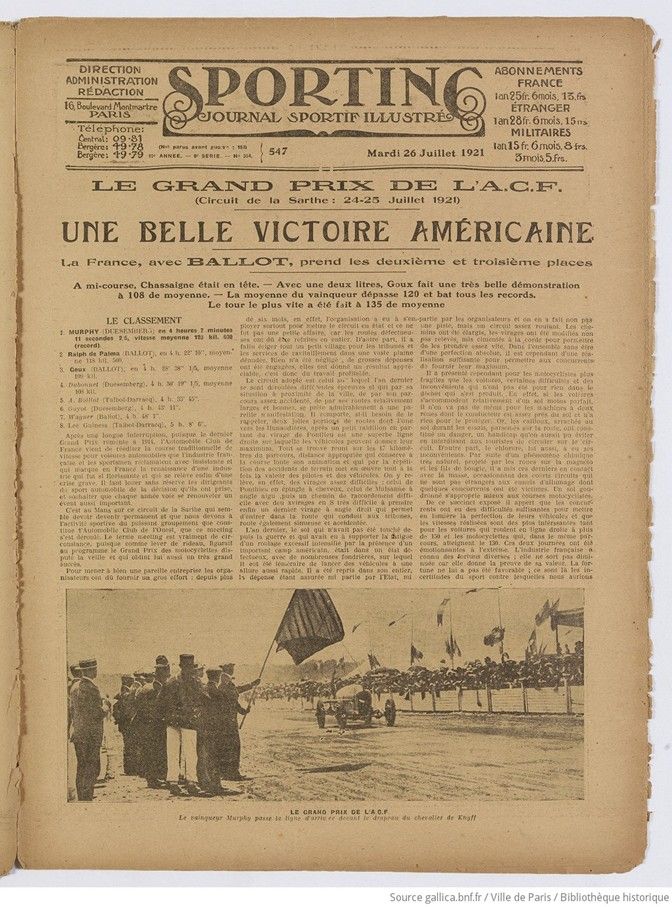
Sporting – Vol. 12, Serie 6, No. 547, Tuesday, 26 july 1921
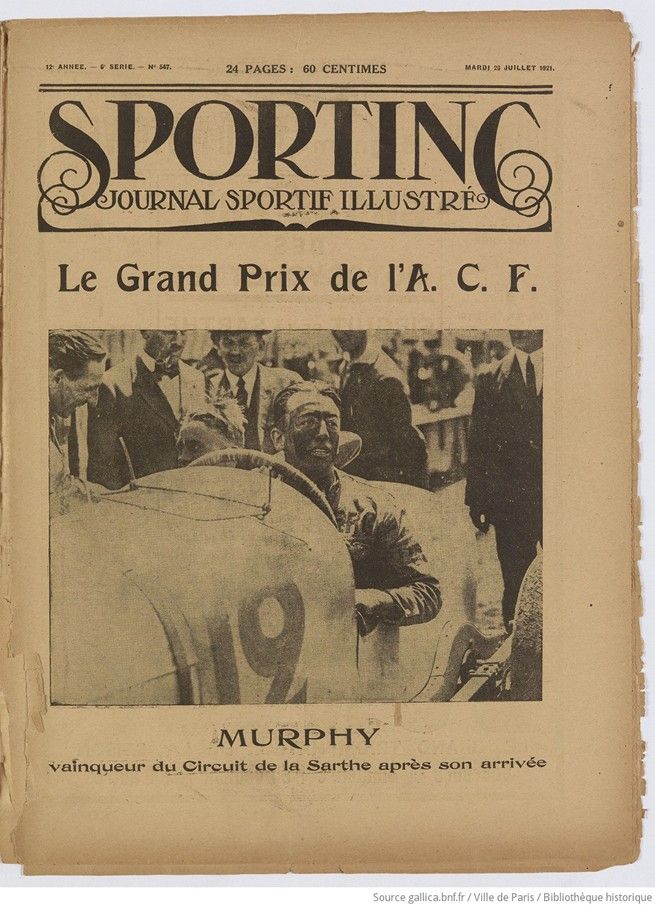
THE A.C.F. GRAND PRIX
MURPHY – winner of the Circuit de la Sarthe after his arrival
THE A.C.F. GRAND PRIX
(Circuit de la Sarthe : 24-25 July 1921)
A GREAT AMERICAN VICTORY
France, with BALLOT, takes second and third place
At halfway race, Chassagne was in the lead. — With a two-liter engine, Goux put on a great show with an average speed of 103. — The winner’s average exceeded 120, breaking all records. — The fastest lap was completed at an average speed of 135.
THE RANKING
1. MURPHY (DUESEMBERG) in 4 hours 7 minutes 11 seconds 2/5, average speed 123 km/h (record).
2. Ralph de Palma (BALLOT), in 4 hours 22 minutes 10 seconds, average speed 118 km/h.
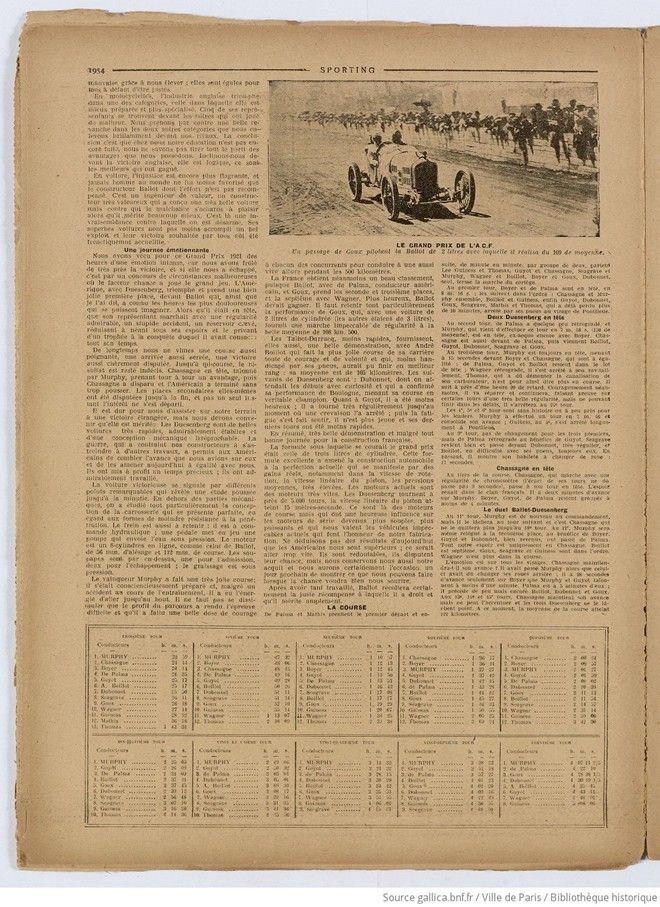
3. Goux (BALLOT), in 4 hours 28 minutes 38.2 seconds, average speed 109 km/h.
4. Dubonnet (Duesenberg), 4 hours 30 minutes 19.2 seconds, average speed 108 km/h.
5. A. Boillot (Talbot-Darracq), 4 hrs 35 min 45 sec.
6. Guyot (Duesenberg), 4 hrs 43 min 11 sec.
7. Wagner (Ballot), 4 hrs 48 min 1 sec.
8. Lee Guiness (Talbot-Darracq), 5 hrs 8’ 6”.
After a long hiatus, since the last Grand Prix dates back to 1914, the Automobile Club de France has just revived the traditional speed race for motor cars, which the French industry and sportsmen had been clamoring for and which marks the rebirth in France of an industry that was once so flourishing and is finally recovering from a serious crisis. The motorsport leaders deserve unreserved praise for their decision, and we hope that such an important event will be repeated every year.
The meeting took place at Le Mans on the Circuit de la Sarthe, which looks set to become a permanent fixture, thanks to the sporting activities of the powerful Automobile Club de l’Ouest. The term “meeting” is truly appropriate, since the program kicked off with the Motorcycle Grand Prix the day before, which was also a great success.
To pull off such an undertaking, the organizers had to make a huge effort: for more than six months, the organization had to focus on getting the circuit ready, which was no small task, as the defective roads had to be completely rebuilt. In addition, an entire small village had to be erected for the grandstands and catering services in a vast, barren plain. Nothing was overlooked, and significant expenses were incurred, but they yielded appreciable results, so it was a worthwhile endeavor.
The circuit chosen is the one on which various races were held last year and which, due to its location near the city, its fairly rugged course, and its relatively wide and good roads, lends itself admirably to such an event. It includes, needless to say, two attractive sections of road, one of which, towards Les Hunaudières, after a short steep climb from the Pontlieu bend, is a superb straight where the vehicles can give their all. Everything comes together on the 17-kilometer course, an appropriate distance that keeps the race exciting and, with its series of undulating terrain, showcases the skills of both the drivers and the vehicles. There are some fairly difficult bends: the hairpin bend at Ponthieu, the sharp bend at Mulsanne, then a difficult connecting road with two very tricky S-bends, and finally a last right-angle bend that leads onto the road to the grandstands, which is also winding and uneven.
Last year, the ground, which had not been touched since the war and had been subjected to excessive wear and tear intensified by the presence of a large American camp, was in poor condition, with numerous potholes, on which it would have been reckless to drive vehicles at such high speeds. It was completely rebuilt, with half the cost covered by the state and half by the organizers, and turned not into a track, but into a fairly smooth circuit. The roads were widened and the bends were modified, not raised, but cemented at the apex to allow them to be taken at speed. Overall, while not perfect, it is nevertheless sufficient to allow competitors to perform at their best.
However, for motorcyclists, who are more vulnerable than cars, it presented certain difficulties and disadvantages that were not unrelated to the accidents that occurred. Indeed, while cars can cope relatively well with less than perfect ground, the same cannot be said for two-wheeled machines, whose drivers are quite close to the ground and have nothing to protect them. The stones that had been torn from the ground during practice and scattered across the road posed a danger, a handicap that could have been avoided by prohibiting tourists from driving on the circuit. Chloride also had its disadvantages. As a result of a very natural chemical phenomenon, it was sprayed by the wheels onto the magneto and spark plug wires, bringing them into contact with the ground and causing short circuits, which contributed to the ignition problems experienced by some competitors. A tarmac surface is more suitable for motorcycle racing.
From this brief account, it is clear that the competitors had enough difficulties to highlight the perfection of their vehicles and that the speeds achieved are most interesting, both for cars traveling in a straight line at over 150 km/h and motorcycles reaching 130 km/h on the same course. These two days were extremely exciting. The French industry has had mixed fortunes; it has not been diminished, as it has proven its worth. Fortune has not been kind to it; these are the uncertainties of sport, against which we would be ill-advised to complain: they are the same for everyone, if not fair.
In motorcycles, the English industry triumphs: in one of the categories, the one in which it is best prepared and most specialized. Five of its representatives are ahead of ours, who have been unlucky. On the other hand, we take sweet revenge in the other two categories, where we brilliantly beat our rivals. The conclusion is that we still have a lot to learn; we do not know how to take full advantage of the strengths we possess. Let us bow to the English victory; it is logical, as the best have won.
In motor racing, the injustice is even more glaring, and no man in the world has been less favored than the manufacturer Ballot, whose efforts have not been rewarded. He is a talented engineer and a very skilled manufacturer who has designed a beautiful car, but against whom bad luck seems to have taken a particular liking, even though he deserves much better. This is an improbability against which we are powerless. His superb cars have nonetheless accomplished a great feat, and their victory, desired by all, would have been frenetically welcomed.
An emotional day
We experienced hours of intense emotion during the 1921 Grand Prix, as we came very close to victory, and if it eluded us, it was due to a combination of unfortunate circumstances in which luck played a major role. America, with Duesenberg, triumphed and took a very nice first place, ahead of Ballot who, as I said, experienced the most painful hours imaginable. While he was in the lead, his representative was performing with admirable consistency, but a stupid accident, a punctured fuel tank, dashed all his hopes and deprived him of a trophy he had devoted all his time to winning.
It had been a long time since we had seen such a thrilling race, such a close finish, such a hard-fought victory. Until halfway through the race, the outcome remained uncertain. Chassagne was in the lead, closely followed by Murphy, each taking turns to gain an advantage, then Chassagne disappeared and the American finished without pushing too hard. Even the secondary places were contested until the end, and not for a single moment did the interest wane.
It is hard for us to witness a foreign victory on our home turf, but we must agree that it is deserved. Duesenbergs are beautiful, very fast cars, admirably built and of impeccable mechanical design. The war, which forced our manufacturers to focus on other work, allowed the Americans to close the gap we had on them and bring them up to parity with us today. They made good use of precious time and did an admirable job.
The winning car stands out for several remarkable features that reveal meticulous research. In addition to the mechanical parts, particular attention was paid to the design of the bodywork, which is perfect in terms of its shape, offering minimal resistance to penetration. The brakes are also noteworthy: they are hydraulically controlled, with a pedal activating a pump that sends water under pressure. The engine is an 8-cylinder in-line, like Ballot’s, with a bore of 56 mm and a stroke of 112 mm. The valves are overhead, one for intake and two for exhaust; lubrication is under pressure.
The winner, Murphy, drove a very good race; he had prepared conscientiously and, despite an accident during practice, he had the energy to go all the way. It should not be forgotten that the profile of the course made the race difficult and that it took a great deal of courage on the part of each of the competitors to drive at such a fast pace for 500 kilometers.
France nevertheless achieved a good ranking, with Ballot, with American driver de Palma, and Goux taking second and third place, and seventh place with Wagner. With more luck, Ballot was bound to win. Goux’s performance was particularly noteworthy, as he drove a 2-liter car (the others were 3 liters) at a steady pace, averaging an impressive 108 km/h.
The Talbot-Darracqs, although less fast, also put in a fine performance, with André Boillot driving the best race of his career, showing great courage and determination. Had he not been so hampered by his tires, he could have finished higher up the field, with an average speed of 105 kilometers per hour. Duesenberg was followed by Dubonnet, whose debut was eagerly awaited and who confirmed his performance in Boulogne, driving like a true champion. Guyot was less fortunate; he drove very consistently until a puncture stopped him; then fatigue set in, he is no longer young and his last laps were slower.
In summary, it was a very fine demonstration and, despite everything, a good day for French engineering.
The formula under which the Grand Prix was run was that of three liters of displacement. This excellent formula has brought automobile construction to its current level of perfection, which is reflected in real gains, particularly in rotational speed, linear piston speed, and very high average pressures. Today’s engines are very fast. Duesenbergs run at nearly 5,000 rpm, with a linear piston speed of 15 meters per second. These are racing engines, but they have had a positive influence on production engines, which have become more flexible and powerful, resulting in the impeccable vehicles we have today, which are a credit to our manufacturing industry. Let us not conclude from today’s results that the Americans are superior to us; that would be jumping to conclusions. They are formidable, they are fighting for their chance, but we too are holding on to our achievements and we will certainly have the opportunity in the near future to show what we can do when luck smiles on us.
After working so hard, Ballot will certainly reap the just reward to which he is entitled and which he richly deserves.
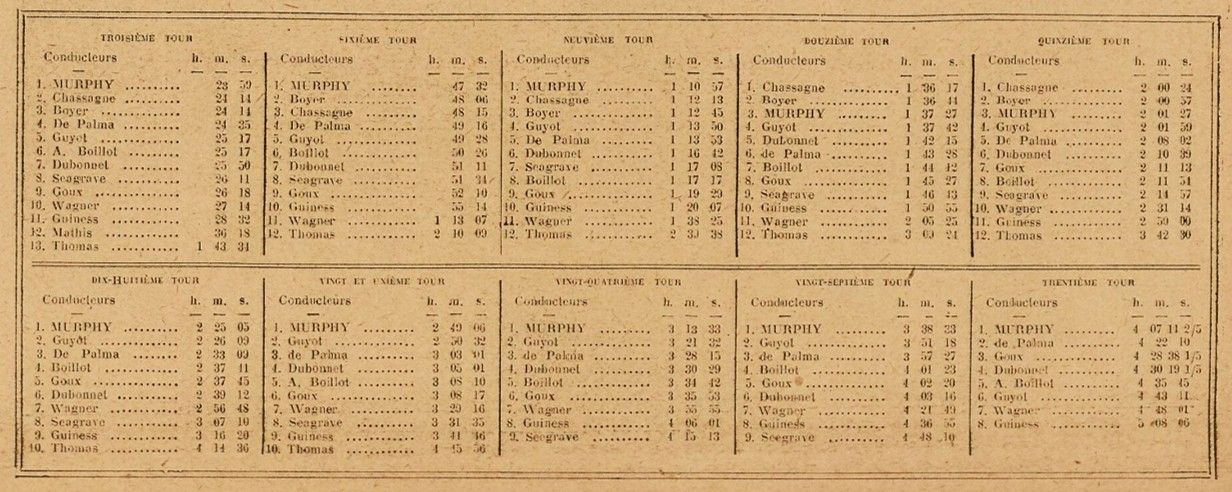
THE RACE
De Palma and Mathis take the first start, followed minute by minute, in groups of two, by Lee Guiness and Thomas, Guyot and Chassagne, Seagrave and Murphy, Wagner and Boillot, Boyer and Goux, with Dubonnet bringing up the rear alone.
On the first lap, Boyer and de Palma are in the lead, in 8 m. 16 s.; they are followed in order by: Chassagne and Murphy together, Boillot and Guiness, and finally Guyot, Dubonnet, Goux, Seagrave, Mathis, and Thomas, who has already lost more than 10 minutes, stopped by his tires at the Pontlieue turn.
Two Duesenbergs in the lead
On the second lap, de Palma had fallen back somewhat, and Murphy, who had just completed the lap in 7:58 (an average of 130 km/h), was in the lead, still tied with Boyer. Chassagne was also ahead of de Palma, followed by Boillot, Guyot, Dubonnet, Seagrave, and Goux.
On the third lap, Murphy was still in the lead, 15 seconds ahead of Boyer and Chassagne, who were tied; de Palma, Guyot, and Boillot remained in the leading group; Wagner dropped back, having stopped to refuel, while Thomas, who had to dismantle his carburetor pipe, was effectively out of the race. He was almost an hour and 20 minutes behind. Courageously, however, he repaired his car and continued, showing great consistency on some laps, but unable to finish within the time limit, he stopped on the second lap.
The fourth, fifth, and sixth laps were uneventful, or almost so, for the leaders. Murphy completed a lap in 7:46 and consolidated his lead; Guiness, in fourth place, stopped for a long time at Pontlieue.
On the ninth lap, there was no change in the top three, but de Palma dropped back in favor of Guyot. Seagrave made a good comeback and passed Dubonnet, who was very consistent, and Boillot, who was still having trouble with his tires. In passing, he demonstrated his skill at changing wheels: 17 seconds.
Chassagne in the lead
A third of the way through the race, Chassagne, who was running with clockwork regularity (the gap between his laps was no more than 9 seconds), took the lead. Hope was reborn in the French camp. He was two minutes ahead of Murphy. Boyer, Guyot, and de Palma remain grouped together within 4 minutes.
The Ballot-Duesenberg duel
On lap 11, Murphy is back in the lead, but he will lose it on the next lap and Chassagne will not let him go until lap 18. On lap 12, Murphy will even be relegated to third place, behind Boyer. Guyot and Dubonnet, who had made a strong comeback, passed de Palma. All our hopes were pinned on Chassagne. Boillot was seventh. Goux, Seagrave, and Guiness followed in that order. Wagner was no longer in the race.
Emotion was written all over everyone’s faces. Would Chassagne maintain his lead? He had passed Murphy when the latter had to change his rear wheels; he is only 28 seconds ahead of Boyer, with Murphy and Guyot less than a minute behind. Palma is 5 minutes behind them; he is slightly ahead of Boillot, Dubonnet, and Goux. On laps 13, 14, and 15, Chassagne maintains his lead but is unable to increase it, and the three Duesenbergs are not letting up. At this point, the average speed of the race reaches 122 kilometers per hour.
Halfway through the race
Chassagne has a 33-second lead over Boyer, which is not much. By the 16th lap, he only has 21 seconds left. However, he regains his 33-second lead on the next lap. Could there be a more thrilling battle? Murphy, who is making a strong comeback, adds to the excitement. He is tied for second place with Boyer.
The withdrawal of the two leaders
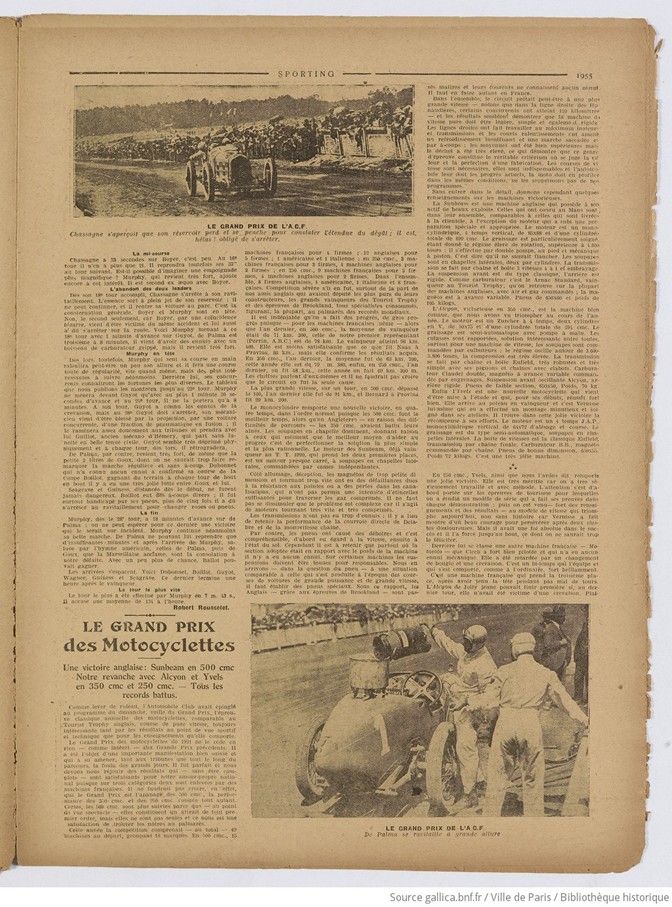
After completing his 18th lap, Chassagne stops at his pit stop. Gasoline is gushing out of his tank; he cannot continue and returns his car to the park. There is general consternation. Boyer and Murphy are in the lead. No, only second, because Boyer, by a bizarre coincidence, has just been the victim of the same accident and he too has had to stop on the road. Murphy is now leading on this 18th lap, 1 minute ahead of Guyot, with de Palma third, 8 minutes behind. He has just had trouble with a seized carburetor, but he is coming back strong.
Murphy in the lead
From then on, however, Murphy, who feels he has the race in hand, may slow down a little and drive a steady race, still fast, but nevertheless very interesting to follow. Behind him, his competitors will experience a wide variety of fortunes. The table we are publishing shows them up to the 23rd lap. Murphy will only lead Guyot by a maximum of 1 minute 30 seconds and on the 24th lap, he will only be 8 minutes ahead. Guyot also experienced problems with a flat tire, but on the 28th lap, he had to stop because his mechanic had just been injured by a piece of melted tire thrown up by a competing car. He drove him back to the stands fairly slowly and took Guillot, Hémery’s former mechanic, with him, who left without his glasses, dressed in smart civilian clothes. Guyot seemed very physically depressed and from then on, he fell back with each lap.
De Palma, on the other hand, comes back very strongly, as does Goux’s little 2-liter car, whose smooth and steady performance cannot be overemphasized. Dubonnet, who has had no problems, confirms his performance in the Boillot Cup, gaining ground with each lap. From start to finish, there is a very nice battle between Goux and him.
Seagrave and Guiness, who fell behind early on, were never a threat. Boillot had various setbacks; he was particularly hampered by his tires, having to stop more than five times to change wheels or tires.
The end
By the 28th lap, Murphy was 18 minutes ahead of de Palma; there is little hope for the latter to win, unless there is an incident. Murphy nevertheless continues his impressive run. De Palma is only able to make up a few minutes on him and after Murphy’s arrival, greeted by the American national anthem, those of Palma and then Goux, cheered on by the Marseillaise, are a consolation for our defeat. With a little more luck, Ballot could have won.
The arrivals are becoming more spaced out. Here come Dubonnet, Boillot, Guyot, Wagner, Guiness, and Seagrave. The latter finishes an hour after the winner.
The fastest lap
The fastest lap was completed by Murphy in 7 min. 43 sec., averaging 134 mph.
Robert Rousselet.
Photo captions.
Page 1953. THE A.C.F. GRAND PRIX. Winner Murphy crosses the finish line in front of the Chevalier de Knyff flag.
Page 1954. THE A.C.F. GRAND PRIX. Goux driving the 2-liter Ballot, with which he achieved an average speed of 109.
Page 1955. THE A.C.F. GRAND PRIX. Chassagne notices that his fuel tank is leaking and leans over to assess the extent of the damage; unfortunately, he is forced to stop.
Advertisement
An unprecedented event in the history of motor racing.
A statement from BALLOT and DE PALMA:
„I, the undersigned, BALLOT, certify that the statement made by Mr. de PALMA, driver of my car no. 1, which finished second in the A.C.F. Grand Prix at an average speed of 118.5 km/h, is accurate and true, affirming that he did not change a single one of his PIRELLI tires during the race.
Signed: BALLOT
PIRELLI TIRES Société Française PIRELLI, 24, Boul. de Villiers – LEVALLOIS-PERRET