
Text and jpegs by courtesy of hathitrust.org www.hathitrust.org, compiled by motorracinghistory.com
Motor Age, Vol. XLI (41), No. 22, June 1, 1922
Racing Experience Helps Designers Obtain Greater Power and Reliability
Comparatively Few Engine Failures Noted-Compression Ratios Decidedly Increased-Effective Method of Spark Plug Cooling Evolved
By PAUL DUMAS
A PAIR of American designers A captured the big end of the prize money at Indianapolis this year. The names of Duesenberg and Miller will always be associated with the running and winning of the Tenth Indianapolis Sweepstakes.
Looking over the results of the race, one is impressed by the high average speed of the place winning cars. The engines this year were of the same displacement as last year, but they were of considerably greater power than their predecessors of the same displacement. Not only was there greater power but also greater freedom from the troubles encountered in racing engines of the past. The improvements that produced the increased power also produced increased reliability.
Higher Compression Ratios
Greater power was secured by using higher compression ratios and improved carburetion and lubrication. High compression demands that engine cooling be adequate, especially the cooling of the spark plugs.
The development and refinement of design and construction has been concentrated, during the past winter, on the fast board tracks of the Pacific Coast. Los Angeles being the home of the parent Miller factory, it was only natural that Miller should take advantage of the opportunity for testing which was offered by the tracks in his home state.
In a somewhat lesser degree Fred Duesenberg Kas used the California boards as his testing laboratory. Louis Chevrolet did not fare well this year as his products were the victims of misfortune.
The great power secured from this year’s models cannot be traced wholly to any one single item, although there are some outstanding factors which are apparent if a comparison of the early and the present day 183-inch engine is made.
Compression ratios have been increased from 90 to as high as 140 pounds. Both the Miller and Duesenberg engines have compression ratios in excess of 7 to 1. The first detrimental effects associated with these high compressions was the tendency to pre-ignite. The chief item in bringing about preignition is overheated spark plugs.
No Lubrication Troubles
Spark plugs that become overheated usually cause preignition and to secure the benefits of power increase through increased compression it became necessary to evolve better spark plug cooling methods. In this respect it is worthy of note to mention that the Miller engines have a very ingeniously yet simply arranged method of spark plug cooling which also holds true on the Duesenberg and Frontenac jobs, the latter two secure this effect through casting a continuous water jacket around the plugs. while on the Miller, a removable threaded sleeve is utilized.
None of the winning cars were detained on account of lubrication trouble nor were any of the entries forced out due to that cause. The practical absence of oil on the track and smoking of the exhaust shows that this phase of engine building has reached a very high stage of development. No radical changes are noticeable in the lubrication system proper and the good performance is due to the generally high grade of balance and workmanship and the use of suitable oils. The majority of cars used a blended castor and mineral oil.
Valve actuating mechanisms as employed on the Duesenberg and Miller engines functioned without a flaw although the Frontenac engines seemed addicted to this malady. The valve mechanism failures on these engines were attributed to faulty material rather than any defect in design. The Peugeot of Wilcox fell a victim to a broken valve which went through the piston head. The Duesenberg engines which have two intakes and one exhaust were the only three valve engines in the race.
Rear Axle Trouble
The aluminum alloy piston with very narrow rings was used practically exclusively. None of the place winning cars were troubled with stops arising from piston trouble.
Going over the items that caused stops or withdrawals we find that rear axle trouble accounted for the elimination of at least two cars. Leon Duray who was well up among the leaders during the first hundred miles was forced to stop at his pit on account of a broken axle shaft. Some 44 minutes later he was again on the track but succumbed a short time later to the breakage of the replacement shaft. Peter De Paola, who impressed everyone by his skillful handling of the eight-cylinder Frontenac, skidded into the wall when the rear axle on his car locked. Contact with the wall practically ruining the rear spring assembly and the frame was badly twisted; nevertheless, Peter brought the wreck- age into the pits under its own power. Jules Goux broke an axle shaft on the Ballot early in the race, leaving the French traditions to be upheld by his teammate, Eddie Hearne, on the other Ballot, who finished third without raising the hood once during the five hundred miles.
Exhaust Heat Bothers Mechanicians
Steering mechanism failures which are always considered as part of an Indianapolis track race were few. Thomas, Duesenberg, and one of the Fronty-Fords were the only two cars to suffer from that scare. Art Klein sustained a broken frame which put him out of the running. The human element was ever present, as always. The extreme natural heat of the car itself and the fatigue-producing effects of the track and the distance covered caused many of the cars to draw up to the pits for relief mechanics or drivers. The mechanicians, especially, suffered from the heat from exhaust pipes, and required relief oftener than the drivers. The younger school of drivers suffered less fatigue than was expected. Jimmy Murphy, Harry Hartz, Peter De Paola, Tom Alley and Hawkes drove the distance without recourse to a relief driver. De Palma, Baker and Mulford were among the old school drivers who went the distance unrelieved.
Pit work generally was well executed. Murphy’s team, which was headed by Pete Henderson, gave a splendid exhibition of well organized activity. De Palma, who besides being a driver, has a fondness for nice tools, had his array of copper plated wrenches and pliers arranged in a manner that his able pitmen always had the right tool at the right moment in the minimum time.
Speedy Tire Changes
On the cars that were equipped with disk wheels a very fast demountable hub was used. The speed made on tire changes was due to well directed human effort and the use of speed demounting fittings. The racing hubs used on the disk wheels are an excellent example of a rugged and rapid locking and unlocking device.
Tom Milton’s car which made a poor showing due to a broken gas tank fastening showed well in the qualifying trials and much was expected of it. The car was capable of turning laps in 1:28 but was handicapped in this race. Due to lack of preparation and unsuitable balance its excessive speed could not be used. An interesting feature of this car is the transverse system similar to Ford. To secure a low resistance chassis Milton eliminated all wheel brakes, placing both emergency and service brake on the driveshaft.
Cliff Durant Special carried four-wheel brakes of the mechanical type. This and Jerry Wonderlich’s hydraulically controlled brake and Frank Elliott’s Miller were the only cars equipped with brakes on the front wheels. Four-wheel brakes, no doubt were a factor in securing maximum engine revolutions on the main stretch and braking on the turns without any great reduction in engine speed. All brakes were on the internal expanding type.
Photo captions.
Page 16.
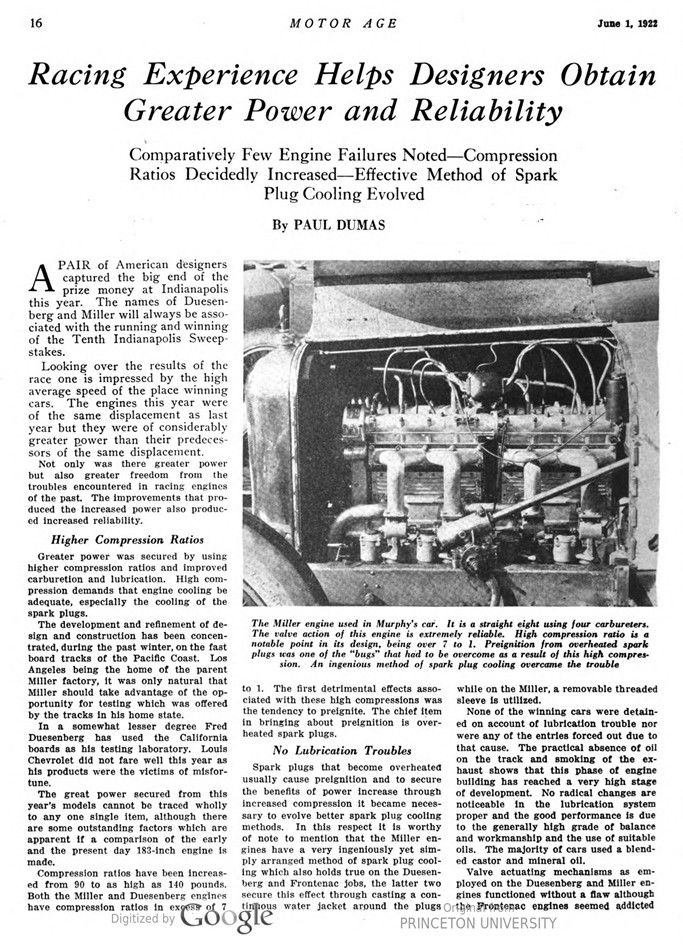
The Miller engine used in Murphy’s car. It is a straight eight using four carbureters. The valve action of this engine is extremely reliable. High compression ratio is a notable point in its design, being over 7 to 1. Preignition from overheated spark plugs was one of the „bugs“ that had to be overcome as a result of this high compression. An ingenious method of spark plug cooling overcame the trouble
Page 17.
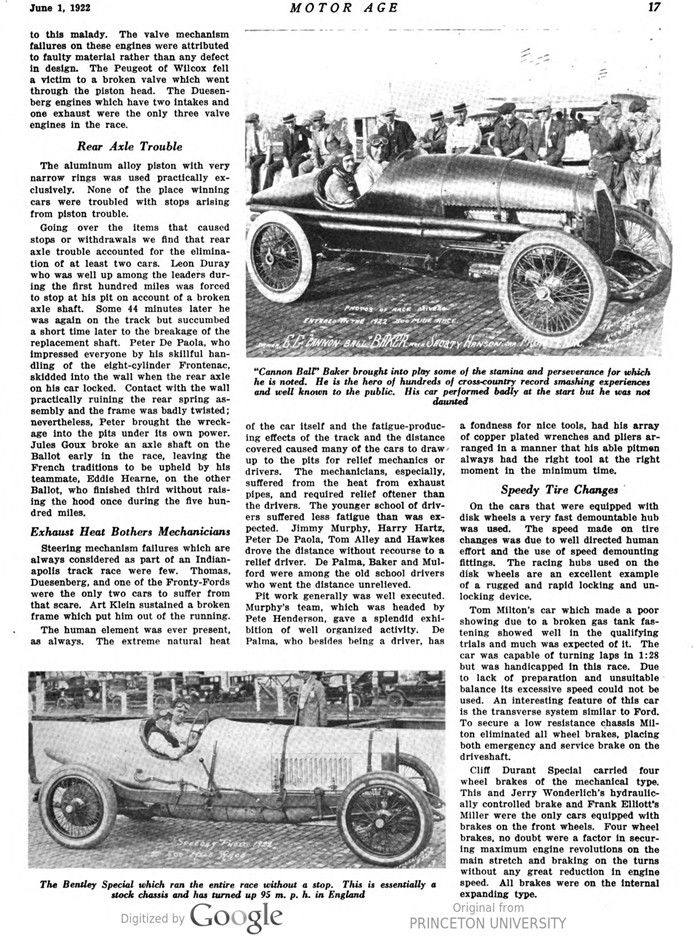
PHOTOS OF RACE DRIVER-ENTERED IN THE 1922 500-MILE RACE
E. CANNON BALL BAKER WITH SHORTY HANSON CAR FRONTENAC
„Cannon Ball“ Baker brought into play some of the stamina and perseverance for which he is noted. He is the hero of hundreds of cross-country record smashing experiences and well known to the public. His car performed badly at the start but he was not daunted.
SPEEDWAY PHOTO 1921 500-MILE RASE
The Bentley Special which ran the entire race without a stop. This is essentially a stock chassis and has turned up 95 m. p. h. in England