
Text and jpegs by courtesy of hathitrust.org www.hathitrust.org, compiled by motorracinghistory.com
Motor Age, Vol. XLI (41), No. 22, June 1, 1922
Small Cars Win New Laurels in 500-Mile Race
Five of the 183 Cu. In. Engines Break Record Made in 1915 With 300 In. Design — 1922 Classic a Field Day for Straight Eights
By B. M. IKERT
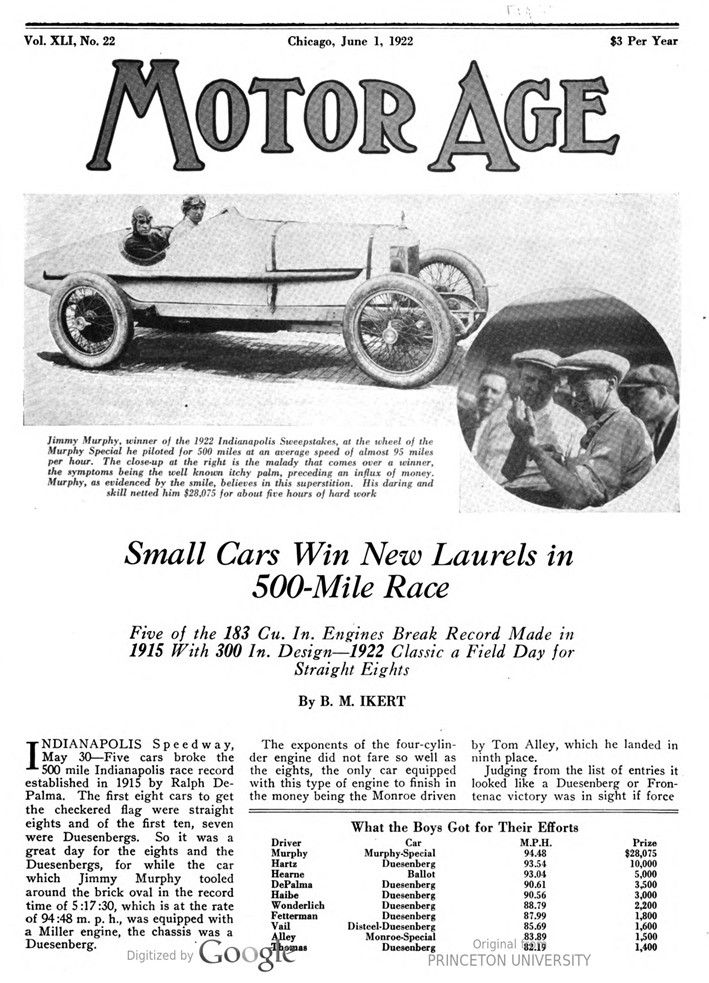
INDIANAPOLIS Speedway, May 30—Five cars broke the 500-mile Indianapolis race record established in 1915 by Ralph De- Palma. The first eight cars to get the checkered flag were straight eights and of the first ten, seven were Duesenbergs. So, it was a great day for the eights and the Duesenbergs, for while the car which Jimmy Murphy tooled around the brick oval in the record time of 5:17:30, which is at the rate of 94:48 m. p. h., was equipped with a Miller engine, the chassis was a Duesenberg.
The exponents of the four-cylinder engine did not fare so well as the eights, the only car equipped with this type of engine to finish in the money being the Monroe driven by Tom Alley, which he landed in ninth place.
Judging from the list of entries it looked like a Duesenberg or Frontenac victory was in sight if force of numbers was a factor, inasmuch as there were eleven Frontenacs including the Fronty-Fords, and nine Duesenbergs. Of the Frontenacs Alley was the only man who finished in the money, the car being a Monroe and identical with the Frontenacs in many respects.
With the elimination in the 25th lap of Goux’s Ballot and almost immediately after the start of the race of Wilcox’s Peugeot, there was little competition left for the American cars, so far as the foreigners were concerned, with the exception of Hearne’s Ballot, which finished third and about 5 minutes after Murphy had been given the flag.
It would be unfair to the foreign contingent, however, not to give a word of praise to the English Bentley Special, which, with the exception of a few details, was a stock car. The chassis had never been tried out until it reached the Hoosier track. This car ran very consistently, averaging about 80 m. p. h. and making no stops whatever. According to officials of this company the car has turned laps at Brooklands around 95 m. p. h. A partial explanation of the slower speeds is that the Indianapolis track curves require that the engine be shut off. Brookland’s track has steeply banked turns.
183 In. Cars Break Past Record
When five cars break the record for all previous 500-mile races on this track, there naturally arises the why and wherefore of it all. It was generally conceded before the race that the old record of 89.84 m. p. h. of the 300-cubic inch Mercedes driven by De Palma in 1915 would be bettered, but that the winner today should exceed this by almost 5 m. p. h. was quite unlooked for.
We have not far, however, to look for the reason. The answer as to why the cars established new records today lies in the fact that they were equipped with more powerful engines, even though the piston displacement of the engines in today’s cars was 183 cubic inches in piston displacement.
More power has been obtained by higher compression ratios, some as high as 7 to 1. This, coupled with the use of lighter pistons, rods and other reciprocating parts, makes possible a higher gas velocity and a consequently better cooling of the plugs. All of these factors being of utmost importance in high-speed racing engines.
The Designers Learn as They Go
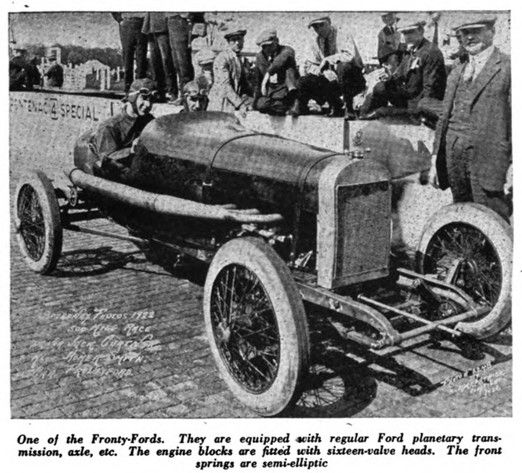
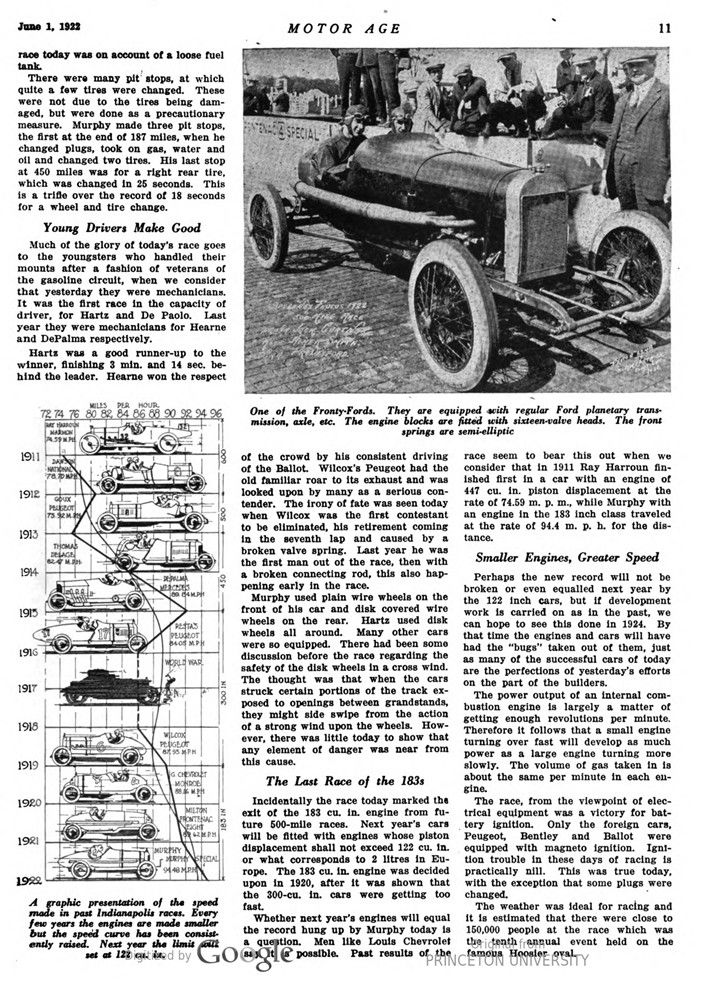
Also it must be remembered that our builders of racing engines and cars have had a year to develop and apply new designs and constructions in their creations. Many things were learned from last year’s race, when Milton in a Frontenac almost equaled DePalma’s old mark. Both of the Fronty-Fords gave a good account of themselves and probably established firmly in the minds of dirt track drivers the fact that they are quite the thing for such work. While these little cars were hopelessly outclassed in speed by their larger brothers, they possessed almost uncanny staying powers and their clean-cut exhaust spoke well for the special cylinder head which had been installed on the blocks. The cars had the usual Ford planetary transmissions and rear axle, although special steels were used in the axle shafts.
Milton’s New Car
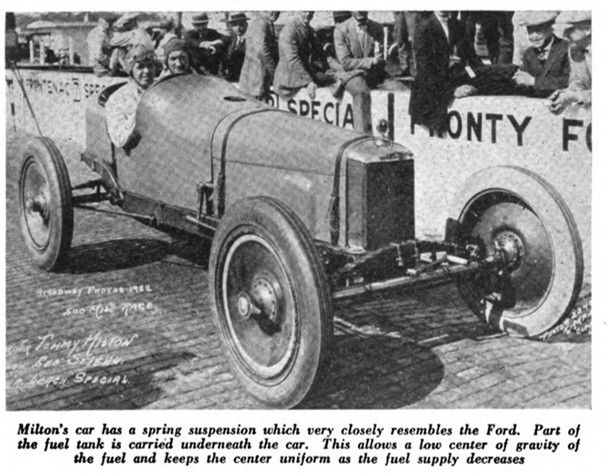
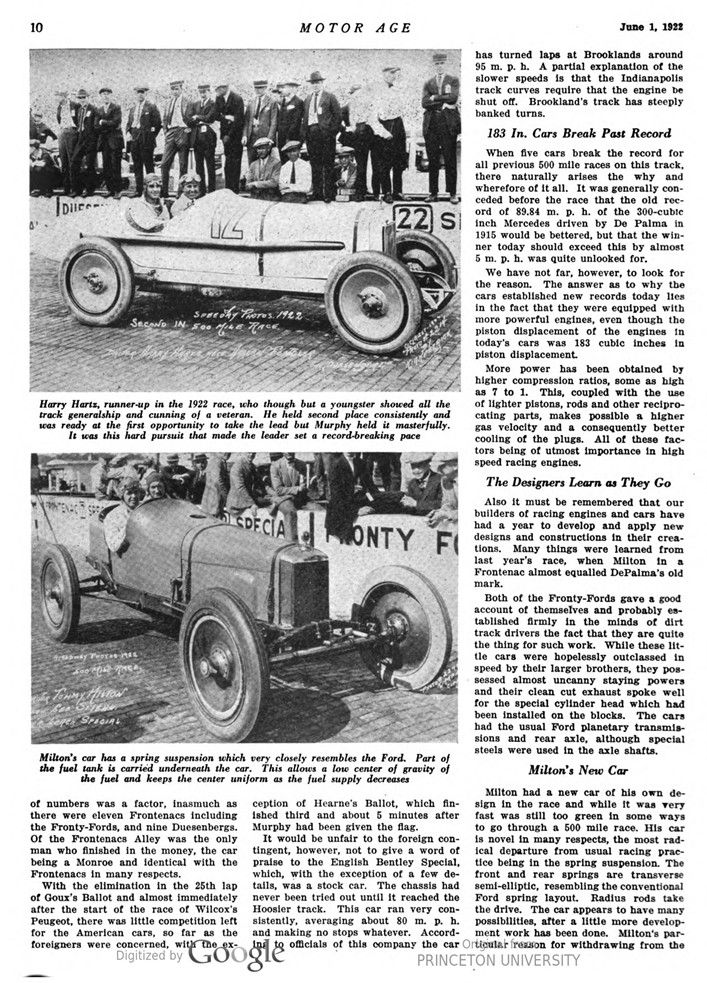
Milton had a new car of his own design in the race and while it was very fast was still too green in some ways to go through a 500-mile race. His car is novel in many respects, the most radical departure from usual racing practice being in the spring suspension. The front and rear springs are transverse semi-elliptic, resembling the conventional Ford spring layout. Radius rods take the drive. The car appears to have many possibilities, after a little more development work has been done. Milton’s particular reason for withdrawing from the race today was on account of a loose fuel tank.
There were many pit stops, at which quite a few tires were changed. These were not due to the tires being damaged, but were done as a precautionary measure. Murphy made three pit stops, the first at the end of 187 miles, when he changed plugs, took on gas, water and oil and changed two tires. His last stop at 450 miles was for a right rear tire, which was changed in 25 seconds. This is a trifle over the record of 18 seconds for a wheel and tire change.
Young Drivers Make Good
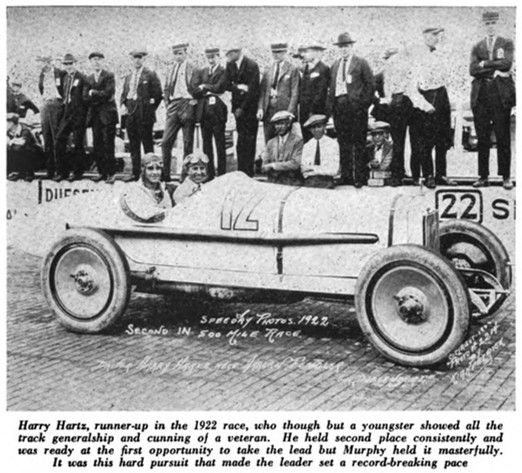
Much of the glory of today’s race goes to the youngsters who handled their mounts after a fashion of veterans of the gasoline circuit, when we consider that yesterday they were mechanicians. It was the first race in the capacity of driver, for Hartz and De Paolo. Last year they were mechanicians for Hearne and DePalma respectively.
Hartz was a good runner-up to the winner, finishing 3 min. and 14 sec. behind the leader. Hearne won the respect of the crowd by his consistent driving of the Ballot. Wilcox’s Peugeot had the old familiar roar to its exhaust and was looked upon by many as a serious con- tender. The irony of fate was seen today when Wilcox was the first contestant to be eliminated, his retirement coming in the seventh lap and caused by a broken valve spring. Last year he was the first man out of the race, then with a broken connecting rod, this also happening early in the race.
Murphy used plain wire wheels on the front of his car and disk covered wire wheels on the rear. Hartz used disk wheels all around. Many other cars were so equipped. There had been some discussion before the race regarding the safety of the disk wheels in a cross wind. The thought was that when the cars struck certain portions of the track exposed to openings between grandstands, they might side swipe from the action of a strong wind upon the wheels. However, there was little today to show that any element of danger was near from this cause.
The Last Race of the 183s
Incidentally the race today marked the exit of the 183-cu. in. engine from future 500-mile races. Next year’s cars will be fitted with engines whose piston displacement shall not exceed 122 cu. in. or what corresponds to 2 litres in Europe. The 183-cu. in. engine was decided upon in 1920, after it was shown that the 300 cu. in. cars were getting too fast.
Whether next year’s engines will equal the record hung up by Murphy today is a question. Men like Louis Chevrolet say it is possible. Past results of the race seem to bear this out when we consider that in 1911 Ray Harroun finished first in a car with an engine of 447-cu. in. piston displacement at the rate of 74.59 m. p.m., while Murphy with an engine in the 183-inch class traveled at the rate of 94.4 m. p. h. for the distance.
Smaller Engines, Greater Speed
Perhaps the new record will not be broken or even equalled next year by the 122-inch cars, but if development work is carried on as in the past, we can hope to see this done in 1924. By that time the engines and cars will have had the “bugs” taken out of them, just as many of the successful cars of today are the perfections of yesterday’s efforts on the part of the builders.
The power output of an internal combustion engine is largely a matter of getting enough revolutions per minute. Therefore it follows that a small engine turning over fast will develop as much power as a large engine turning more slowly. The volume of gas taken in is about the same per minute in each engine.
The race, from the viewpoint of electrical equipment was a victory for battery ignition. Only the foreign cars, Peugeot, Bentley and Ballot were equipped with magneto ignition. Ignition trouble in these days of racing is practically nill. This was true today, with the exception that some plugs were changed. The weather was ideal for racing and it is estimated that there were close to 150,000 people at the race which was the tenth annual event held on the famous Hoosier oval.
Photo captions.
Page 9.
Jimmy Murphy, winner of the 1922 Indianapolis Sweepstakes, at the wheel of the Murphy Special he piloted for 500 miles at an average speed of almost 95 miles per hour. The close-up at the right is the malady that comes over a winner, the symptoms being the well-known itchy palm, preceding an influx of money. Murphy, as evidenced by the smile, believes in this superstition. His daring and skill netted him $28,075 for about five hours of hard work.
Page 10.
SPEEDWAY PHOTOS. 1922 SECOND IN 500-MILE RACE. Photo #2214 KIRKPATRICK.
Harry Hartz, runner-up in the 1922 race who, though but a youngster showed all the track generalship and cunning of a veteran. He held second place consistently and was ready at the first opportunity to take the lead but Murphy held it masterfully. It was this hard pursuit that made the leader set a record-breaking pace
SPEEDWAY PHOTOS 1922 500-MILE RACE. TOMMY MILTON LEO STIEHL LEACH SPECIAL. Milton’s car has a spring suspension which very closely resembles the Ford. Part of the fuel tank is carried underneath the car. This allows a low center of gravity of the fuel and keeps the center uniform as the fuel supply decreases.
Page 11.
1911 RAY HARROUN MARMON 74.59 M.PH. – 1912 DAWSON NATIONAL 178.70 MP.H – 1913 GOUX PEUGEOT 75.92 M.PH – 1913 THOMAS DELAGE 82.47 M.PH – 1915 DE PALMA MERCEDES 89.84 M.PH – 1916 RESTAS PEUGEOT 8405 M.PH – 1917 WORLD WAR – 1919 WILCOX PEUGEOT 8795 MPH. – 1920 G. CHEVROLET MONROE 88.16 M.PH. – 1921 MILTON FRONTENAC LIGHT 8962 M.Ρ.Η. – 1922 MURPHY, MURPHY SPECIAL 94.48 MP.H.
1911 – 1912: 600 cu. inch; 1913: 500 cu. inch; 1914 – 1915: 450 cu. inch; 1916 – 1919: 300 cu. inch; 1920 – 1922: 183 cu. inch.
A graphic presentation of the speed made in past Indianapolis races. Every few years the engines are made smaller but the speed curve has been consistently raised. Next year the limit will set at 122 cu. in.
SPEEDWAY FOTOS 1922 500-MILE RACE. One of the Fronty-Fords. They are equipped with regular Ford planetary trans- mission, axle, etc. The engine blocks are fitted with sixteen-valve heads. The front springs are semi-elliptic