
Text and jpegs by courtesy of hathitrust.org www.hathitrust.org, compiled by motorracinghistory.com
Motor Age, Vol. VI, No. 10, September 8, 1904
THE PREMIER WOMAN MOTORIST
AMERICA ranks well with the countries of Europe in the possession of expert automobile racing men; it does not possess the prominent women drivers such as France may claim in Madame Lockert, Madame Gobron and Madame du Gast; the first famous for her long and consistent touring, the second for her sharing- of the fast rides of her husband, and the last for her actual and skilled participation in some of the biggest road races. There is no other Camille du Gast in any country. She is the premier woman motorist.
It was through curiosity that Madame du Gast became an automobilist. It was in 1807, and her husband, who was a great lover of sports, had interested her in fencing, bicycling, ballooning, horse riding and other sports. Like all debutantes in automobiling, she thought that the car was not being driven fast enough, when she bad her initiatory ride. This happened 7 years ago, when motor cars did not compete in speed with express trains. The first ride of the future lace driver was to Versailles. Hardly had the Villa d’Array been reached, only a few miles from the starting place, when she complained of the slowness of the ride. When the Picardie hill was in sight, she simply said: „Why, we are not going at all, it seems to me we are standing still.“
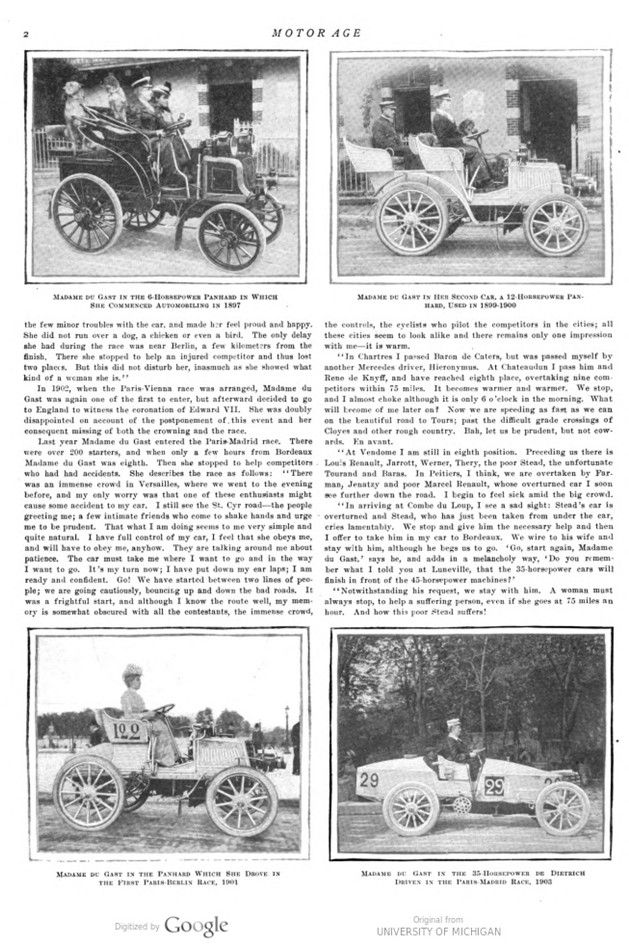
The second time the French woman was in an automobile she started to drive the car after an Hour’s lesson from the instructor who was with her. She then drove the car at 32 kilometers — 20 miles — an hour, a great rate of speed for the time, and especially remarkable on account of being made on the Paris Versailles Road, which was considered a hard course then. A few days after her first ride, Madame du Gast obtained her official permit to drive, and so, with the Duchess d’Uzes, is the eldest holder of such a permit, among French women. She purchased a 6-horsepower Panhard & Levassor car, which was able to go at 20 miles an hour, sufficiently fast, then, to terrify the people in the streets.
Before long the 6-horsepower car had become of little interest to the woman driver, and from then on, she bought faster going cars almost every year. Being familiar with the roads and possessed of the nervous and quick temperament of the French race. Madame du Gast became greatly interested in road races and decided to enter some of these events. „When the Paris-Berlin race was organized in 1901, she was among the first to enter, and while there was some astonishment at the fact that a woman had entered a race which everybody knew would be a hard one, there was no discrimination on account of her sex.
There were „more than 100 starters, and less than fifty finished the race, but Madame du Gast was nineteenth in Berlin, and might have been seventeenth. The man who accompanied her in the race, as mechanician, wrote afterwards about „In every town, village or hamlet ovations were given to her from the minute she was sighted until she had left the neighborhood. At the controls the people crowded upon the steps of the car and shook hands with her, while others threw flowers in the machine. There were even some who wanted to kiss her hands. Madame du Gast was the idol of the people. The hearty reception given her everywhere made her forget the tiresome journey, the dust, the few minor troubles with the car and made her feel proud and happy. She did not run over a dog, a chicken or even a bird. The only delay she had during the race was near Berlin, a few kilometers from the finish. There she stopped to help an injured competitor and thus lost two places. But this did not disturb her, inasmuch as she showed what kind of a woman she is.“
In 1902, when the Paris-Vienna race was arranged, Madame du Gast was again one of the first to enter, but afterward decided to go to England to witness the coronation of Edward VII. She was doubly disappointed on account of the postponement of this event and her consequent missing of both the crowning and the race.
Last year Madame du Gast entered the Paris-Madrid race. There were over 200 starters, and when only a few hours from Bordeaux Madame du Gast was eighth. Then she stopped to help competitors who had had accidents. She describes the race as follows: „There was an immense crowd in Versailles, where we went to the evening before, and my only worry was that one of these enthusiasts might cause some accident to my car. I still see the St. Cyr Road — the people greeting me; a few intimate friends who come to shake hands and urge me to be prudent. That what I am doing seems to me very simple and quite natural. I have full control of my car, I feel that she obeys me, and will have to obey me, anyhow. They are talking around me about patience. The car must take me where I want to go and in the way I want to go. It’s my turn now; I have put down my ear laps; I am ready and confident. Go! We have started between two lines of people; we are going cautiously, bouncing up and down the bad roads. It was a frightful start, and although I know the route well, my memory is somewhat obscured with all the contestants, the immense crowd, the controls, the cyclists who pilot the competitors in the cities; all these cities seem to look alike and there remains only one impression with me — it is warm.
„In Chartres I passed Baron de Caters, but was passed myself by another Mercedes driver, Hieronymus. At Chateaudun, I pass him and Rene de Knyff, and have reached eighth place, overtaking nine competitors within 75 miles. It becomes warmer and warmer. We stop, and I almost choke although it is only 6 o’clock in the morning. What will become of me later on? Now we are speeding as fast as we can on the beautiful road to Tours; past the difficult grade crossings of Cloves and other rough country. Bah, let us be prudent, but not cowards. En avant.“
„At Vendome I am still in eighth position. Preceding us there is Louis Renault, Jarrott, Werner, Thery, the poor Stead, the unfortunate Tourand and Baras. In Poitiers, I think, we are overtaken by Farman, Jenatzy and poor Marcel Renault, whose overturned car I soon see further down the road. I begin to feel sick amid the big crowd. „In arriving at Combe du Loup, I see a sad sight: Stead’s car is overturned and Stead, who has just been taken from under the car, cries lamentably. We stop and give him the necessary help and then I offer to take him in my car to Bordeaux. We wire to his wife and stay with him, although he begs us to go. ‚Go, start again, Madame du Gast,‘ says he, and adds in a melancholy way, ‚Do you remember what I told you at Luneville, that the 35-horsepower cars will finish in front of the 45-horsepower machines?‘
„Notwithstanding his request, we stay with him. A woman must always stop, to help a suffering person, even if she goes at 75 miles an hour. And how this poor Stead suffers!
“Finally, we arrive in Bordeaux. The race is over. No one dares show a sign of happiness, of rejoicing. Ah, how sadly this great race ended. How happy we felt when we left, and how disappointed we were at the finish. Not at ourselves but at the fate, at the circumstances which made the end of the race such a lamentable affair.“
This year Madame du Gast wanted to compete in the French eliminating race before the James Gordon Bennett cup race was run, but the sporting committee Of the Automobile Club of France refused to let her, or any other woman, compete, giving as reason that it was too dangerous a sport for a woman. Madame du Gast protested against the decision and influential members of the trade and club tried to get the club to reconsider its decision, but it would not.
„I love the automobile,“ writes Madame du Gast, „because of the independence one, derives from it, and on account of the sensation it gives to go as fast as one desires to go. One appreciates this sensation well, only at the moment, when in getting off the car, one is astonished at being so lame, of walking so slowly.
„Then, too, you get to like your automobile as one likes a horse. You love it, you take care of it, you know it almost like you know yourself. If you do not find the car right, you do not care to look mi at the prettiest scenery, and you become sad, worried and nervous; its cough makes you wonder what the sickness is and you get more worried., On the other hand, if everything goes all right, if you hear the car buzz; if it responds correctly to every movement you want it to make, then you feel really happy, there is pleasure in traveling in the beautiful scenery seems to take an even prettier aspect.
„The pleasure of speed is in itself only a rather obscure sensation, yet quite agreeable. The real charm of the automobile is the extreme ease with which one can go from one place to another and see the quickly changing scenery which presents itself. The pleasure of speed is relative, because even at a speed of 110 kilometers per hour, the sensation disappears after a few minutes driving on a straight, level road. Besides, I never drive fast except whop I am sure that I will not endanger anybody, and the road is straight and plainly visible.
„Before the start of a race, at the moment the starter counts the seconds which still remain before being sent away, I am very nervous, but just as soon as the start is given, I become calm, and the love of fighting grows. Just as soon as I see, away ahead, the little cloud of dust which tells me that I am overtaking another car, I have but one idea, one thought—to go faster, to pass the other car. Almost oppressed, I bend myself through instinct, just as though I wanted to push my automobile. I would whip her to increase her speed, and she does not seem to me to go until I have the joy of passing my competitor. Then my satisfaction is intense.
„I acknowledge that in connection with the Paris-Madrid race, I believed that there was danger; I believed it so strongly, that, just as at the eve of a duel, I had arranged all my private affairs, and given all my instructions in case of accident. After the first stage of that race, I was very sad and painfully impressed at seeing, injured and dying, several of those I had just seen in Versailles full of life and happy.
„During the run through the country, I was not greatly excited, but in the towns where I saw the crowd thickly assembled in the middle of the road, this crowd which did not get out of the way until the very last second, I was really stricken with terror. „What I fear most, are the men that stay on the roadway. It is in trying to avoid them that one runs the greatest chances. I am able to drive 22 hours in succession without becoming tired.
„As to my impressions when I arrived in Berlin or in Bordeaux! To be truthful, the pleasure, the joy of the triumph, the applause, the enthusiasm affected me deeply. But my own satisfaction was even greater for my car to which I owe my success.“
Few people know Camille du Gast, except as being the leading woman motorist of France, but she is more, being handsome, well educated, bright, refined, a good musician and a true sportswoman in every sense of the word.


Photo captions.
Page 1. Madame Camille Du Gast, the Premier Woman Motorist.
Page 2.
Madame du Gast in the 6-Horsefower Panhard in which she commenced Automobiling in 1897
Madame du Gast in Her Second Car, a 12-Horsepower Panhard, Used in 1890-1900
Madame du Gast in the Panhard which she Drove in the first PARIS-BERLIN Race 1901
Madame du Gast in the 35-IIorsepower de Dietrich Driven in the Paris-Madrid Race, 1903