

Text and jpegs by courtesy of hathitrust.org www.hathitrust.org, compiled by motorracinghistory.com
MoRoR Age, Vol. 37, September 1921
The Grand Prix is Ours
How Murphy in His Duesenberg Captured Europe’s Most Important Racing Event
By Richard Kennerdall – Chairman Contest Board A. A. A.
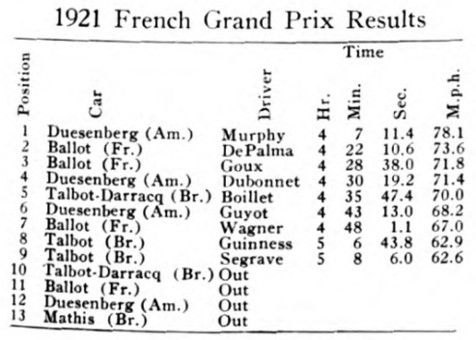
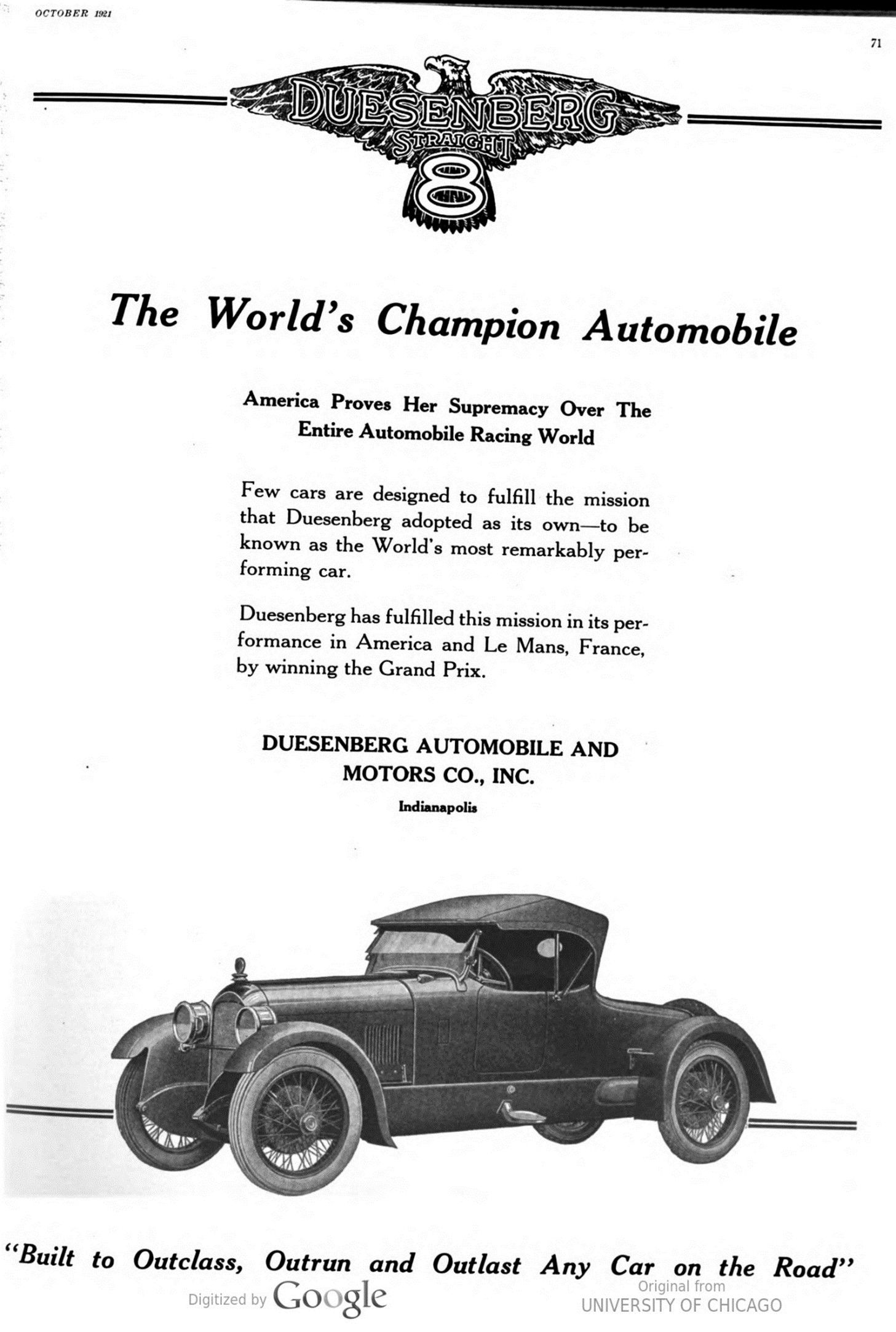
JIMMY MURPHY, whose ancestry we do not question, driving a Duesenberg straight eight, the work of our own Fred Duesenberg of Dutch nativity, went to France some weeks ago and for the first time in the history carried off the honors in the most important racing event in Europe the Grand Prix promoted by the Automobile Club of France. And it was through the financial assistance of a Frenchman, Albert Champion, who makes spark plugs in Flint, that it was possible for Murphy to take his mount to the other side. Murphy won the 322-mile race over the macadam course at LeMans, France, in the record time of 4 hours, 7 minutes, 11.4 seconds, an average speed of 78.1 m.p.h. And the little Irishman won from a field of thirteen starters. Our own De Palma driving a French 8-cylinder Ballot was second, 73.6 miles per hour; Goux in a four-cylinder Ballot third, 71.8 miles per hour; Dubonnet in a Duesenberg fourth, 71.4 miles per hour. Five other cars finished and four retired because of trouble, the latter comprising Joe Boyer, Rene Thomas, Chassagne, and Mathis.
Anyone who has seen Murphy, De Palma and Joe Boyer in action can imagine the sort of a race this was-with Boyer setting the hottest pace possible, DePalma making it interesting by following and occasionally taking the lead and with Murphy holding the fear that the two have gone crazy and therefore considered it unwise to follow, and so risk breaking up. Boyer did break up, so did Chassagne who tried to keep up in his Ballot, but Ralph held out and finished second a full lap behind the winner.
Never did the French see such a race 1906 over the macadam course in such bad condition. The cars without exception kicked up so many large stones that in one case a mechanic was knocked unconscious. Murphy crossed the finish line with a hole in the radiator caused by a stone, and Chassagne, who might have won the race, had to retire because the vibration loosened his gasoline tank. The vibration and danger were multiplied many times compared with our Elgin road race course. The Le Marne course is narrow most of the way and there are many sharp turns which must be taken in second speed, so that, everything considered, the speed of the winner and of De Palma were remarkably high.
Aside from the performance of De Palma and the winner, that of Goux in the 4-cylinder Ballot was quite remarkable, for it went through the race without making a stop. This was a two-liter model as compared with three-liters (183 cubic inches) for the eight-cylinder Duesenberg and Ballots. The two liters size has been selected for the 1923 Indianapolis race.
A share of the honors should go to American equipment as well for the Duesenbergs were all equipt with AC spark plugs, Delco ignition, Miller carbureters and Oldfield tires.
Photo captions.
Page 39.
Murphy, after the finish of the 322-mile Grand Prix race, fostered by the Automobile Club of France
At the start. The car on the left is a Ballot with DePalma at the wheel. He finished second
One of the sharp turns on the Le Mans course. There were many of these as indicated on the map on page 84.
Page 84.
Murphy taking a right-angle turn during the Grand Prix
The course showing the numerous sharp turns