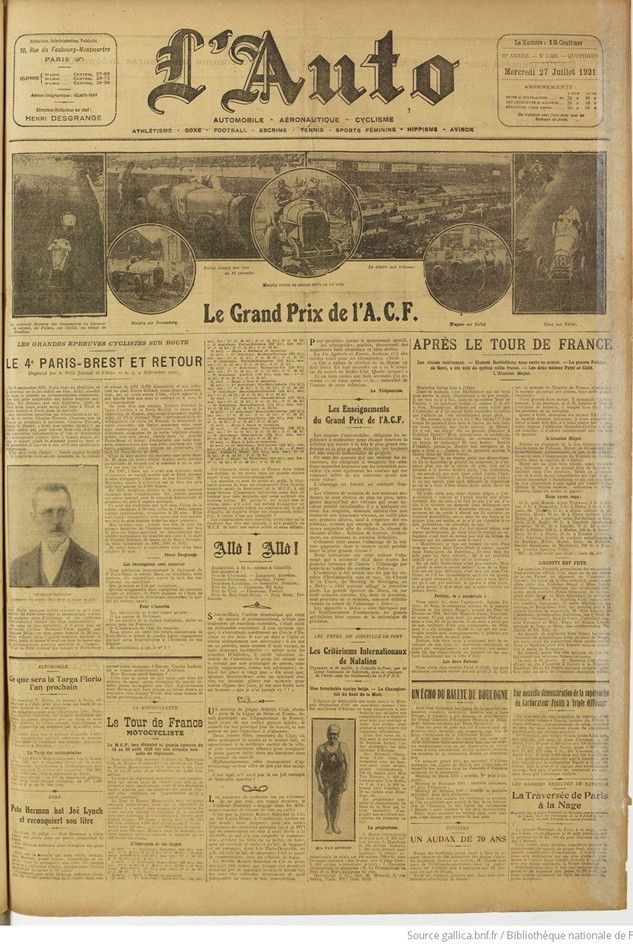
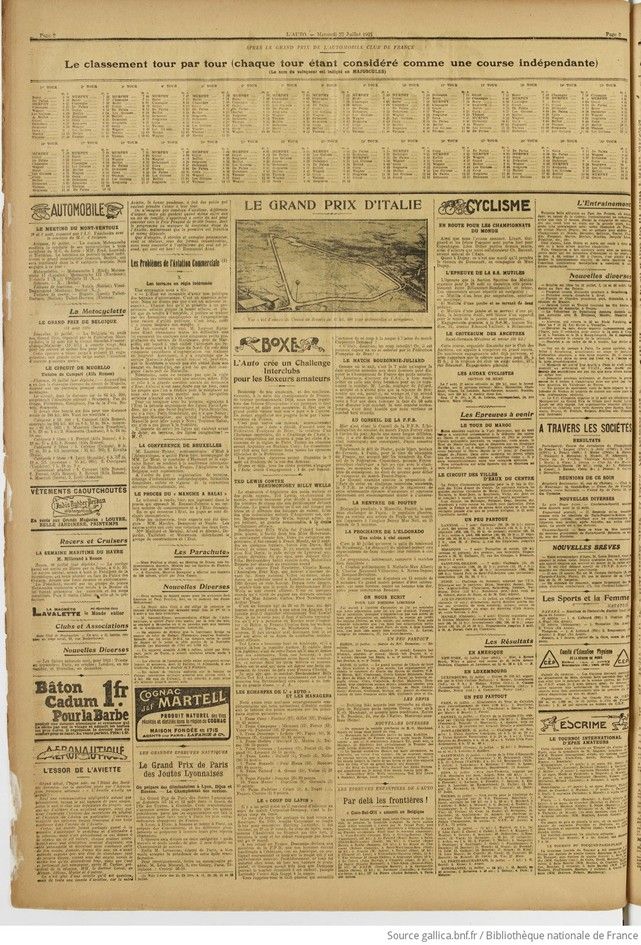
After the 1921 French Grand Prix at la Sarthe road course, a short „after the race“ summary was written. First, some race deciding pictures are presented, as well as the race’s lap-to-lap standings. But specially on the ingnition system of Delco, some attention is given. I’m not sure if this is the American company, founded by a.o. Charles Kettering in 1909. In this article it is stated that the Delco that is meant here, originates in France. Maybe Établissements Continsouza (founded 1909) produced these ignitons in licence from the US based Delco.
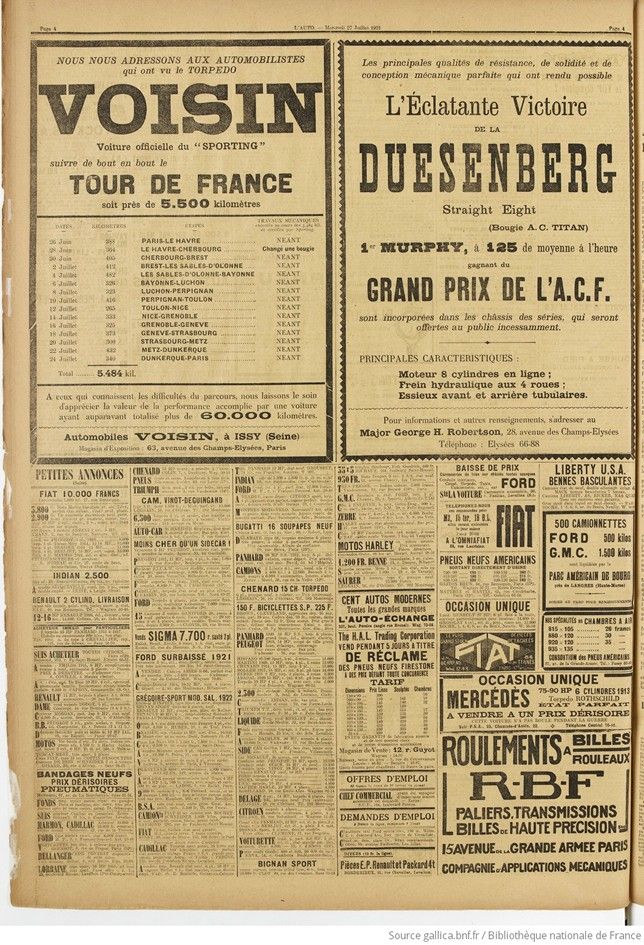
Textes et photos avec autorisation du Bibliothèque national francais, gallica.bnf.fr www.gallica.bnf.fr compilé par motorracinghistory.com
L’Auto, 22e Année, No. 7.529, Mercredi 27 juillet 1921.
Le Grand Prix de l’ACF 1921.
Le gagnant Murphy ; sur Duesenberg vu dépasser le second, de Palma, sur Ballot; au virage de Pontlieu. – Murphy sur Duesenberg. – Baillot change une roue en 11 secondes. – Murphy rentre au pesage après sa victoire. – Le départ aux tribunes. – Wagner sur Ballot. – Goux sur Ballot.
Les Enseignements du Grand Prix de l’A.C.F.
Les courses d’automobiles, obligeant les ingénieurs à rechercher pour chaque fonction la solution qui assure à la fois le plus grand rendement et la plus grande sécurité, ont toujours été une source indiscutable de progrès.
Ce sont les courses qui ont stimulé les inventeurs, les obligeant à imaginer les solutions nouvelles imposées par les nécessités nouvelles. Ce sont également les courses qui ont consacré‘ celles de ces solutions ayant une réelle valeur.
L’allumage en fournit un exemple frappant.
Les vitesses de rotation de nos moteurs modernes se sont élevées de plus en plus, atteignant aujourd’hui des vitesses qui nous auraient semblé irréalisables il y a quelques années. La magnéto, donnant satisfaction aux basses et aux moyennes vitesses, ne suffit plus aux grandes allures, sauf à employer des expédients, comme par exemple de monter plusieurs magnétos afin de réduire la vitesse de chacune d’elles… Solution de fortune, évidemment, en attendant la solution définitive.
Comment était assuré l’allumage de la voiture gagnante, dont le moteur avait précisément la plus grande vitesse ?
Nous retrouvons sur cette voiture l’allumage qui a triomphé déjà dans toutes les grandes épreuves, de l’année : l’allumage par batterie et bobine du système « Delco ».
L’attention a été attirée sur lui par les victoires d’Indianapolis 1920 et 1921, du Circuit de la Corse, du Meeting de Boulogne, où « Delco » s’est partout adjugé la première place. La grande épreuve du Mans, où sur neuf voitures classées, six, dont la première, sont pourvues de ce système, consacre définitivement la valeur de l’allumage « Delco ».
Les appareils « Delco » sont fabriqués par les Etablissements Continsouza, les grands spécialistes bien connus de la mécanique de précision.
——
LE GRAND PRIX D’ITALIE Vue à vol d’oiseau du Circuit de Brescia de 17 kil. 400 pour automobile et aéroplanes.
Translation by DeepL.com
The A.C.F. Grand Prix.
The winner Murphy; in a Duesenberg overtaking the runner-up, de Palma, in a Ballot; at the Pontlieu turn. – Murphy in a Duesenberg. – Baillot changes a wheel in 11 seconds. – Murphy returns to the weigh-in after his victory. – The start at the grandstands. – Wagner in a Ballot. – Goux in a Ballot.
Lessons from the A.C.F. Grand Prix.
Car racing, which forces engineers to seek solutions for each function that ensure both maximum performance and maximum safety, has always been an indisputable source of progress.
It is racing that has stimulated inventors, forcing them to come up with new solutions imposed by new requirements. It is also racing that has established which of these solutions are truly valuable.
Ignition is a striking example of this.
The rotational speeds of our modern engines have increased steadily, reaching speeds that would have seemed unattainable a few years ago. The magneto, which performs satisfactorily at low and medium speeds, is no longer sufficient at high speeds, unless expedients are used, such as installing several magnetos in order to reduce the speed of each one… This is obviously a makeshift solution, pending a definitive solution.
How was the ignition of the winning car, whose engine had precisely the highest speed, ensured?
This car features the ignition system that has already triumphed in all the major races of the year: the “Delco” battery and coil ignition system.
Attention was drawn to it by the victories at Indianapolis in 1920 and 1921, the Corsica Circuit, and the Boulogne Meeting, where “Delco” took first place everywhere. The great Le Mans race, where six of the nine cars classified, including the winner, were equipped with this system, definitively confirmed the value of the “Delco” ignition system.
Delco devices were manufactured by Etablissements Continsouza, the renowned specialists in precision engineering.
——
THE ITALIAN GRAND PRIX
Bird’s-eye view of the 17.4 km Brescia Circuit for cars and airplanes.