Text and photos with authorisation of Bibliothèque National de France, gallica.bnf.fr.; compiled by motorracingistory.com,
THE NEW YORK HERALD, European Edition, PARIS, THURSDAY, JUNE 17, 1904.
HOMBURG IS EAGER FOR THE BIG RACE.
Population Already Camping On the Doorsteps and Fired With Enthusiasm in Advance.
Fiction of German Undemonstrativeness Amply Shown by Lively Interest Which “Beats the Irish.’‘
ROAR OF THE BIG MACHINES.
Mystery of the Accident to M. Dufaux’s Swiss Automobile —
Emperor Visits the Saalburg.
—–
[SPECIAL TO THE HERALD.]
Homburg, Thursday. — Who ever invented the legend that the Germans are an undemonstrative people?
Like most legends, it crumbles to pieces under investigation. Certainly, every foreigner in Homburg at the present moment would shriek with derisive laughter at any reference to Teutonic stolidity after this spectacle of a whole community — nay,
More, of an entire province — swept off its balance by passionate interest in an automobile race. One is compelled to believe that the legend is a deliciously subtle piece of irony, evolved by a master humorist.
Even the Irish enthusiasm of last year becomes mild tranquility in comparison to this – madness is the only word for it. This people has apparently determined to surpass the Celt in the vehemence of its demonstration, just as the German Automobile Club has tried to surpass all previous attempts at an automobile race organization.
A whole town is living on the doorstep, or at the window, and well-fed Hans and plump Gretchen have succumbed to the vertigo of speed. All day long the sidewalks have been blocked by spectators quivering with tense interest, as completely as the roadway has been blocked by automobiles of every size, shape and color.
Such a deafening uproar was surely never heard before, except during a hot artillery engagement, nor is the simile so far-fetched as one might think. The air is full of detonations of ear-shattering reports, as of exploding bombs, of the tooting of horns, the throbbing of motors and the hurrahing of the crowd.
Paroxysm of Excitement.
Perhaps the brilliant sunshine this afternoon may have contributed to work up this paroxysm of public excitement. At any rate, as the day wears on, the people grow more enthusiastic, and after the race another good full-grown Homburg rainstorm will be a Godsend to serve as a sobering “douche” for the perfervid population.
Nothing except the race is spoken about or even appears to merit attention. The shop windows are filled with articles named after the race. One baby-linen establishment exhibits an automobile cunningly constructed of pocket handkerchiefs. Herr Max Stern, of Frankfort, a firm of tobacconists, has put on the market a new cigarette christened after the race, and a special brew of beer has been similarly honored. I regret to add that this beer is by no means so good as its title.
Souvenir scarfpins, souvenir brooches, souvenir buttons, illustrated postcards in bewildering variety, guides for visitors to the race, the history of the previous races for the Coupe Internationale, pieces of music written in honor of the event, cartoons, caricatures, everything that commercial ingenuity could devise in connection with tomorrow’s contest is on sale in the shops.
The race, in fact, monopolizes industry for the moment as completely at it monopolizes public attention.
All the competing machines were weighed this morning amid such a dense throng that it is a miracle if some of the spectators were not weighed with the automobiles.
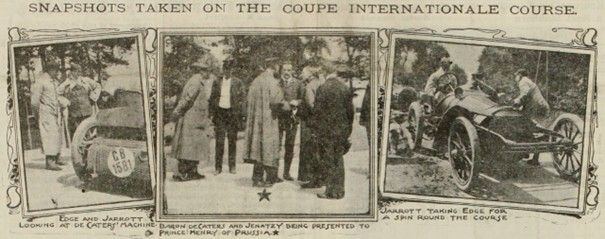
Some little diversity was imparted to the scene by a small fire that started under Mr. Edge’s Napier machine just before it was pushed on the scales. Air. Edge really has not had reason to regard himself as a mascot since he arrived here. The first day he went out, he broke a crankshaft, the following day a borrowed Darracq came to grief while he was making another attempt to go round the course; then Mr. Jarrott offered to take him along.
This appears to have been the signal for the Wolseley, which had hitherto given not the slightest trouble, to refuse to budge. Finally, a Fiat that had aroused considerable admiration by the regularity of its working was borrowed, and on this machine, Mr. Edge made another trial to get acquainted with the course.
It will surprise no one, after the preceding catalogue of misfortunes, to learn that the Saalburg, about seven minutes’ run from Homburg, was reached in something over a couple of hours, and that in this short distance most of the conceivable forms of “panne” were experienced by that Fiat.
More Trouble.
As though this run “on the black” was not sufficient, the new crankshaft arrived on Sunday, but the offices were closed and when, after much difficulty, Mr. Edge got to the officials it was discovered that the Customs authorities had sent forward the wrong papers. Result: still further delay.
Luckily the fire this morning did no damage to the machine. The flames, as though in irony, seared the doors of the Homburg Fire Department’s hose station, and it was a rather humorous spectacle to see the horses harnessed to the engines to fight a fire that was almost singeing their noses at their posts. There was a little scurry in the crowd, perhaps not so much to get out of the way as to witness the blaze from a vantage point. The fire broke out just as the Napier was being emptied of its oil and essence. It is believed to have been caused by a cigarette or a lighted match thrown down by some careless smoker.
As is to be expected, there are dark hints dropped that this little incident was a fruitless attempt to put Mr. Edge’s machine out of the race, but it is certainly unnecessary to add that the people in their senses pooh-pooh such hints as being the offspring of sensation-loving imaginations.
What appears more serious is the report that the accident which has disabled the automobile of M. Dufaux, the young Swiss racer, is due to malevolence. As he was passing the Kurhaus this morning between nine and ten, on his way to the weighing, the steering pin to the right front wheel suddenly snapped like a stick of barley sugar. The examination appears to prove that the breakage was not due to an inherent weakness, as there was absolutely no strain on the broken part, nor to defective material, but to malignity. The pin, in fact, which was made of nickel steel, seems to have been filed or sawn almost completely through from the underside.
Lodged a Protest.
M. Dufaux, after making this discovery, lodged a protest with the Automobile Club, accompanying his letter with the broken piece of metal. A commission, composed of three members, a German, an Englishman and a Frenchman, has been appointed to investigate the matter, and it will meet on Saturday morning.
“I haven’t the faintest idea who‘ can have been guilty of such a piece of ill-will,” said M. Dufaux later in the day. “The machine came by rail to Frankfort yesterday, and by road to Homburg last night. It was lodged under lock and key in the improvised garage in the Lomsenstrasse. Naturally I have no means of ascertaining whether the part was three-quarters sawn through in the train or here, but what I am convinced of is that the part has been sawn through. Look at it,” and he pointed to a portion of the metal still adhering to the machine, the other part being in the keeping of the German Automobile Club.
To within a few millimeters of the upper side the metal is as smooth as though it had been filed, only the thin skin of metal at the top remaining rough. Exasperating though such an incident may be, if the investigation proves that the breakage was really due to an attempt to disable the machine, M. Dufaux has reason to congratulate himself that the metal gave way while he was going slowly along the streets. Had the weakened part resisted until the race was well under way tomorrow, the chances are about a million to one that there would have been a fearful accident on one or another of the break-neck curves, with which the course is plentifully provided. Thus, from one point of view M. Dufaux’s luck is as unquestionable as Mr. Edge’s bad luck is.
The Emperor’s arrival was the first event of the) day. His Majesty reached Homburg at eight o’clock and was driven to the Schloss. At ten o’clock he received the Duke of Ratibor and Freiherr von Brandenstein, who accompanied him to the Saalburg, where all the arrangements for tomorrow were minutely scrutinized.
One does not need to be a thought-reader to realize the pride of the organizers when the Kaiser expressed his complete satisfaction with what had been done. His praise was well bestowed, for Freiherr von Brandenstein, Dr. Levin, Dr. Marx, burgomaster of Homburg; the Duke of Ratibor, president of the German Automobile Club, and Count Sierstorpff have accomplished a Herculean task.
The Kaiser announced that he would be present at the start. He will arrive at the Saalburg at 6.45 tomorrow morning.
Some early rising will have to be indulged in tomorrow, and, realizing this fact, several good tradesmen have placards out informing the public that the shutters will be down in the morning at four o’clock. It’s the early bird that catches the worm.
Social Phases.
From a social point of view Homburg can rarely have been busier. The terrace at Ritter’s is the place of general rendezvous. Last night, for example, I saw daring there Prince and Princess Solms, with Baroness von Erlanger and Count Kolowrat and Count. Bees. Prince Solms and Count Kolowrat made the journey from Vienna in a twenty-four horsepower Spitz automobile, and they told me they were delighted with the trip. Not a single mishap occurred on the way — not even a burst “pneu,” and the only disagreeable experience was a drenching which they received yesterday between Heidelberg and Homburg.
Prince and Princess Frederick Carl von Kohenlohe had a party at another table.
Mr. Charlemagne Tower had a number of Austrian friends at that favorite corner table to the left on Ritter’s terrace, which is so eagerly sought by the connoisseurs, as it commands a view both of the entire terrace and the park in front.
Herr Fnedlander, the Berlin “Coal King,” with his charming and pretty wife, and several guests, formed another animated group. Here and there I noticed: Mr. Leon Graves, with his pretty wife, who wore a most effective Hack costume; Mr. James Low Harriman, with a group of French friends; Mrs. Stein way, with a party; Mr. and Mrs, Howard Johnstone, with Mr. and Mrs. Pelton and Mr. and Mrs. Manning; the Duke of Buccleuch, with Mr. Glyn, Mr. Ballin Hinde and Mr. Wallace, former president of the British Automobile Club; Colonel Holden, the actual president of that body; Mr. Julian Orde, its handsome and energetic secretary; Mr. and Miss Bird, Mr. James Nachs, Mrs. Gerard Leigh, Colonel and Mrs. Drummond and Mr. Sykes.
Also, Mr. Auffm-Ordt, bubbling over with enthusiasm about the race, with Mr. “Willie” 0. Roosevelt and party; M. Jellinek-Mercedes, with Mr. and Mrs. Warren and a large party, that I had not time to count, so amused was I by the satisfied tone with which Mr. Jelinek-Mercedes told me that Baron de Caters had promised not to stop during the race tomorrow to help any disabled competitor, as he did with Mr. Jarrott in Ireland last year. “He says that, if eighteen out of the nineteen competitors, are thrown out, he will still keep on until the end.”
Others “en Evidence.”
I also noticed Mr. and Mrs. Clarence Gray-Dinsmore, with Mr. Allison V. Armour, whose brother arrives today. Mr. Armour, by the way, accompanied Prince Henry of Prussia on a run on Tuesday from Schloss Wolfsgarten, where the prince is stopping, to Hoechst and hack in a White steam automobile made in Cleveland. The prince, who retains a pleasant recollection of America and is keenly interested in steam automobiles, examined the machine closely and praised it emphatically for its noiselessness, regularity and easy motion over some of the horrible roads.
Mr. Walter White drove, and Mr. Coleman accompanied the party. On the way an Italian circus was met, and the prince insisted upon stopping while an impromptu performance was given, a camel’s air of patient indifference and the antics of a cage of monkeys convulsing Prince Henry and the party with merriment.
The latest arrivals include Prince A. de Lucinge, who came by the road in his superb sixty horsepower Charron, breakfasting in Paris on Tuesday and dining in Metz the same evening. Nothing happened in the shape of drawbacks. Prince de Lucinge even escaped yesterday’s rainstorm, as he arrived at shelter just at the moment it commenced.
M. Mors arrived in a Mors machine, naturally, and without incident, equally naturally.
Others were Baron de Zuylen, Count Bela Zichy, Comte de Gramedo, Marques de Villalonga and Dr. John Grant Lyman, who came by the road from Paris in his handsome machine, accompanied by Mr. T. J. Trafford-Huteson, of London.
Countess Kolowrat, of Vienna, gives a dinner for forty to-morrow followed by a dance, if anyone has energy enough to dance after such a day well filled with excitement as to-morrow promises to be.
ACCIDENTS ON THE COURSE.
Machinist Reported Killed, and Herr Uhl Has Arm Broken.
[SPECIAL TO THE HERALD.]
Homburg, Thursday. — Two accidents are reported from the racecourse this afternoon. Baron von Leitenberger, with his wife and a mechanic, was surprised by one of the turns and is believed to have clapped on the brakes, with the result that his 70 horsepower Mercedes turned turtle.
The “chauffeur” is reported to have been killed, and the baron and baroness were gravely injured and are in the hospital.
The mishap is said to have happened near Gravenwiesbach, and later it is denied that the “chauffeur” is dead.
The second accident happened to Herr Conrad Uhl, proprietor of the Bristol Hotel, of Berlin. It appears that he was coming down the hill at the Saalburg and turned the corner at too great a speed. The machine left the road, and Herr Uhl is said to have sustained a double fracture of the arm. His companion, Herr Murling, was injured seriously.
MANY HIGH-POWER MACHINES.
‘Forties” Look Small Among the Monsters at Homburg.
[SPECIAL TO THE HERALD.]
Homburg, Thursday. — I have been looking round the garages to-day, and a lot of them there are in every court-yard and every stable, while every garden patch has been utilized in one form or another, while the very streets outside the principal hotels have been lined on either side with rows of automobiles hailing from every country.
There can be no doubt that the Mercedes predominate, though the Panhards run them close. I have been particularly struck by the crowd of high-power machines. The forty horse powers look desperately small among the “sixties,” “eighties” and even “nineties” that abound.
The Fiats are making an excellent display, and in a half-hour this afternoon I counted no fewer than twenty go past a given point.
Photos.
Snapshots taken on the Coupe Internationale Course.
Edge and Jarrott Looking at de Caters’ Machine.
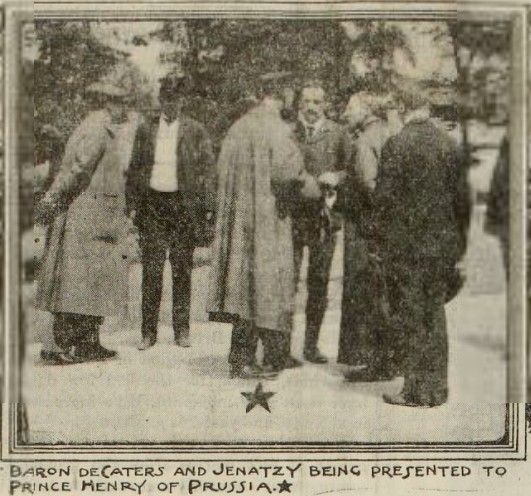
Baron de Caters and Jenatzy being Presented to Prince Henry of Prussia. Jarrott taking Edge for a Spin around the Course.