

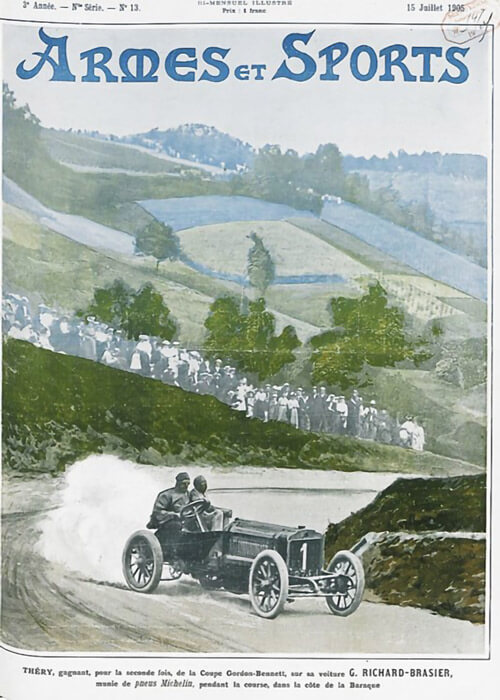


Text and jpegs by courtesy of hathitrust.org www.hathitrust.org, compiled by motorracinghistory.com
The Automobile, Vol. XIV (14), No. 26, June 28, 1906, p. 1009
DETACHABLE RIMS FOR THE GRAND PRIX
PARIS, June 15.-An extremely interesting feature of the Grand Prix will be the use of detachable rims and tires by some of the competing cars. As the drivers and mechanics must do all their own work without outside assistance, manufacturers have looked for some easy method of changing tires, and the two devices described herewith have been adopted. Both these systems allow spare inflated tires to be carried on the car and replaced for a disabled tire in from one and a half to two minutes without the use of a pump or special tools.
The patent M. L. rim, which has been on the French market since the last Paris Salon, is sold by the Société des Jantes Amovibles M. L., of 112 rue Richelieu, Paris, and although patented abroad, is at present only to be found in London and Paris.
An ordinary wooden wheel may be converted, or the wheels may be specially constructed. On the outer edge of the road wheel are embedded six bolts projecting about three-quarters of an inch. The detachable rim, which is of steel, has the same flanged edges as an ordinary rim. Six projecting ears are riveted within the circumference of the rim and near its outer edge. Each of these ears is drilled to fit the bolts projecting from the face of the wheel. The tire is fixed on this rim, the air chamber inserted and inflated exactly as an ordinary automobile wheel. The rim is then slid on the road wheel, the bolts on the wheel passing through the ears on the rim and held in position by nuts. Provision is made for the projecting valve by a notch cut in the wooden rim, and as a further security against creeping the ears are countersunk into the wooden and metal rims of the wheel. The surface of the rim coming in contact with the felloe consists of two steel rails machine finished, with a groove between them, in which are imbedded the nuts holding the valve on its seating and the bolts of the leather cover of which the air chamber rests. Being flush with the level of the rails, it is im- possible for the bolts to work loose.
The Vinet rim will also be seen in the Grand Prix. M. Kepferer, of 24 rue de la Rochefoucault, Paris, is the only selling agent. As in the system just described, the Vinet consists of a double rim, one part being fixed on the wheel and the other bearing the tire being detachable. The flat steel rim B encircling the road wheel H carries on its interior edge a ridge C, against which is pressed one edge of the detachable rim M M. This latter has only to be slid on to the wheel, the diameter of the wheel being about four millimeters less than that of the rim in order to make the operation easy. Five or six projections on the detachable rim fit into indentations on the fixed rim, preventing one rim revolving on the other. The rim placed in position, a steel ring. E, split to facilitate mounting and having one of its faces beveled to fit against the face of M M, is placed over the six projecting bolts on the wooden rim and held in position by nuts L. To dismount a tire, it is only necessary to unscrew the nuts L, take off the split ring E and withdraw the rim and tire M M. A special short valve has to be employed, not projecting beyond the false rim M M. To inflate the tire it is necessary to dismount it. An improved model is now being made in which the fixed rim of wood and metal is pierced to allow of the passage of a prolongation of the valve, screwing into the valve embedded within the false rim. By this means it would not be necessary to dismount the rim to inflate the tires.
All the cars employing these rims in the Grand Prix race will carry two spare tires completely inflated. When a change is necessary the tire will be changed and dropped off at the first repair station and another taken on board. Valuable time will certainly be saved, and, seeing that seconds will probably decide the winning or losing of the race, one might at first suppose that all cars would be fitted with these wheels. The weight limit of 1,000 kilos, however, prevents several competitors from adopting them, and the private objections of drivers may be a determining factor in other cases.
Clément Bayard and Vulpés cars are certain to be fitted with either Vinet or M. L. rims, while other firms, having given them extensive trials but not having yet definitely decided, are Darracq, Renault, and Brasier. The Itala, to be driven by Baron de Caters, will stick to fixed rims, declares M. Henri Fournier.
In all previous big road races, the most elaborate preparations have been made to keep good tires under the cars, and the scores of tire experts stationed at intervals around the course have often had a very important, though not fully appreciated, share in placing the cars at the finish. Stacks of tires, patent pumps, steel tanks of compressed air, the most ingenious tire tools and the pick of the tire men have been considered essential to a great road race, and the scene when a car dashed up to a tire depot to have tires changed was spirited; the tire men would rush out with sharp knives and with dexterous strokes cut the tires from the wheels, giving way instantly to another gang carrying new tires ready to apply. A third set of men would be ready with the hose connections from the air tanks, and in a short time the car would be again on its way. In the meantime, the driver and his mechanic could take things as easily as their dispositions would permit. While a picturesque feature has been removed, the new arrangement will doubtless do much to develop a more convenient method of fastening tires.
Photo captions.
VINET DETACHABLE RIM. – CROSS SECTION OF VINET RIM. – THE M. L. RIM WITH TIRE REMOVED.