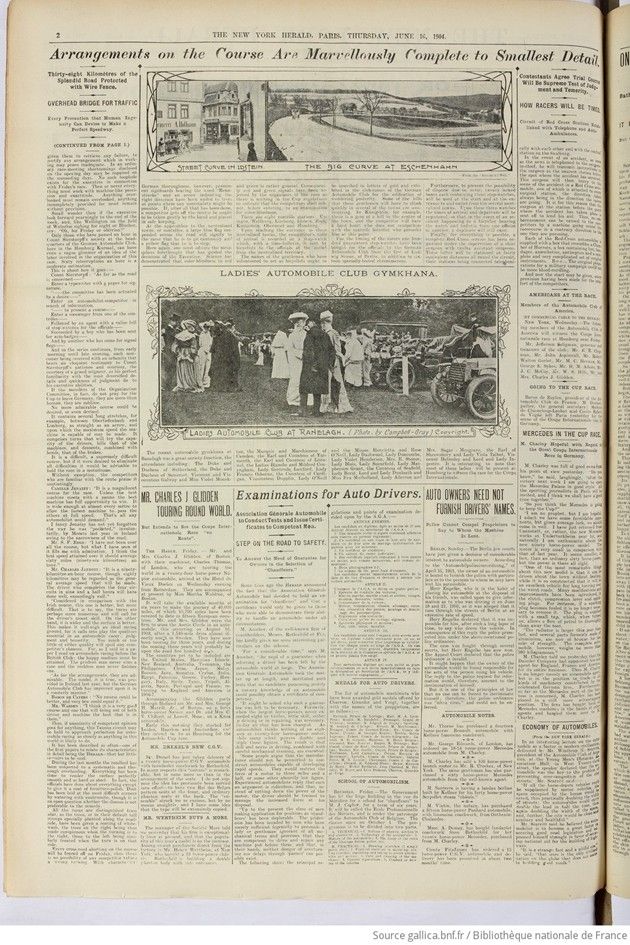
Text and photos with authorisation of Bibliothèque National de France, gallica.bnf.fr.; compiled by motorracingistory.com,
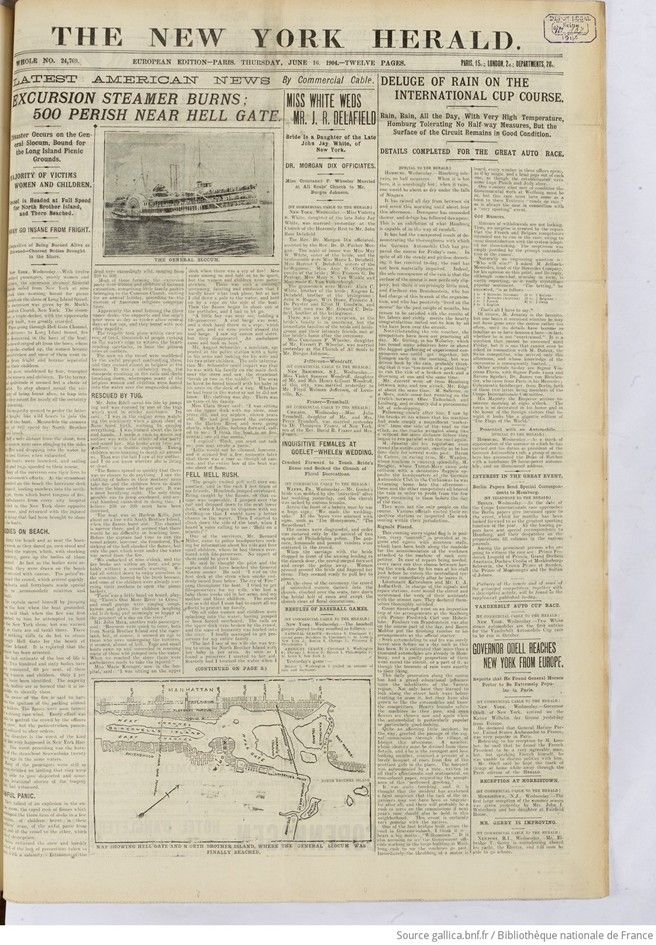
THE NEW YORK HERALD, European Edition, PARIS, THURSDAY, JUNE 16, 1904.
DELUGE OF RAIN ON THE INTERNATIONAL CUP COURSE.
Rain, Rain, All the Day, With Very High Temperature, Homburg Tolerating No Half-way Measures, But the Surface of the Circuit Remains in Good Condition.
DETAILS COMPLETED FOR THE GREAT AUTO RACE.
—–
[SPECIAL TO THE HERALD.]
Homburg, Wednesday. — Homburg tolerates no half measures. When it is hot ‚here, it is scorchingly hot; when it rains, one would be about as dry under the falls of Niagara.
It has rained all day from between six and seven this morning until about four this afternoon. Downpour has succeeded shower, and deluge has followed downpour. This is an exhibition of what Homburg is capable of in the way of rainfall.
It has had the unexpected result of demonstrating the thoroughness with which the German Automobile Club has prepared the course for Friday’s race. In spite of all the steady and pitiless drenching it has received to-day, the road has not been materially impaired. Indeed, the sole consequence of the rain is that the surface of the course is now perilously slippery, but there is surprisingly little mud, and Freiherr von Brandenstein, who has bad charge of this branch of the organization, and who has positively “lived on the course” for the past couple of months, has reason to be satisfied with the results of his labors and richly merits the hearty congratulations meted out to him by all who have been over the circuit.
Notwithstanding the idle weather, the competitors have been out practicing all day. Mr. Girling, in his Wolseley, which has found many admirers here in about the biggest gathering of experienced connoisseurs one could get together, left Usingen early in the morning, but was driven back by the rain, probably thinking that it was “too much of a good thing” to run the risk of a broken neck and a drowning at one and the same time.
Mr. Jarrott went off from Homburg between nine and ten o’clock, Mr. Edge at about the same time. M. Salleron, on a Mors, made some fast running on the stretch between Ober-Tiefenbach and Limburg, and evidently did a phenomenal bit of side-slipping.
Following closely after him, I saw by the tracks of his wheels that his machine bad made simply a magnificent “embardee” from one side of the road to the other, as the tracks wriggled along like a serpent lor some distance before they began to run parallel with the road again.
M. Jenatzy did his regulation runs round the entire circuit, exactly as he has done daily for several weeks past. Baron de Caters, in racing trim, Mr. Warden, whose machine is running splendidly, M. Rougier, whose Turcat-Mery came into collision with a decorative flagpole opposite the headquarters of the German Automobile Club in the Curhaus as he was returning home late this afternoon — these and the other competitors all braved the rain in order to profit from the few hours remaining to them before the day of the race. They were not the only people on the course. Various officials visited their respective stations or inspected the work coming within their jurisdiction
Signals Placed.
This evening every signal flag is in position, every “controle” is provided at ingress and egress with nineteen stalls, which have been built along the roadside for the accommodation of the workmen attached to the machine of each competitor. In case of repairs being needed, every racer can thus choose between having the work done by his man at his stall just before he enters the neutralized territory, or immediately after he leaves it.
Lieutenant Kaltenborn and Mr. C. A. Auffm-Ordt. in charge of the signals and repair stations, went round the circuit and scrutinized the work of their assistants with the utmost care. They declared themselves thoroughly satisfied.
Count Sierstorpff went on an inspection trip of the arrangements at the Saalburg with Prince Frederick Carl von Hohenlohe. Freiherr von Brandenstein was also on the course part of the day, and Baron Molitor put the finishing touches to his arrangements as the official starter.
Such automobiling to and fro was surely never seen before on a day such as this has been. It is estimated that more than a thousand automobiles are already in Homburg, and a goodly proportion of them went round the circuit, or a part of it, as though the torrents of rain were exactly to their liking.
This daily procession along the course has had a grand educational influence upon the inhabitants of the Taunus region. Not only have they learned to look along the street both ways before starting to cross it, but they have also grown to like the automobiles and know the competitors. Hearty hurrahs salute the machines as they pass, and even flowers are thrown now and again when the automobilist is particularly popular or particularly good-looking.
Quite an affecting little incident, by the way, greeted the passage of the signal commission through the village of Idstein this afternoon. A member, whose identity must be divined from these details, and who is the youngest and best looking member, received a present of a lovely bouquet of roses from five of the prettiest girls in the place. The bouquet was accompanied by a note, written in all that’s affectionate and sentimental, on rose-colored paper, requesting the acceptance of this “perfumed greeting.”
It was quite touching, and it is thought that the incident has awakened a faint suspicion that the task of the organizers may not have been so ungrateful after all and there will probably be a rush to serve on the commissions if next year’s race should also be held in this neighborhood. This event is certainly very popular with the natives.
One of the foot bridges built across the road in Gravenwiesbach, I think it is — bears a big motto: “Wilkommen.” It is also amusing to see the Government officials working in the large building at Weilburg rush to see the machines go past. Immediately the throbbing of a motor is heard, every window in these offices opens as it by magic, and a head pops out of each one, as though the establishment were some huge Punch and Judy show.
One wonders what sort of condition the Governmental work at Weilburg must be in, but this race must have come as a boon to these Teutonic “ronds de cuir,” as is always the case in connection with a “very sporting” event.
Odd Rumors.
Rumors of withdrawals are not lacking. Thus, no surprise is created by the report that the French and Belgian competitors intended not to run in the race, owing to some dissatisfaction with the system adopted for time-taking. The skepticism was amply justified by the prompt contradiction of the rumor.
Naturally an engrossing question is: “Who will win?” I asked M. Jellinek-Mercedes, head of the Mercedes Company, for his opinion on this point, and his reply, although somewhat oracular in form, is worth reporting, as it really crystallizes popular sentiment.
“The betting,” he answered,“ is as follows : —
6 to 4 Mercedes (German) 20 to 1 Italians
2 to 1 Mercedes (Austrian) 20 to 1 Belgians
2 to 1 French 40 to 1 Swiss
4 to 1 English
“That’s all I have to say.”
Of course, M. Jenatzy is the favorite, but one hears it surmised whether he may not have gone over the course rather too often, until its details have become so familiar as to have become a bore — in fact, whether lie is not “overtrained.” It is a question that cannot be answered until Friday, but it is one that cannot even be asked in connection with M. Dufaux, the Swiss competitor, who arrived only this afternoon, and whose knowledge of the racecourse is consequently limited.
Other arrivals to-day are Signor Vincenzo Florio, with Signor Paolo Tasca and Barone Sgadari, Dr. James von Bleichroder, who came from Paris in his Mercedes; Geheimrath Goldberger, from Berlin, both of these two latter being members of the Coupe Internationale Committee.
His Majesty the Emperor arrives to morrow morning at eight o’clock. The town is so decorated in his honor and in the honor of the foreign visitors that tonight it looks like a gigantic edition of “The Flags of the World.”
Presented with an Automobile.
[SPECIAL TO TIIE HERALD.]
Homburg, Wednesday. — As a mark of appreciation of the manner in which he has carried out his duties as president of the German Automobile Club, a group of members has presented the Duke of Ratibor with a handsome 28 horse-power automobile, and an illuminated address.
INTEREST IN THE GREAT EVENT.
Berlin Papers Send Special Correspondents to Homburg.
[BY TELEPHONE TO THE HERALD.]
Berlin, Wednesday. — As the date of the Coupe Internationale race approaches the Berlin papers give increased space to the event, which for months has been looked forward to as the greatest sporting function of the year. All the leading papers have sent special correspondents to Homburg, and their despatches on the preparations fill columns in the various journals.
Among the prominent persons who are going to witness the race are: Prince Frederick Leopold of Prussia, Grand Duchess Anastasia, Duchess Cecilia of Mecklenburg-Schwerin, the Crown Prince of Sweden, the Prince of Montenegro and the Sultan of Jahore.
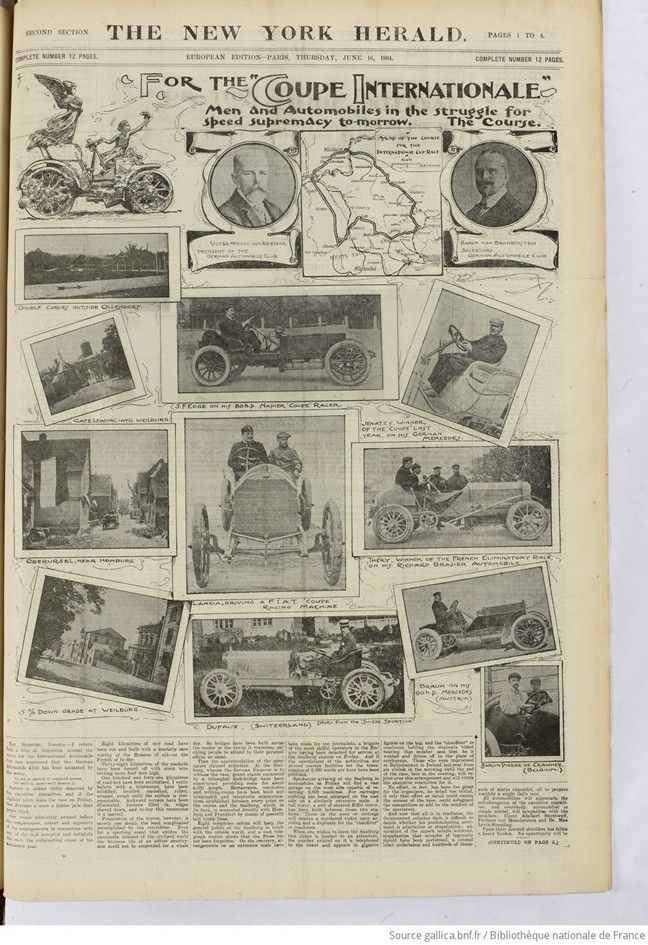
Pictures of the course unci of some of the principal competitors, together with a descriptive article, will he found ill the supplement published to-day.
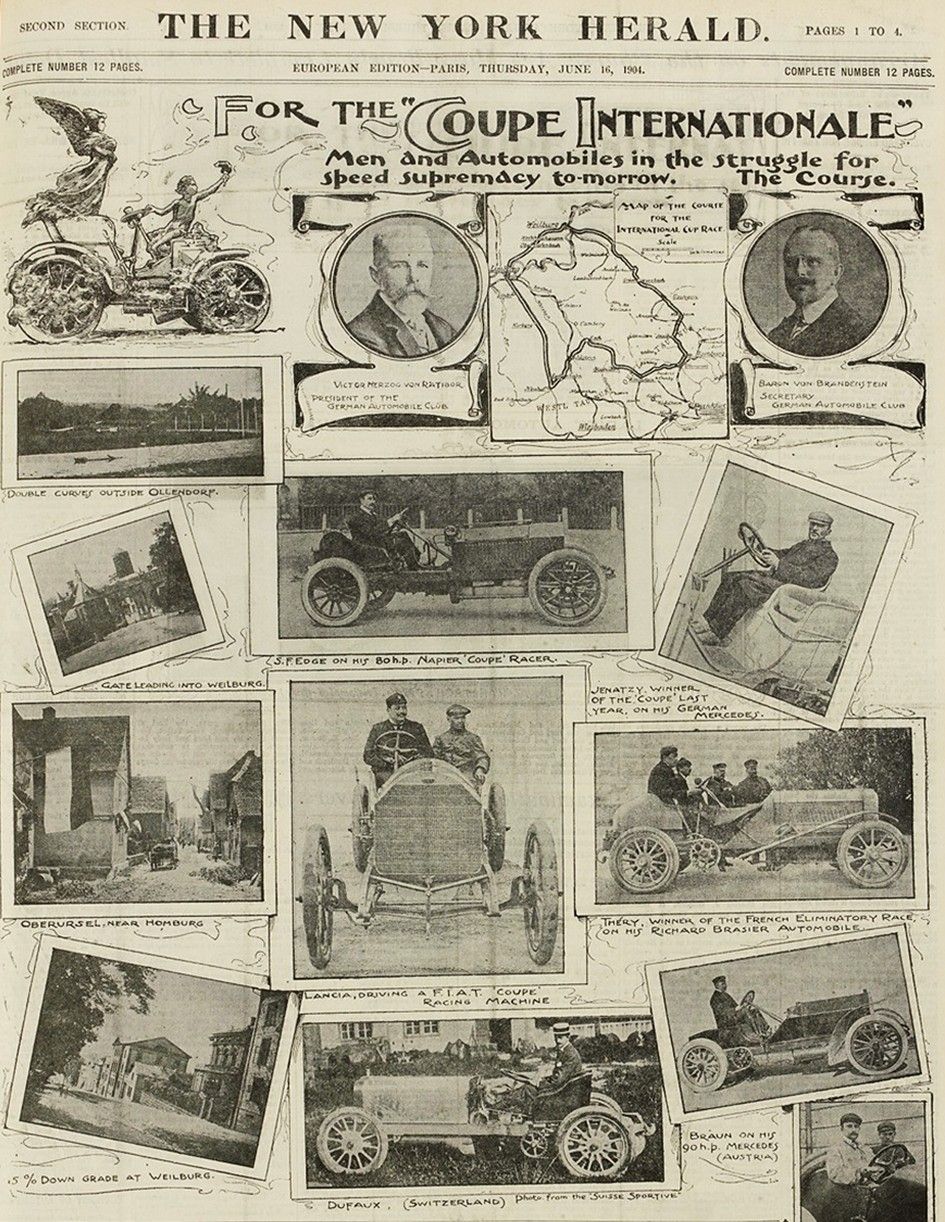
THE NEW YORK HERALD. EUROPEAN EDITION—PARIS, THURSDAY, JUNE 16, 1904.
SECOND SECTION – PAGES 1 TO 4. – NUMBER 12 PAGES. COMPLETE NUMBER 12 PAGES,
FOR THE “COUPE INTERNATIONALE”
Men And Automobiles in the Struggle for Speed Supremacy to-morrow.
Victor Herzog von Ratibor. – President of the German Automobile Club.
Baron Von Brandenstein. – Secretary of the German Automobile Club.
Double Curves outside Ollendorf.
Gate Leading into Weilburg.
Oberursel – Near Homburg.
5 % Down Grade at Weilburg.
S. F. Edge on his 80 h.p. Napier “Coupe” Racer.
Lancia, Driving a F.I.A.T. “Coupe” Racing Machine.
Dufaux (Switzerland) Photo from the “Suisse Sportive”.
Jenatzy, Winner of the “Coupe” Last Year, on his German Mercedes.
Théry, Winner of the French Eliminatory race, on his Richard-Brasier Automobile.
Braun on his 90 h.p. Mercedes (Austria)
Baron Pierre de Crawhez (Belgium)
THE NEW YORK HERALD. EUROPEAN EDITION—PARIS, THURSDAY, JUNE 16, 1904.
SECOND SECTION – PAGES 1 TO 4. – NUMBER 12 PAGES. COMPLETE NUMBER 12 PAGES.
FOR THE “COUPE INTERNATIONALE”
Men And Automobiles in the Struggle for Speed Supremacy to-morrow.
BAD HOMBURG, Tuesday. – I return from a trip of inspection around the course for the International Automobile Cup race convinced that the German Automobile Club has been animated by this motto: ‚Tis not in mortals to command success, But we’ll do more – we’ll deserve it.
Success is indeed richly deserved by the executive committee, and if the slightest hitch mars the race on Friday, then Fortune is even a fickler jade than people think.
One stands absolutely amazed before the completeness, extent and ingenuity of the arrangements in connection with one, of the task accepted and faithfully this race, the culminating event of the automobile year.
Eight kilometres of new road have been cut and built with a masterly care worthy of the Romans of old – or the French of to-day.
Thirty-eight kilometres of the roadside have been fenced off with stout wire netting some four feet high.
One hundred and forty-one kilomètres of road-bed have been scrutinized, I verily believe with a microscope, have been solidified, levelled, smoothed, rolled, scraped, swept until the surface is irreproachable. Awkward corners have been eliminated, furrows filled in, ridges shaved down, and to-day this racecourse is a marvel.
Preparation of the course, however, is merely one detail, the least complicated accomplished by the committee. Even for a sporting event that excites the passionate interest of the civilized world the business life of an entire country-side could not be suspended for a whole day. So bridges have been built across the course in the towns it traverses, enabling people to attend to their personal affairs as usual.
Then the accommodation of the spectators claimed attention. At the Saalburg, whence the German Emperor is to witness the race, grand stands connected by a triumphal arch-bridge have been constructed providing seats for about 4,500 people. Restaurants, wardrobes and writing-rooms have been built and telegraphic and telephonic communications established between every point on the course and the Saalburg, which, in its turn, is connected directly with Homburg and Frankfort by means of specially laid trunk lines.
Eight telephone cabins will keep the general public at the Saalburg in touch with the outside world, and a vast telegraph station shows that the Press has not been forgotten. On the contrary, arrangements on an extensive scale have been made for the journalists, a brigade of the most skillful operators in the Empire having been detached for service at the Saalburg station on Friday. And if the calculations of the authorities are proved correct facilities for the transmission of 6,000 words per hour have been provided.
Spectators arriving at the Saalburg in automobiles on Friday will find a vast garage on the west side capable of receiving 5,000 machines. For carriages stabling has been arranged on the east side on a similarly extensive scale. A tall tower, a sort of stunted Eiffel tower, has been built between these two stations. Those in the auto or carriage will receive a numbered ticket upon arriving and a duplicate for the “chauffeur“ or coachman.
When one wishes to leave the Saalburg this ticket is handed to an attendant, the number printed on it is telephoned to the tower and appears in gigantic figures on the top, and the “chauffeur” or coachman holding the duplicate ticket hearing that number sees that he is wanted and drives off to the place of rendezvous. Those who were imprisoned at Ballyshannon in Ireland last year from six o’clock in the morning until the end of the race, late in the evening, will rejoice over this arrangement and will thank the executive committee for it.
No effort, in fact, has been too great for the organizers, no detail too trivial, if only that effort or detail could ensure the success of the race, could safeguard the competitors or add to the comfort of the spectators.
And now that all is in readiness, the disinterested onlooker finds it difficult to decide whether his predominating sentiment is admiration or stupefaction: admiration of the superb results achieved, stupefaction that miracles of ingenuity should have been performed, a colossal labor undertaken and hundreds of thousands of marks expended, all to prepare worthily a single day’s race.
All automobilists will appreciate the self-abnegation of the executive committee, and everybody, automobilist or simple mortal, will sympathize with the members: Count Adalbert Sierstorpff, Freiherr von Brandenstein and Dr. Max Levin-Stoepling. (CONTINUED ON PAGE 2.)
(CONTINUED FROM PAGE 1.)
Arrangements on the Course Are Marvellously Complete to Smallest Detail.
Thirty-eight Kilometres of the Splendid Road Protected with Wire Fence.
OVERHEAD BRIDGE FOR TRAFFIC – Every Precaution that Human Ingenuity Can Devise to Make a Perfect Speedway.
Upon their devoted shoulders has fallen a heavy burden. No opportunity will be given them to retrieve any failure, to rectify any arrangement which in working may prove inadequate. In an ordinary race-meeting shortcomings disclosed on the opening day may be repaired on the succeeding days. No such loophole exists for the executive in connection with Friday’s race. Then or never everything must work with machine-like precision and exactitude. Anything overlooked must remain overlooked, anything incompletely provided for must remain without provision.
Small wonder then if the executive look forward yearningly to the end of the week, and, like Wellington on the field of Waterloo sighing for night or Blucher, cry: “Oh, for Friday or oblivion!”
Only those who have passed an hour in Count Sierstorpff’s society at the headquarters of the German Automobile Club, here in the Homburg Kursaal, can have even a vague glimmer of an idea of the labor involved in the organization of this race. Sixty interruptions an hour is a moderate estimation.
This is about how it goes: —
Count Sierstorpff : “As far as the road is concerned ” Enter a typewriter with a paper for signature. “ – the committee has been actuated by a desire ”
Enter an automobilist-competitor in search of information. “ — to present a course —
Enter a messenger from one of the contrôles —
Followed by an agent with a valise full of stop-watches for the officials —
Succeeded by a boy who has been sent for arm-badges —
And by another who has come for signal flags —
And so, the series continues, from early morning until late evening, each new comer being received with an urbanity that bears an eloquent testimony to Count Sierstorpff’s patience and courtesy, the courtesy of a grand seigneur, as his perfect familiarity with the most diversified details and quickness of judgment do to his executive abilities.
If the members of the Organization Committee, in fact, do not pray for the Cup to leave Germany, they are more than human, they are sublime.
No more admirable course could be desired, or even devised.
It contains several long stretches, for example, between Obertiefenbach and Limburg, as straight as an arrow, and upon which the maximum speed the machine is capable of may be made. It comprises turns that will try the capacity of the drivers, hills that of the machines, and descents, combined with bends, that of the brakes.
It is a difficult, a supremely difficult course, but if it were desired to eliminate all difficulties it would be advisable to hold the race in a motodrome.
Without exception, the competitors who are familiar with the route praise it unstintingly.
Camille Jenatzy: “It is a magnificent course for the race. Unless the best machine meets with a panne the best machine has full opportunity to win. It is wide enough at almost every metre to allow the fastest machine to. pass the others at full speed. That’s all any automobilist could demand.”
I fancy Jenatzy has not yet forgotten the way he was “pockteted,” involuntarily, by Mooers last year in Ireland owing to the narrowness of the road.
Mr. S. F. Edge: “I have not been over all the course, but what I have seen of it fills me with admiration. I think the best speed attained over it should average sixty miles (ninety-six kilometres) an hour.”
Mr. Charles Jarrott: “It is a ninety-kilometre-an-hour course, though eighty kilometres may be regarded as the general average speed that will be made. The driver who completes the four circuits in nine and a half hours will have done well, exceedingly well.”
“Considered in comparison with the Irish course, this one is better, but more difficult. That is to say, the turns are perhaps more numerous and will call for the driver’s nicest skill. On the other hand, it is wider and the surface is better. This makes it well-nigh an ideal racing ground, for it calls into play the qualities
essential in an automobile racer: judgment and temerity. Too much or too little of either quality will spoil any competitor’s chances. For, as I said in a paper I read on automobile racing before the British Club: the happy medium must be attained. The prudent man never wins a race, and the reckless man never finishes one.
“As for the arrangements, they are admirable. The model, it is true, was provided in Ireland last year, but the German Automobile Club has improved upon it in a masterly manner.”
Baron de Caters: “No course could be better, and very few could equal it.”
Mr. Warden: “I think it is a very good course and one that will bring out of both driver and machine the best that is in them.”
Thus, if unanimity of competent opinion goes for anything, this Taunus circuit may be held to approach perfection for automobile racing as closely as anything in this world is likely to do.
It has been described so often — one of the first papers to relate its characteristics in detail being the Herald —that but little regains to be said.
During the last months the roadbed has been subjected to a systematic and thorough overhauling. Everything has been done to render the surface perfectly smooth and as hard as steel. In fact, the officials have done about everything except to give it a coat of furniture-polish. Dust has been laid at the most difficult corners by watering with westrumite, though it is an open question whether the disease is not preferable to the remedy.
All the turns are distinguished from afar, as the trees, or in their default tall stumps specially planted along the road side, have been given a coating of white wash, the trees on the right being thus made conspicuous when the turning is to the right, those to the left being similarly treated when the turn is on that side.
Every cross-road abutting on the course will be fenced off on Friday, thus there is no possibility of any competitor taking a wrong turning. With characteristic German thoroughness, however, prominent signboards bearing the word “Rennstrecke” and an arrow indicating the right direction have been nailed to trees at points where any uncertainty might be possible. If, after all that has been done, a competitor gets off the course lie ought to be taken gently by the hand and placed in safe keeping.
At the approaches to the neutralized towns, or contrôles, a large blue flag suspended across the road will signify to the racer that he is to go cautiously and a yellow flag that he is to stop.
Here again, one must admire the meticulous forethought that has guided the decisions of the Executive. Science has demonstrated that color-blindness to red and green is rather general. Consequently, red and green signals have been rejected by the organizers of the race as there is nothing in the Cup regulations to indicate that the competitors shall submit, before entering, to an examination for color-blindness.
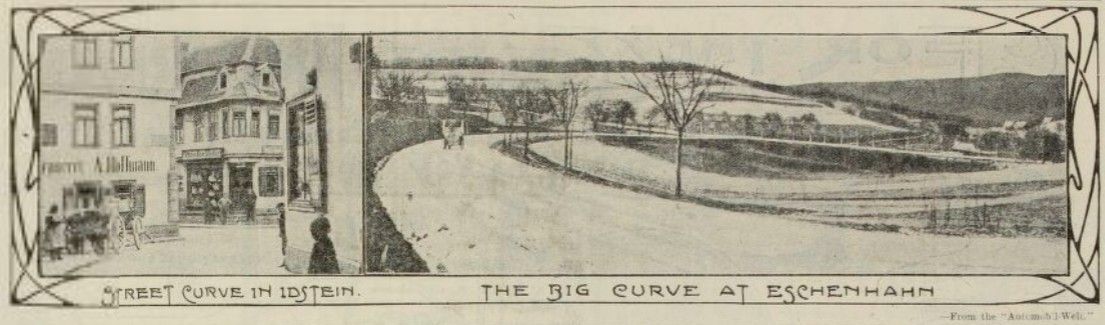
There are eight controle stations: Usingen, Weilburg, Limburg, Idstein, Esch, Königstein, Oberursel and Homburg.
Upon reaching the entrance to these neutralized towns, the competitor’s time of arrival is recorded on a stop-watch which, with a time-bulletin, is sent by bicyclists to the officials at the outlet from the neutralized territory.
The names of the gentlemen who have volunteered to act as bicyclists ought to be inscribed in letters of gold and exhibited in the club-rooms of the German Automobile Club for the edification of wondering posterity. Some of the hills that these gentlemen will have to climb quickly in several of the towns are awe-inspiring. In Konigstein, for example, there is a gem of a hill in the centre of the town, and the competitor will have a hard heart who does not sympathize with the controle bicyclist who precedes him at this point.
For, the timing of the racers one hundred guaranteed stop-watches have been bought for the officials by the German Automobile Club from the firm of Ludwig Simon, of Berlin, in addition to sixteen specially-tested chronometers. Furthermore, to prevent the possibility of dispute due to error, twenty locked boxes each containing three stop-watches, will be used at the start and at the entrance to and outlet from the several neutralized towns. Upon these three watches the times of arrival and departure will be registered, so that in the event of an accident happening to a bicyclist bearing the watch and bulletin from one official to another, a duplicate will still exist.
Contestants Agree Trial Course. Will Be Supreme Test of Judgment and Temerity.
HOW RACERS WILL BE TIMED. – Circuit of Red Cross Stations Established with Telephone and Auto Ambulances.
Finally, for everything‘ is possible, a complete Red Cross service has been organized under the supervision of a chief surgeon with twelve assistant surgeons. These latter will be stationed at fairly equivalent distances all-round the circuit, their stations being connected telephonically with each other and with the central station on the Saalburg.
In the event of an accident as soon as the news is telephoned to the surgeon-in-chief, he will transmit instructions to the surgeon at the nearest station before the spot where the accident has occurred. This surgeon will then hurry to the scene of the accident in a Red Cross automobile, one of which is attached to every surgical station, the direction taken always being in the direction the racers are going. It is for this reason that surgeon at the station before the point where the accident has taken place is sent off to lend his aid. Thus, no embarrassment can be caused to the competitors by a machine going round the racecourse in a contrary direction to the one they are pursuing.
Each of the Red-Cross automobiles is supplied with a box that resembles a Chamber of Horrors, a box containing lint, bandages, anesthetics, antiseptics and a complete and very complicated set of surgical instruments. B-r-r… The surgical preparations for a military campaign could not be more blood-curdling.
And now the start may be given, every provision having been made for the comfort of the competitors.
AMERICANS AT THE RACE.
Members of the Automobile Club of America.
[BY COMMERCIAL CABLE TO THE HERALD]
New York, Wednesday. — The following members of the Automobile Club of America will witness the Coupe Internationale race at Homburg next Friday:
Mr. Jefferson Seligman, governor and treasurer of the club; Mr. E. R. Chapman, Air. John Aspinwall, Mr. Robert Walton Goelet, Mr. M. C. Herman, Mr. George E. Sykes, Mr. H. M. Adams, Mr. J. C. McCoy, Mr. W. S. Hills, Mr. and Mrs. Charles J. Glidden.
GOING TO THE CUP RACE.
Baron de Zuylen, president of the Automobile Club de France; M. Dumontpallier, the general secretary; Marquis de Chasseloup-Laubat and Comte Robert de Vogue left Paris yesterday for the scene of the Coupe Internationale race in Germany.
MERCEDES IN THE CUP RACE.
M. Charley Hopeful with Regard the Great Coupe Internationale Race in Germany.
M. Charley was full of good news from his point of view yesterday. “Do you know,” he said, laughingly, “after the victory next week I am going to open the Mercedes Palace in good style. All the sporting journalists in Paris will be invited, and I think we shall have a good time together.”
“So you think the Mercedes is going to keep the Cup”
“I am no prophet, but I am hopeful. I admit we have some formidable opponents, but given average luck, we should come in well. I have just returned from Cannstatt, or, rather, the new Mercedes works at Undertürkheim nearby, and naturally I am enthusiastic about the new ninety horse-power model. The motor is very small in comparison with that of last year. It seems smaller, in fact, than an ordinary sixty horse-power, but the power is there all right.
“One of the most remarkable things about this new model is that it can be driven about the town without heating, while it is so constructed that it will be an excellent vehicle for long touring over the worst roads. Many modifications and improvements have „been introduced in the clutch, compression, lever and sparking plugs. For instance, if a sparking plug becomes fouled it is no longer necessary to remove it. The plug is supplied with a small tap, which, when turned on, allows a flow of petrol to thoroughly clean away the soot.
“The radiator is larger this year than last, and several parts formerly made of aluminium, are now of bronze for the sake of strength. The complete automobile,, however, weighs no more than 980 kilogrammes.”
M. Charley told me yesterday that the Daimler Company had appointed him sole agent for England, France and America, for its entire business. Thus M. Charley is no longer merely an automobile agent, but is in the position to trade in all kinds of machinery constructed by the celebrated German firm. Furthermore, so far as the Mercedes part of the business is concerned, M. Charley has been placed in a still more advantageous position. The firm has bought back all Mercedes machines in the hands of other agents and handed them over to M. Charley.