The first French Grand Prix after the Great War, very clearly showed that America has developed their automotive insustrie far more that Europe during the years od the war. This general report of the race, combined with an analysis of the consequences for France, gives a fine summary.

Text and photos jpg by kind authorisation of gallica.bnf.fr / / Bibliothèque national français gallica.bnf.fr
Translation by DeepL.com of A L’Amérique le Grand Prix de l’A.C.F.
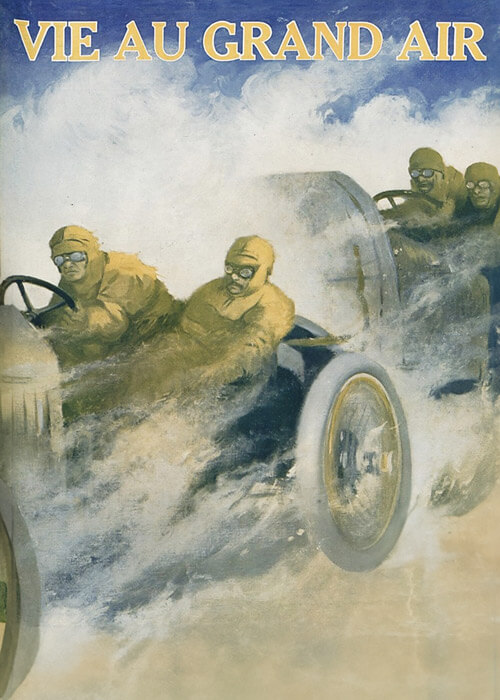
La Vie au Grand Air, 22e Année, No. 868, august 15, 1921
TO AMERICA THE GRAND PRIX OF THE A. C. F.
BY JACQUES MORTANE
THE GRAND PRIX OF THE AUTOMOBILE CLUB OF FRANCE HAS BROUGHT US ANOTHER DISAPPOINTMENT.
IT HAS RETURNED TO AMERICA. HOWEVER, WE MUST ACKNOWLEDGE THAT FRANCE DEFENDED ITSELF REMARKABLY WELL, TAKING THE PLACES OF HONOR IN THE RANKINGS.
It is with sadness that I take on me, the task of reporting on the A.C.F. Grand Prix. You would undoubtedly have preferred to read an article by our competent contributor, Henri Petit, in this place. Alas! Our friend is seriously ill and was unable to travel to Le Mans. So, as I did last month for Carpentier, I am obliged to weave wreaths of mourning for our failure in the Sarthe. For here too, America has won.
The A.C.F. Grand Prix has not often been kind to us in the past: in 1906, the year it was created, we won with Szisz. But in 1907, Italy triumphed with Nazzaro, and in 1908, Germany with Lautenschlager. Disappointed, we stopped organizing it.
In 1912, however, the Automobile Club of France understood the importance of racing and stopped sulking. It was a good decision, because in 1912 and 1913, victory smiled on us, thanks to Boillot. The following year, another failure — and what a failure! Germany took first place again, with Lautenschlager, the 1908 winner. The war ended, and it was not until 1921 that we were awarded the important event.
Our manufacturers are strange people. When there are no races, they protest, claiming that no one thinks to encourage them or give them the means to showcase the purity of their manufacturing; and when races are organized, they disdain to participate, declaring that they are not interested in competition, that their reputation is already established, etc. Foreign manufacturers, on the other hand, understand the full benefit they can derive from a public demonstration. They do not hesitate to incur considerable expenses, register, prepare methodically… and teach us a painful lesson.
This is how Murphy, driving a Duesenberg car, won the race on July 25 at Le Mans. You will soon see that this success will not have been in vain for the brand that agreed to make the trip from America to France, while so many others neglected to travel from Paris to Sarthe!
In the past, our construction was by far the most remarkable. American cars were considered useless junk. The war changed all that. Now, across the Atlantic, they have top-quality steel, a skilled workforce, and manufacturing processes and methods that we can envy.
The days when we could disparage foreigners are over. They are providing us with proof of their expertise. Let us not be discouraged, but simply imitate their determination and understanding of racing. Let us prepare now for the 1922 Grand Prix. Let us join forces. Let all French manufacturers think about flying our colors high and not fight each other. A national success reflects well on all brands. It proves that in such a country, the automotive industry is carefully nurtured. Everyone benefits. Let our manufacturers be convinced of this truth, and we will no longer have to wear the dismayed look that hung in the air the other day amid the dust of the Circuit.
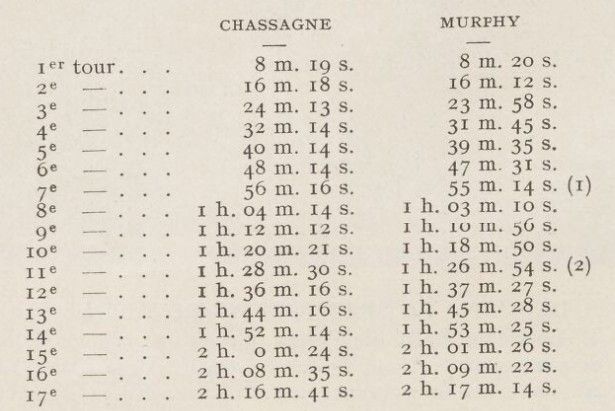
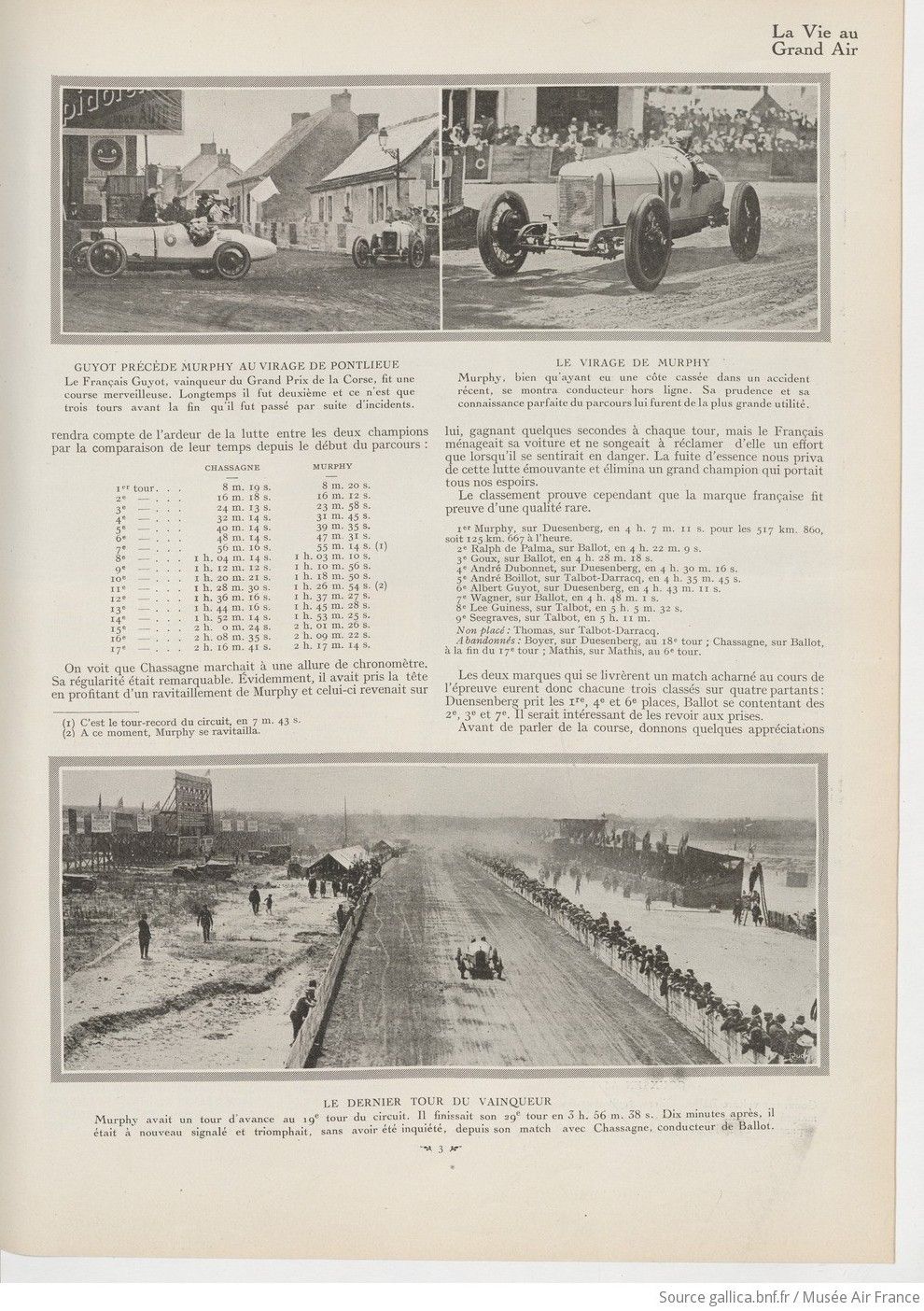
Murphy’s victory was indisputable, and we would not be so distasteful as to diminish it, but we must acknowledge that the company Ballot once again suffered from bad luck that seemed almost deliberate. Those who witnessed the nail-biting battle between Chassagne and Murphy couldn’t help but feel their hearts sink when, on his seventeenth lap, with a 33-second lead, the Frenchman was forced to stop, defeated by a stupid breakdown: a punctured gas tank. The intensity of the battle between the two champions can be seen by comparing their times since the start of the race:
CHASSAGNE MURPHY (see picture below; grocerjack)
(1) This is the circuit record lap, in 7 min. 43 sec.
(2) At this point, Murphy refueled.
We can see that Chassagne was driving at a steady pace. His consistency was remarkable. Obviously, he had taken the lead by taking advantage of Murphy’s pit stop, and Murphy was catching up, gaining a few seconds on each lap, but the Frenchman was conserving his car and only thought about pushing it harder when he felt he was in danger. The fuel leak deprived us of this thrilling battle and eliminated a great champion who carried all our hopes.
However, the rankings prove that the French brand demonstrated rare quality.
1st Murphy, in a Duesenberg, in 4 hours, 7 minutes, and 11 seconds for 517 km. 860, or 125 km/h. 667.
2nd Ralph de Palma, in a Ballot, in 4 hrs. 22 mins. 9 secs.
3rd Goux, in a Ballot, in 4 hrs. 28 mins. 18 secs.
4th André Dubonnet, in a Duesenberg, in 4 hrs. 30 mins. 16 secs.
5th André Boillot, in a Talbot-Darracq, in 4 hours, 35 minutes, and 45 seconds.
6th Albert Guyot, in a Duesenberg, in 4 hours, 43 minutes, and 11 seconds.
7th Wagner, in a Ballot, in 4 hours, 48 minutes, and 1 second.
8th Lee Guiness, in a Talbot, in 5 hours, 5 min. 32 sec.
9th Seegraves, in a Talbot, in 5 hrs. 11 min.
Not placed: Thomas, in a Talbot-Darracq.
Retired: Boyer, in a Duesenberg, on the 18th lap; Chassagne, in a Ballot, at the end of the 17th lap; Mathis, in a Mathis, on the 6th lap.
The two brands, which fought a fierce battle during the race, each had three finishers out of four starters: Duesenberg took 1st, 4th, and 6th place, while Ballot had to settle for 2nd, 3rd, and 7th. It would be interesting to see them compete again.
Before talking about the race, let’s take a look at the drivers: James Murphy, little known in France, showed incomparable mastery, pacing himself as needed, taking the lead he needed and finishing at a more patriarchal pace, if I may say so when talking about a car that exceeded 120 km/h. He didn’t make a single mistake and didn’t hesitate, at the start of the 30th and final lap, to make a brief pit stop to refuel, fearing some kind of breakdown in the last 17 kilometers.
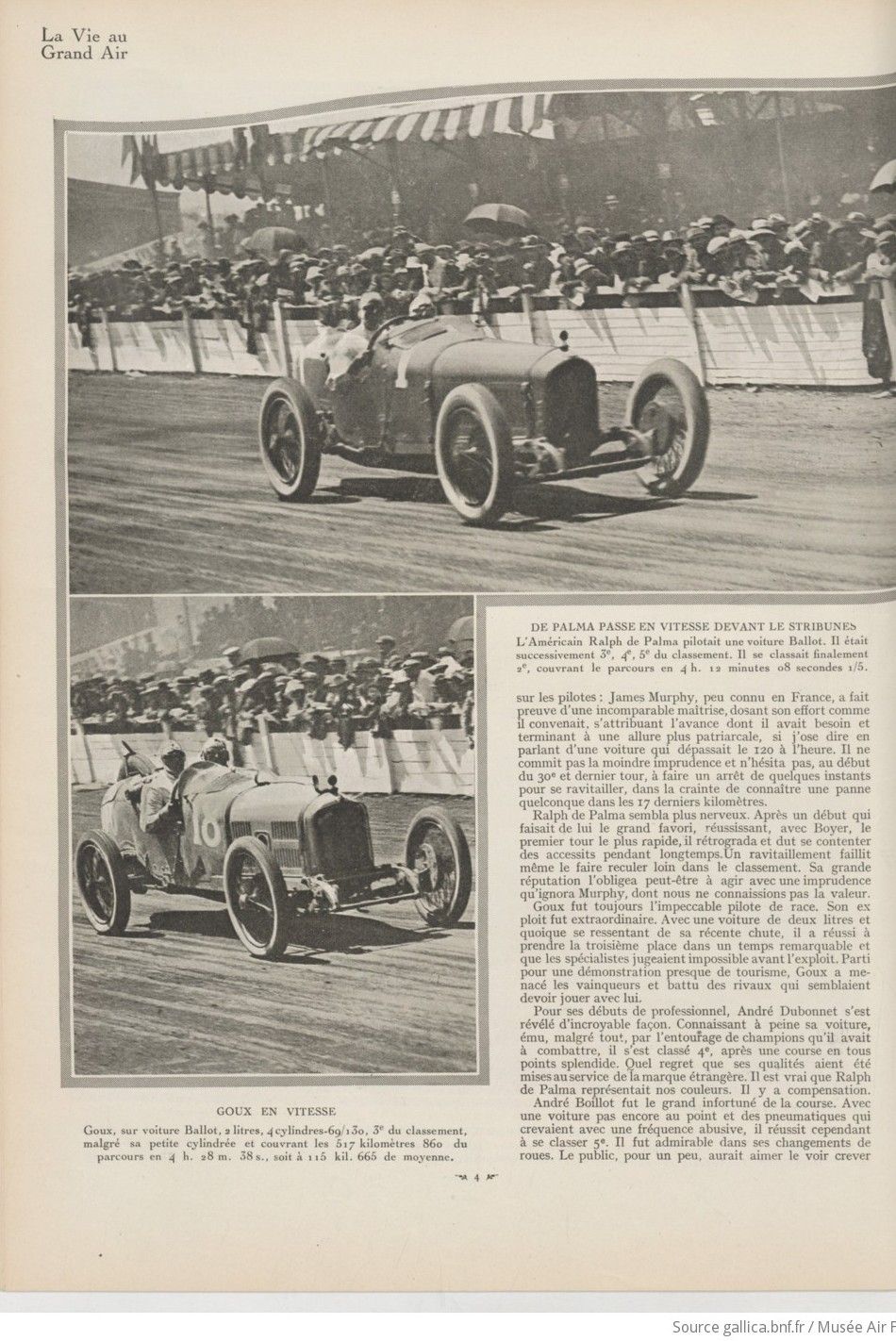
Ralph de Palma seemed more nervous. After a start that made him the big favorite, achieving the fastest first lap with Boyer, he fell back and had to settle for second place for a long time. A refueling even almost caused him to fall far behind in the rankings. His great reputation perhaps forced him to act recklessly, which Murphy, whose value we did not know, ignored.
Goux was always an impeccable racing driver. His achievement was extraordinary. With a two-liter car and despite feeling the effects of his recent fall, he managed to take third place in a remarkable time that experts had considered impossible before the race. Setting out on what was almost a tourist demonstration, Goux threatened the winners and beat rivals who seemed to be playing with him.
For his professional debut, André Dubonnet proved himself in an incredible way. Barely familiar with his car, yet moved by the champions he had to compete against, he finished fourth after a splendid race.
What a shame that his talents were put to use for a foreign brand. It’s true that Ralph de Palma represented our colors. That’s some consolation. André Boillot was the unlucky one in the race. With a car that wasn’t quite ready and tires that punctured with excessive frequency, he still managed to finish 5th. He was admirable in his wheel changes.
The crowd would have liked to see him get more punctures; just think, on the 10th lap, it took him only 17 seconds to replace a wheel, and a few laps later, in one minute, he replaced both rear wheels. What cheers!
Guyot was also unlucky, but he performed as well as could be expected given his ability. The other veteran, Wagner, had difficulties from the start but did not lose heart. Guiness and Seaegrave were consistent. Thomas had numerous breakdowns. As for Boyer, he had a magnificent race until he had to abandon it, even though he was seen as a possible winner. Mathis’s demonstration, who insisted on starting despite everything, lasted five laps.
WHAT THE RACE WAS LIKE
From start to finish, the race was nerve-wracking. It was a long battle between Ballot and Duesenberg, with the Talbot-Darracqs struggling: Boillot’s with his tires and Thomas’s with too many pit stops, preventing the excellent driver from finishing on time, even though he only had a few kilometers left to go. As for the Talbots driven by Seegrave and Lee Guiness, they performed consistently but were content to follow at a respectful distance. The Mathis, which arrived at the last minute, needed serious tuning and had to stop after covering 86 kilometers 310 in 1 hour 01 minute 40 seconds.
This left the spectators to cheer on Ralph de Palma, Chassagne, Wagner, and Goux on one side, and Guyot, Murphy, Boyer, and Dubonnet on the other. We will see how these eight drivers, the first four in Ballots and the other four in Duesenbergs, performed during the race by studying them only every five laps..
However, we will begin by indicating their speed on the initial lap:
1st Lap (17 km 262).
1st Ralph de Palma 8 m 15 (France), J. Boyer 8m 15 (America); 3rd Chassagne 8 m 19 (F.); 4th Murphy 8 min. 20 (A.); 5th Wagner 8 min. 37 (F.); 6th Dubonnet 8 min. 56 (A.); 7th Guyot 8 min. 59 (A.); 8th Goux 9 min. (F.). 5 Laps (86 km 310).
1st Murphy, 39 m 35 (A.); 2nd Boyer, 40 m 05 (A.); 3rd Chassagne, 40 m 14 (F.); 4th Ralph de Palma, 41 m 06 (F.); 5th Guyot, 41 min 25 sec (F.); 6th Dubonnet, 42 min 38 sec (A.); 7th Goux, 43 min 24 sec (F.); 8th Wagner, 1 hr 04 min 26 sec (F.).
10 laps (172 km 620).
1st Murphy, 1 hr 18 min 50 sec (A.); 2nd Chassagne, 1 hr 20 min 21 sec (F.); 3rd Boyer, 1 hr 20 min 43 sec (A.); 4th Guyot, 1 hr 21 min 47 sec (A.); 5th Ralph de Palma, 1 hr 22 min 04 sec (F.); 6th Dubonnet, 1 hr 24 min 39 sec (A.); 7th Goux, 1 hr 29 min 08 sec (F.); 8th Wagner, 1 hr 46 min 47 sec (F.).
15 laps (258.930 km).
1st Chassagne, 2 hr 24 sec (F.); 2nd Boyer, 2:00:56 (A.); 3rd Murphy, 2:01:26 (A.); 4th Guyot, 2:01:58 (A.); 5th Ralph de Palma, 2:08:02 (F.); 6th Dubonnet, 2 hrs 10 mins 39 secs (A.); 7th Goux, 2 hrs 13 secs (F.); 8th Wagner, 2 hrs 31 mins 14 secs (F.).
20 laps (345 km 240).
1st Murphy, 2 hrs 40 mins 59 secs (A.); 2nd Guyot, 2 hrs 42 mins 20 secs (A.); 3rd Ralph de Palma, 2 hrs 54 mins 20 secs (F.); 4th Goux, 2 hrs 55 mins 38 sec. (F.); 5th Dubonnet, 2 hrs. 55 min. 08 sec. (A.); 6th Wagner, 3 hrs. 13 min. 58 sec. (F.).
Chassagne (F.) retired on lap 17; Boyer (A.) retired on lap 18.
25 laps (431.550 km).
1st Murphy, 3 hrs 21 mins 48 secs (A.); 2nd Guyot, 3 hrs 33 mins 59 secs (A.); 3rd Ralph de Palma, 3 hrs 33 mins 55 secs (F.); 4th Dubonnet, 3 hrs 38 mins 54 secs (A.); 5th Goux, 3 hrs 44 mins 44 secs (F.); 6th Wagner, 4 hrs 04 mins 45 secs (F.);
30 laps (517.360 km).
1st Murphy, 4 hrs 07 mins 10 secs 2/5 (A.); 2nd Ralph de Palma, 4 hrs 22 mins 10 secs 3/5 (F.); 3rd Goux, 4 hrs 28 mins 38 secs 1/5 (F.); 4th Dubonnet, 4 hrs 30 mins 19 secs 1/3 (A.); 5th Boillot, in a Talbot-Darracq, 4 hrs 35 mins 47 secs 2/5 (F.); 6th Guyot, 4 hrs 43 mins 13 secs.
(A.); 7th Wagner, 4 hrs 48 mins 7 secs 4/5 (F.); 8th Lee Guiness, 5 hrs 6 mins 43 secs 4/5 (English); 9th Seagrave, 5 hrs 8 mins 6 secs (English).
We can see that André Boillot was the only one to manage to squeeze in between the competitors in the Duesenberg-Ballot match.
Let’s consider the first lap and each of the five-lap segments as rounds in a France-America match:
1st lap. — France, 17 points.
America, 18 points.
5th — — America, 14 points.
— — France, 22 points.
10th — — America, 14 points.
— — France, 22 points.
15th — — America, 15 points.
— — France, 21 points.
20th — — America, 8 points.
— — France, 13 points.
25th — — America, 7 points.
— — France, 14 points.
30th — — America, 11 points.
— — France, 12 points.
France therefore only led in the first round. That is the brutal, distressing fact, but we can add that the Ballot cars defended themselves with rare valour and achieved a magnificent result. We could have hoped for better, but we did not suffer the crushing defeats of 1908 and 1914. Since, alas, we are forced to console ourselves, let us acknowledge that taking second and third place in a competition where the Duesenbergs proved so formidable is a very pleasant mitigating circumstance.
And we cannot overemphasize the remarkable success achieved by Goux. The car was a Ballot, 2 liters, 4 cylinders 69×130, competing against 3-liter, 8-cylinder cars. We expected it to perform respectably and were prepared to award it a certificate of consistency, but nothing more. However, it proved dangerous for the winners and took first place, far ahead of much more powerful vehicles. Incredibly, its final laps were covered at a faster pace than those at the start, with some exceeding 130 kilometers per hour. In fact, look at the progress made: 8th in the first lap, 7th in the 5th, 10th, and 15th laps, 4th in the 20th lap, 5th in the 25th lap, and 3rd in the 30th lap. Isn’t that a satisfying achievement? Let us add that there was a 150-kilogram weight difference between the Ballot and Duesenberg cars, which was a severe handicap to our manufacturer. Finally, let us note that Goux’s 2-liter car consumed only 14.2 liters per 100 kilometers, which is fantastic at such speeds.
Admittedly, the Grand Prix leaves us with bitter regrets. We must react in order to triumph next year, and we dare to hope that our other manufacturers will not leave Mr. Ballot with the heavy but glorious mission of representing our industry on his own. For 1921, let us admire without reservation the courage and tenacity of our great industrialist and hope that the bad luck that has been following him in the form of stupid incidents will finally leave him. We will then have beautiful laurels to add to the successes of yesteryear, when our manufacturers understood their interests and those of France.
JACQUES MORTANE.
P.S. — The A.C.F. Grand Prix was another opportunity for Delco ignition to prove its excellence.
In our opinion, Delco devices contributed greatly to Murphy’s victory, thanks to the marvelous consistency with which they ensured the ignition of his Duesenberg engine, running at the fantastic speed of 4,000 revolutions per minute.
The Delco system is truly remarkable, as this year it took first place in all the major sporting competitions: first in Indianapolis, first on the Corsica circuit, first at the Boulogne meeting, and finally, first at the A.C.F. Grand Prix.
At the A.C.F. Grand Prix, six out of nine cars in the rankings, including the winner, were equipped with Delco.
And it is important to remember that the brilliant qualities of the Delco ignition are not only evident at very high speeds, as it is also with this ignition that the lowest idle speeds observed to date have been achieved.
The major manufacturers have fully grasped all the advantages of this new system, and we will see many chassis equipped by Etablissements Continsouza, well-known specialists in precision mechanics and manufacturers of Delco devices, at the next motor show.
Finally, let’s note the excellent performance of the Sunvilla magnetos that equipped the Ballot cars in the Grand Prix.
Photo captions.
Page 2.
(Photos taken by our special correspondents.)
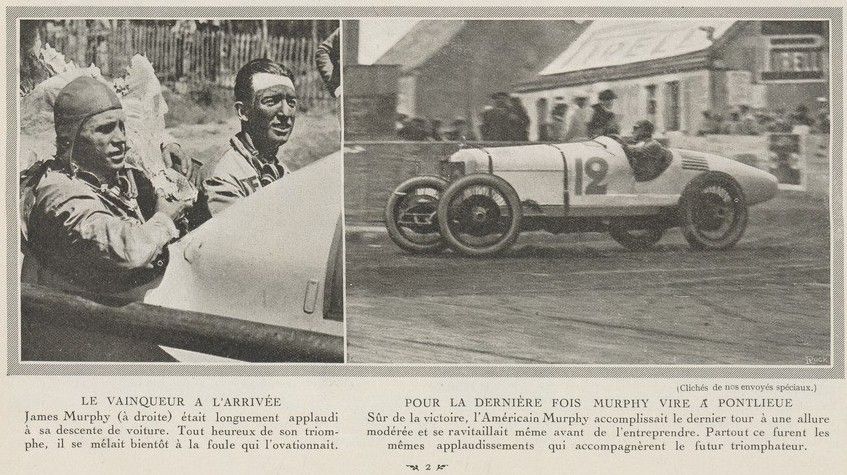
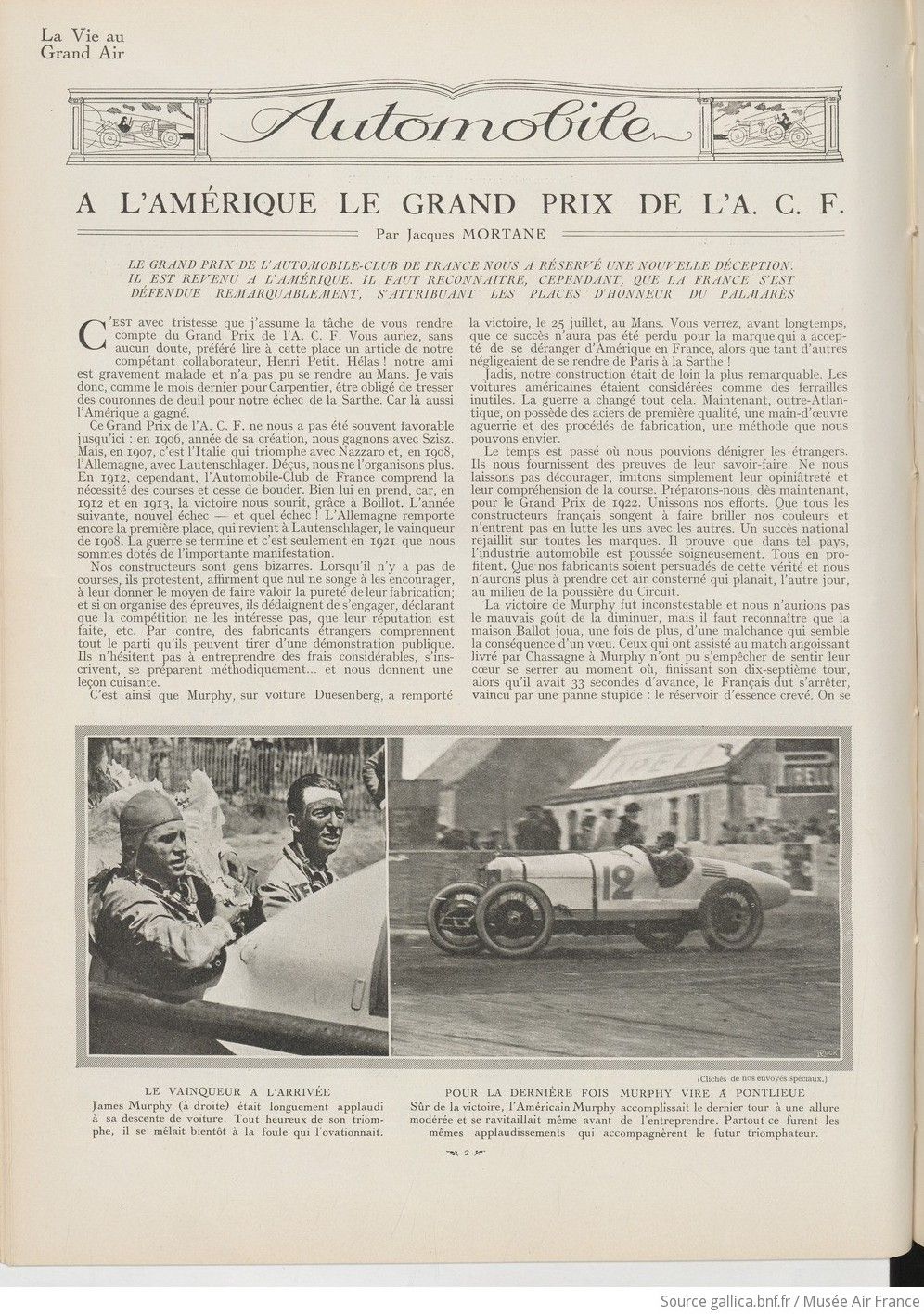
THE WINNER AT THE FINISH LINE
James Murphy (right) received a long round of applause as he got out of his car. Delighted with his triumph, he soon mingled with the crowd that was cheering him on.
FOR THE LAST TIME, MURPHY TURNS AT PONTLIEUE
Confident of victory, the American Murphy completed the last lap at a moderate pace and even refueled before starting it. Everywhere, the same applause accompanied the future winner.
Page 3.
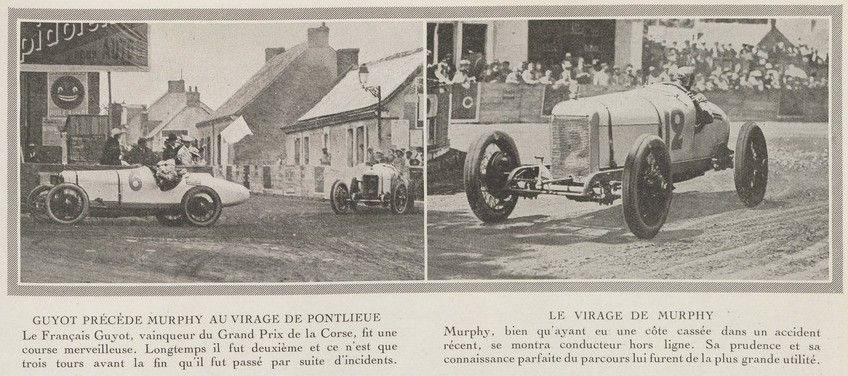
GUYOT BEATS MURPHY AT THE PONTLIEUE TURN
Frenchman Guyot, winner of the Corsica Grand Prix, had a wonderful race. He was in second place for a long time and it was only three laps before the end that he was overtaken due to incidents.
THE MURPHY TURN
Murphy, despite having broken a rib in a recent accident, proved to be an outstanding driver. His caution and perfect knowledge of the course served him well.
THE WINNER’S LAST LAP
Murphy was one lap ahead on the 19th lap of the circuit. He finished his 29th lap in 3 hours, 56 minutes, and 38 seconds. Ten minutes later, he was reported again and triumphed, unchallenged since his match with Chassagne, Ballot’s driver.
Page 4.
DE PALMA SPEEDS PAST THE STANDS
American Ralph de Palma was driving a Ballot car. He was successively 3rd, 4th, and 5th in the rankings. He finally finished 2nd, covering the course in 4 hours, 12 minutes, 08 seconds 1/5.
GOUX IN THE LEAD
Goux, in a Ballot car, 2 liters, 4 cylinders-69/130, came in 3rd in the rankings, despite his small engine size, covering the 517 kilometers 860 of the course in 4 hours, 28 minutes, and 38 seconds, at an average speed of 115 kilometers 665.
Page 5.
DE PALMA REFUELS
De Palma’s brother was the great driver’s mechanic and proved to be a valuable assistant to the Ballot driver. — Right: Amateur driver Dubonnet, who had a great race.
GOUX IN PURSUIT OF BOYER
Goux, in his 2-liter Ballot, delivered an extraordinary performance. He finished third, beating many cars with superior power. Joe Boyer, who was in the lead for a few laps, had to abandon the race.
Pages 6–7.
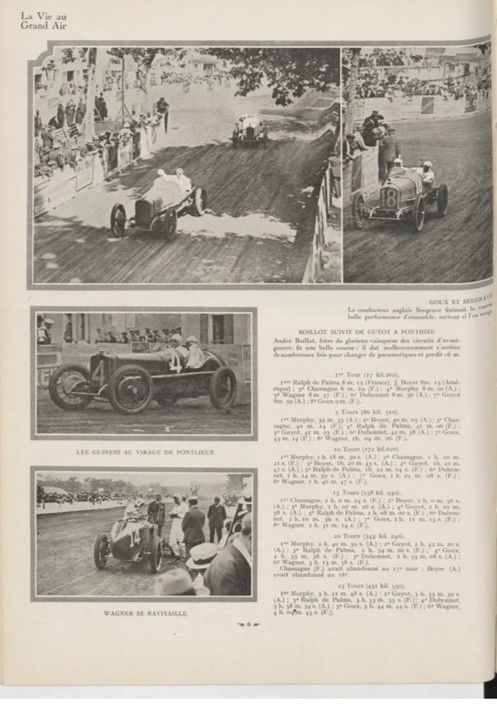
GOUX AND SEEGRAVES TURN AT PONTLIEUE
English driver Seegrave finished the race in 5 hours, 8 minutes, and 8 seconds. The English put in a fine overall performance, especially considering their lack of preparation and fine-tuning.
BOILLOT FOLLOWS GUYOT AT PONTHIEU
André Bolliot, brother of the glorious pre-war circuit winner, had a good race; unfortunately, he had to stop many times to change tires and lost 16 m.
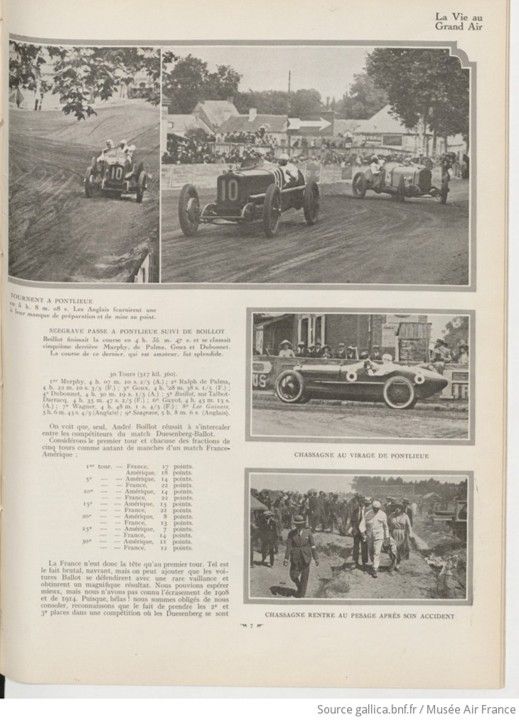
SEEGRAVE PASSES IN PONTLIEUE FOLLOWED BY BOILLOT
Bolliot finished the race in 4 hours, 35 minutes, 47 seconds and came in fifth behind Murphy, de Palma, Goux, and Dubonnet. The latter, who is an amateur, had a splendid race.
LEE GU1NESS AT THE PONTLIEUE TURN
WAGNER REFUELS
CHASSAGNE AT THE PONTLIEUE TURN
CHASSAGNE RETURNS TO THE WEIGHING STATION AFTER HIS ACCIDENT
Page 8.
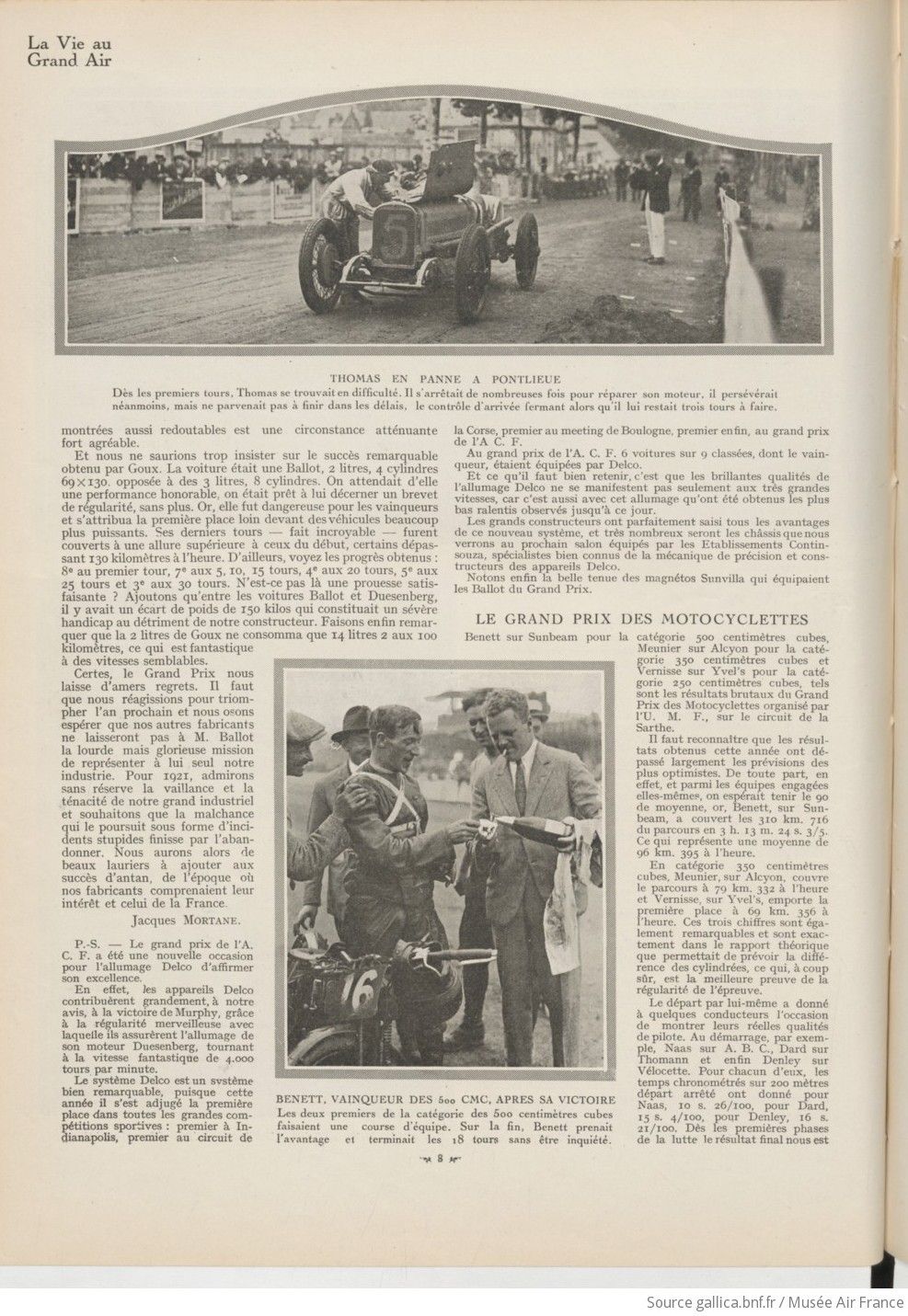
THOMAS BREAKS DOWN AT PONTLIEUE
From the very first laps, Thomas was in trouble. He stopped numerous times to repair his engine and persevered nonetheless, but was unable to finish within the time limit, with the finish line closing when he still had three laps to go.