Intro is on the way.

By courtesy of hathitrust.org www.hathitrust.org, Text and jpegs compiled by motorracinghistory.
THE AUTOMOBILE Vol. XXVII, No. 22, May 19, 1913
The 1913 Targa Florio in Picture and in Story
Nazzaro’s Skilled Driving and Reliable Car Are Winning Factors
PALERMO, SICILY, May 14 – Felix Nazzaro’s success in the Targa Florio race was due to skilled driving and an absolutely reliable car. It was a race in which the man counted for much. Starting from Palermo, the competitors had to make a complete circle of the island of Sicily, the road keeping within sight of the Mediterranean practically the whole of the way. Throughout the 650 miles there was not a straight stretch of more than a quarter of a mile, the greater portion of the route forming a ledge cut on the mountain side, with hairpin turns, and short, steep gradients. The regulations allowed a cylinder volume of 549 cubic inches, but owing to the nature of the road it was impossible to make use of all the power available from such dimensions and very few of the competing cars approached the limit. Quick acceleration was an important factor, the weight problem had to be carefully studied, the cars required a wide steering lock and moderate wheelbase and the course was too dangerous for dare-devil driving. No attempt was made to guard the roads: the competitors had to take their chance of meeting with mountain mules which became scared at the sight of an automobile, and of Sicilian peasants who were hardly less frightened.
Thirty-seven Cars Start
Thirty-seven cars lined up for the start, which was given in the center of the town of Palermo at 5 a. m., the first car to get away being a Minerva with Knight motor. The others followed at intervals of 10 minutes. Practically all the cars were standard touring models stripped as low as possible for racing purposes. The equipment consisted of nothing more than a couple of seats, a gasoline tank, three to five spare wheels or tires, and a couple of headlights. These latter were necessary on account of the start of the second stage of the race being given to the leading car at midnight. Italians figured most prominently in the race. Among the foreigners were five American cars: an Overland, two Fords, a Metz, and a Flanders. France had an eight-cylinder De Dion Bouton and a 20-30 Renault; Belgium had one Minerva, with Knight motor; Switzerland had a couple of Sigma, also with Knight motor; and Germany was represented by a Mercedes team.
The first stage stopped at Girgenti, after a run of 447 miles. The real struggle on this stage was between Felix Nazarro, on his own car and Marsaglia on the Aquila-Italiana of which he is the designer. Marsaglia had started eighth, or nearly 2 hours before Nazzaro, and was therefore not aware how dangerous his competitor might be. This first stage proved a weeding out of the weaker cars and of the less skilled of the drivers, only sixteen of the competitors getting to Girgenti within the time allowance.
Marsaglia maintained his lead on the first day’s run with an advantage of 30 minutes on Nazzaro. Bordino on Lancia came in a very close third, there being an interval of more than an hour between this car and the fourth. Of the American competitors only the Overland was able to finish the first stage, Lopez bringing his car into tenth position sandwiched between a De Vecchi and an Isotta. On their arrival at Girgenti the cars were locked up, the continuation of the race being fixed for midnight for the first car, Marsaglia’s Aquila-Italiana, the others following with the same interval as marked their arrival. At an early stage Marsaglia had trouble with his headlights, which gave Nazzaro a chance to creep up to him and finally get ahead.
Bordino, who had finished the first stage a good third, had trouble on the second day’s run, causing him to fall back to eighth place.
One of the rotary valve Italas dropped out, and the Overland crept up two places, finishing seventh. The cars which fell out on the second day’s run were Itala, Isotta, Fiat, Sigma (Knight), and Mercedes.
Speed Was 33.5
Nazzaro’s speed worked out at the average of 33.5 miles an hour, which is considerably faster than any other competitor has made over this course. In 1907 Nazzaro won the Targa Florio for Fiat, the race on that occasion being three rounds of the island. The winning Nazzaro car is a standard model built by Nazzaro at Turin, and having a four-cylinder block motor of 3.9 by 5.5 inches bore and stroke. The cylinder make, a fine, clean-cut casting with integral intake and exhaust manifolds, and having the body of the water pump cast with the crank chamber.
The Aquila-Italiana with which its designer, Marsaglia, finished second, has a six-cylinder motor of 3.1 by 5.1 inches bore and stroke, the construction being distinctive by reason of the block casting of cylinders and upper half of crank chamber.
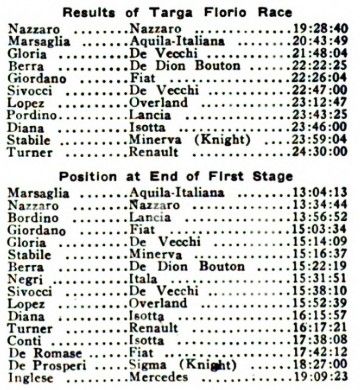
Results of Targa Florio Race
Nazzaro – Nazzaro – 19:28:40
Marsaglia – Aquila-Italiana – 20:43:49
Gloria – De Vecchi – 21:48:04
Berra – De Dion Bouton – 22:22:25
Giordano – Fiat – 22:26:04
Sivocci – De Vecchi – 22:47:00
Lopez – Overland – 23:12:47
Bordino – Lancia – 23:43:25
Diana – Isotta – 23:46:00
Stabile – Minerva (Knight) – 23:59:04
Turner – Renault -24:30:00

Position at End of First Stage
Marsaglia – Aquila-Italiana – 13:04:13
Nazzaro – Nazzaro – 13:34:44
Bordino – Lancia – 13:56:52
Giordano – Fiat – 15:03:34
Gloria – De Vecchi – 15:14:09
Stabile – Minerva (Knight) – 15:16:37
Berra – De Dion Bouton – 15:22:19
Negri – Itala – 15:31:51
Sivocci – De Vecchi – 15:38:10
Lopez – Overland – 15:52:39
Diana – Isotta – 16:15:57
Turner – Renault -16:17:21
Conti – Isotta – 17:38:08
De Romase – Fiat – 17:42:12
De Prosperi – Sigma (Knight) – 18:27:00
Inglese – Mercedes – 19:09:23


Photos.
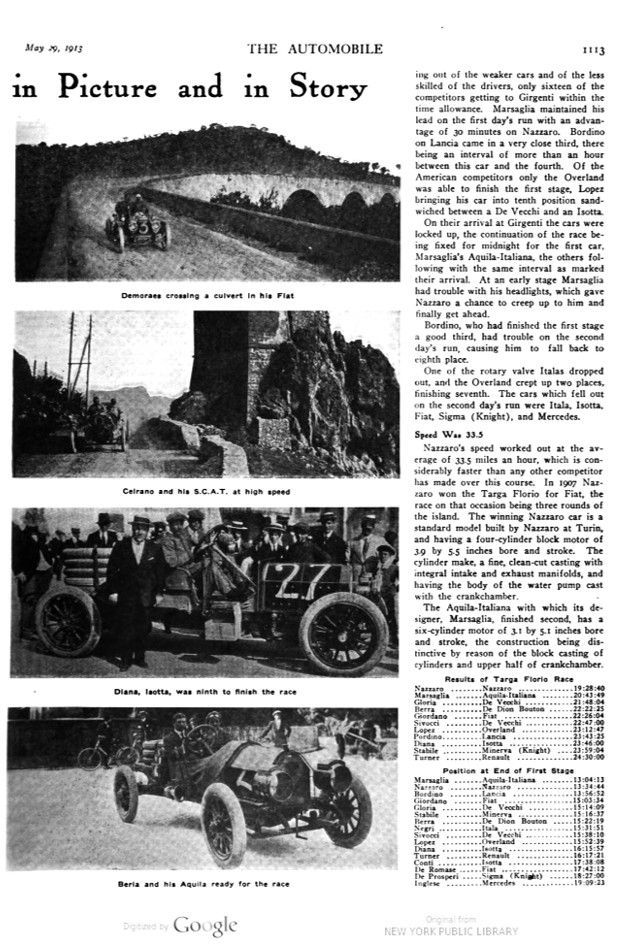
Page 1112: Fracassi taking the curves in a Ford – Giordano coming through a pass in his Flat – Nazzaro, the winner, and his Nazzaro car – Berra, fourth, in his eight-cylinder De Dion.
Page 1113: Demoraes crossing a culvert in his Flat – Ceirano and his S.C.A.T. at high speed – Diana, Isotta, was ninth to finish the race – Beria and his Aquila ready for the race